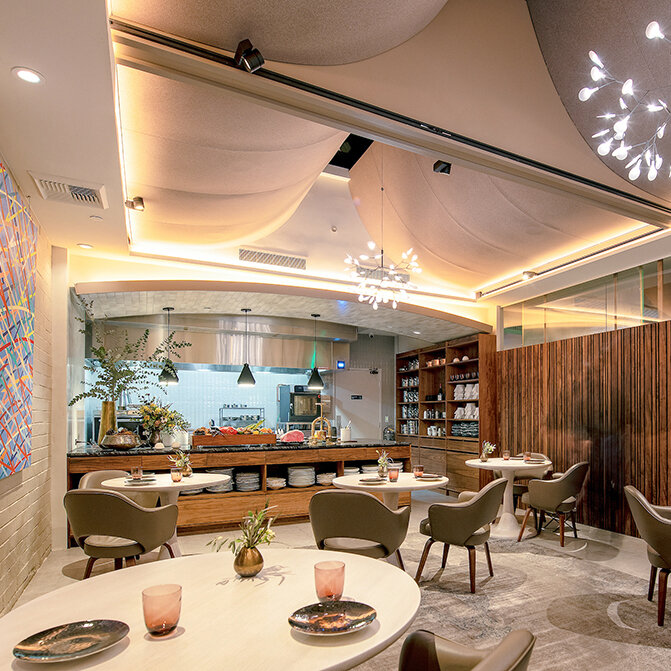
Many luxury tasting rooms still confuse seriousness with acreage. They give you distance, layers of upholstery, and a long walk between the front door and anything that feels alive. Mélisse works the other way. The useful way to read it in 2026 is not as a generic two-star Santa Monica special-occasion room, but as a tightly managed operating system built around concealment, compression, and guided attention. The side-street entrance matters. The 14-seat scale matters. The 18-serving format matters. And the famous duck finish matters because it arrives at the end of a room already designed to make old French luxury feel edited rather than bloated.[1][2][4][5]
The current public record is unusually clear on that point. The official Mélisse page calls it "a restaurant in a restaurant", placing Josiah Citrin's revived institution in an intimate backstage room with Chef/Partner Ken Takayama and direct chef-sommelier guidance through the meal.[1] The 50 Best Discovery profile sharpens the same picture from outside: Mélisse is tucked behind a door within Citrin, serves just 14 diners, and runs a tasting menu from $399 rather than trying to win by sheer maximalist sprawl.[5] The official hours page then adds the practical frame: the entrance sits on 11th Street, and current seatings are limited to Wednesday at 6:30 p.m. and Thursday-Saturday at 5:30 p.m. and 8:30 p.m.[2] Nothing in that setup suggests a room designed for casual overflow. It is a precision enclosure.
Image context: the lead image uses the official interior shot because this article is about room design more than plated glamour. The photo makes the restaurant's logic visible at once: round tables close to the action, an open kitchen that never disappears into the back, and enough softness in the lighting to keep the room intimate even while the work stays exposed.[1]
1. The hidden entrance is not branding trivia; it is pace control
Mélisse's current operation starts by taking friction away from the street and relocating it inside the meal. The official location page is blunt: the restaurant sits on the southeast corner of Wilshire, but the entrance is on 11th Street.[2] Michelin's current listing adds the experiential version of the same fact, describing a discreet side entrance that leads into an enclosed room with a vaguely underground feel, though still anchored by classic luxury.[4] Those details sound small until you put them next to the scale of the dining room. A restaurant that only has fourteen seats does not need a loud arrival sequence. It needs a clean handoff.
That handoff is part of the house style. When a guest enters from the side instead of from a large hotel lobby or a visibly grand facade, the restaurant can skip the public theater of "arrival" and move directly into controlled immersion. This is why the phrase "restaurant in a restaurant" is more than a neat marketing line.[1] Mélisse is nested inside Citrin, but operationally it behaves like a protected chamber. The guest crosses one threshold, leaves the looser California room behind, and enters a space where every table can be seen, paced, and reset in one glance.[1][2][5]
For service, that matters enormously. Small-room luxury only works if the staff can monitor tempo without appearing to hover. With fourteen seats, the room can absorb intricate pacing, synchronized pours, and repeated chef-side explanations without becoming noisy or slow. What would feel mannered in a larger dining room starts to feel natural here because the geometry supports it.[1][5]
2. The menu is built like a guided sequence, not a parade of prizes
The official page gives away the restaurant's operating idea in a single sentence: "The 18 servings symphony" is fueled by California suppliers stretching from San Diego to Napa Valley.[1] That combination is revealing. Eighteen servings sounds expansive, but the supplier language points in the opposite direction. Mélisse is trying to make abundance feel curated rather than endless. The sample menu moves through wagyu, tuna tart, kanpachi, sweet pea soup, uni cromesquis, caviar, scallop, striped bass, quail, morels, and desserts, but the point is not that luxury ingredients appear one after another.[1] The point is that the room has enough control to organize them into something like a score.
The 50 Best Discovery profile supports that reading with representative dishes such as uni cromesquis with fermented yuzu honey and Maine scallop preparations, then explicitly describes the menu as marrying global flavors with classic and contemporary technique.[5] That is important because Mélisse is not presenting itself as a purely regional Californian room, nor as a museum of French orthodoxy. The operation depends on keeping those two tendencies in balance. California provides the product network; French formality provides the spine; global seasoning and memory keep the room from hardening into nostalgia.[1][3][5]
You can also feel the service implication in the official wording. Guests are not merely served courses; they are guided by chefs and sommeliers.[1] In other words, the room does not separate cooking from interpretation. The meal is supposed to be explained, steered, and tuned in real time. A larger restaurant could claim the same thing and still leave guests mostly alone. At Mélisse, the small scale makes that promise literal.
3. The duck press survives because the room is small enough to support it
Michelin's current listing provides the cleanest modern description of why Mélisse still matters. It says the room offers the finest cutlery, gorgeous presentations, plenty of tableside saucing, and a signature finale of dry-aged duck "Rouennaise" finished with the help of an antique silver press.[4] That is old luxury language, and in the wrong setting it can become dead weight. At Mélisse it works because the restaurant has already stripped away excess elsewhere.
The duck press is therefore not just a flourish at the end. It is the logical outcome of the room's scale. Pressed duck sauce, tableside finishing, and other acts of visible service authority need closeness. They need staff who can move around the room without turning the whole night into ceremony for ceremony's sake. They also need guests who already understand they are inside an authored environment, not a casual neighborhood dinner with a sudden antique prop rolled out at the end.[2][4][5]
This is where Mélisse's "backstage" idea becomes useful again.[1] The room is not anti-theatrical; it is selective about where the theater lands. The operation withholds spectacle at the door, withholds it in the room count, and withholds it in the calm palette. Then it spends that saved energy on service moments that actually change the meal: guided pacing, tableside finishing, and a final bird course strong enough to close the night with authority.[1][4]
4. Santa Monica matters because the room refuses Santa Monica looseness
Josiah Citrin's background also helps explain why the room has this particular tension. The official story page traces his Santa Monica and Venice upbringing, his years in Paris, and the 1999 opening of Mélisse as his long-held fine-dining project.[3] That biographical line matters because the restaurant reads like a negotiation between California ease and French discipline rather than a surrender to either one. The room is in Santa Monica, but it does not act like a breezy coastal tasting counter. It is formal, though never stiff. It is intimate, though never casual.[2][3][4]
That balance is hard to achieve. Many Los Angeles luxury rooms drift toward one of two failures: either they lean so hard into California friendliness that the tasting menu loses shape, or they import French solemnity so literally that the city drops out of the experience. Mélisse stays sharper by keeping the room small and the script exact. The result is not relaxed luxury. It is supervised warmth.
That is why Mélisse still lands in 2026. Its strongest move is not any single ingredient and not even the duck itself. It is the decision to make luxury operate at chamber scale. A side entrance, fourteen seats, chef-and-sommelier guidance, an open kitchen, and a finale that still believes in tableside authority all push in the same direction. The restaurant hides its size, then uses that size to keep every gesture legible.[1][2][4][5]
Sources
- Citrin and Mélisse, "MÉLISSE" - official page covering the 14-seat backstage dining room, Chef/Partner Ken Takayama, 18-serving format, California sourcing, sample menu, and the official interior photograph used for this article.
- Citrin and Mélisse, "Hours & Location" - official page covering the 11th Street entrance, current Wednesday/Thursday-Saturday seatings, and valet details.
- Citrin and Mélisse, "Our Story" - official background on Josiah Citrin, his Paris training, Santa Monica roots, and the 1999 launch of Mélisse.
- MICHELIN Guide, "Mélisse - Santa Monica - a MICHELIN Guide Restaurant" - current listing covering the discreet side entrance, two-star status, tableside saucing, and the dry-aged duck Rouennaise finale with an antique silver press.
- 50 Best Discovery, "Mélisse - Santa Monica - Restaurant" - current profile covering the tucked-away 14-diner room inside Citrin, tasting menu from $399, and the house style of global flavors over California supply.