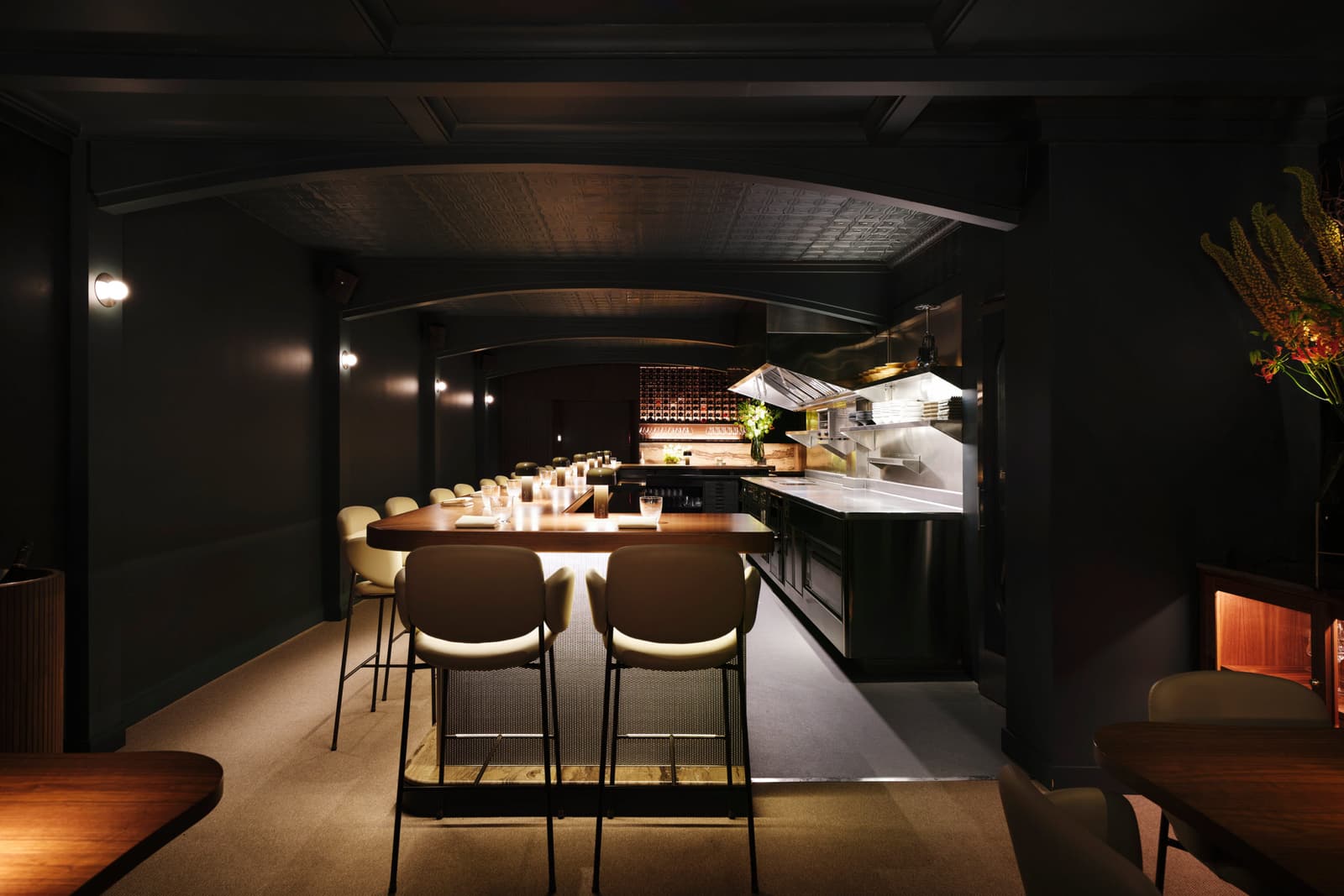
Many hidden-counter restaurants survive on the entrance trick longer than they deserve. A curtain, a door, a painting, a dark hallway: once the reveal lands, the meal itself can start behaving like any other expensive downtown tasting menu. FREVO works because the reveal is not the product. It is the first pacing device. The more useful way to read the restaurant in 2026 is as an authored sequence in four linked parts: the gallery hush at the door, the 16-seat counter, Chef Franco Sampogna's sauce-centered cooking, and service rules rigid enough to keep the whole night from drifting loose.[1][2][3][4]
The current public record points in the same direction from several angles. FREVO's official restaurant page calls the room "a contemporary art gallery" leading to "a 16-seat chef's counter and open kitchen" and defines the cuisine through the expressive power of sauces, with the menu currently priced at $255.[1] The about text on the site and gallery page adds the structural detail: the menu, gallery exhibition, and wine pairings rotate every four months.[2][3] The FAQ then makes the operating discipline explicit, from reservations opening on the first day of the current month at 2 p.m. to the 2.5-hour seating limit and the rule that parties arriving more than 15 minutes late lose part of the menu because the kitchen cannot reset to the beginning.[2] Michelin's current listing sharpens the outside view by describing FREVO as an under-the-radar tasting-menu room that doubles as a gallery.[4]
Image context: the lead image uses FREVO's official interior photograph because this article is about how the room works before any single plate appears. The open counter matters more than a hero shot of one dish; it is the place where the restaurant's whole timing system becomes visible.[1]
1. The gallery is not decoration; it lowers the pulse before the counter takes over
FREVO's own language makes this point unusually clear. The gallery page does not treat the art program like a side amenity; it says the restaurant and contemporary art gallery are one concept, co-founded by Chef Franco Sampogna and Bernardo Silva, with the exhibitions changing three to four times a year and rotating in sync with the menu every four months.[2][3] That matters because it tells you what the house wants the guest to do before dinner even starts: look first, settle second, eat third.
Michelin's current listing aligns with that reading. The guide's write-up describes FREVO as a tasting-menu-only restaurant that doubles as a gallery, and treats the artistic entrance as part of the identity rather than as a novelty flourish.[4] Read against the official pages, the effect is less theatrical than editorial. The gallery works like a visual palate cleanser. Instead of arriving directly into a room that shouts luxury at full volume, the guest is asked to pass through a quieter threshold where attention narrows before the first course lands.[2][3][4]
That is a smart New York move. In a city where fine dining often has to compete with noise before you even sit down, FREVO uses the entrance to strip noise away. The restaurant does not need a grand staircase, a skyline view, or a giant room to manufacture occasion. It needs a cleaner transition from street pace to counter pace. The gallery provides it.[2][4]
2. The counter matters because the cuisine is built around connective tissue, not just headline ingredients
The official restaurant page gives away the restaurant's strongest claim in a few sentences.[1] Sampogna's cuisine is described as rooted in classical French technique, shaped by South American and Asian influences, and organized around sauces. The page then gets more specific: at FREVO, a sauce is never just a sauce. Emulsions, jus, foams, and condiments carry depth, acidity, sweetness, and brightness, unify the plate, and can even become its visual signature.[1]
That is more than branding copy. It tells you how to walk through the meal. In many tasting rooms, the sequence is easiest to remember through the proteins: this seafood course, that meat course, the big main, the pre-dessert, the petit fours. FREVO is asking to be read another way. The recurring engine is not one luxury object after another. It is the changing role of the liquid layer around them: how much the sauce pushes, calms, brightens, softens, or lengthens each course.[1]
This is why the small counter is so important. A 16-seat room can keep a very close relationship between plating, explanation, and reception.[1] When the kitchen is building a menu whose distinctiveness lives in connective tissue rather than in brute spectacle, distance becomes the enemy. You want the guest close enough to catch the logic while it is still warm. The counter format gives FREVO exactly that: a room small enough that the sauce-centered thesis does not dissipate into generic fine-dining prettiness.[1][4]
The four-month rotation rule reinforces the same point.[1][2][3] Since the menu, the gallery exhibition, and the pairings all change together, the restaurant is not trying to make one immortal signature dish carry the whole reputation. The stable thing is the method. The authored unit is the season-sized run, not a frozen greatest-hits plate. That makes FREVO feel more like an exhibition with a fixed thesis than like a classic menu protecting old monuments.[1][2][3]
3. The service rules tell you this is a script, not a casual choose-your-own night
The FAQ is one of the best documents in the public record because it strips away fantasy.[2] FREVO states that reservations for the following month open on the first day of the current month at 2 p.m.; all deposits and pre-sold tasting menus are non-refundable; food restrictions must be declared at least 48 hours before arrival; and vegan or lactose-free diets cannot be accommodated.[2] Most revealing of all, the restaurant says it allows 2.5 hours per seating, that dinner averages about two hours for parties of up to four, and that guests arriving more than 15 minutes late will lose portions of the menu because the kitchen follows a pre-defined script and cannot revert to the beginning.[2]
That language matters because it tells you what FREVO thinks it is selling. This is not a flexible salon where the room will expand and contract around a guest's mood. It is a timed composition. The meal has entry points, pressure points, and no true rewind button. The late-arrival rule is therefore not rude on its own terms. It is the cleanest proof that the kitchen sees the tasting menu as a continuous authored line rather than as a pile of interchangeable courses.[2]
Once you accept that, the restaurant's decisions look more coherent. The no-laptop policy makes sense.[2] The limited seat count makes sense.[1] The synchronized pairing program makes sense.[1][2][3] FREVO is not trying to maximize personal customization at every turn. It is trying to preserve a reading order.
4. The pairings are structural because they rotate with the show
The drinks page on the restaurant section adds another key fact: the wine and non-alcoholic pairings rotate every four months alongside the menu and gallery exhibition, and the current published prices are $135 for the wine pairing, $290 for the premium pairing, and $85 for the non-alcoholic pairing.[1] That means the beverages are not bolted on after the menu is built. They are part of the same exhibition logic.
This is an important distinction in fine dining. Many restaurants offer pairings because diners expect them. FREVO's public materials describe something narrower and more ambitious. If the cooking is sauce-centered, and if the room wants the guest to receive the dinner as one edited sequence, the liquids in the glass have to participate in those transitions rather than simply accompany them.[1][3]
That does not mean every guest should take the full pairing. It means the restaurant has clearly designed one authored lane for people who want the house's complete reading. If you book FREVO and choose to improvise with your own drinks, the smart approach is to do so knowingly. The stronger default, based on the way the restaurant describes itself, is that the pairing is part of the script, not a sidecar.[1][3]
5. Why FREVO still feels distinct in New York right now
New York does not lack chef's counters. It lacks many that feel fully edited. FREVO's advantage is that the same idea keeps recurring through every layer of the public record. The gallery quiets the threshold.[2][3][4] The counter removes physical distance.[1] The cuisine uses sauces as the main organizing device.[1] The beverage lane rotates with the menu.[1][3] The service rules protect the sequence from slippage.[2]
That is why the restaurant still feels worth booking now. The strongest luxury on offer is not simply scarcity, and not simply the trick of entering through art before dinner. It is control used with restraint. FREVO makes a small room do a great deal of work, and it does so without over-explaining itself once you sit down.
The useful tasting-menu walkthrough, then, is simple. Arrive on time. Treat the night as a composed run rather than a leisurely negotiation. Read the sauces as the through-line, not just as garnish. And notice that the gallery was already telling you how to eat here before the counter ever came into view.[1][2][3][4]
Sources
- FREVO NYC, "Restaurant" - official page covering the 16-seat chef's counter, open kitchen, sauce-centered cuisine, current menu price, official interior photograph used here, and current pairing prices.
- FREVO NYC, "Story" - official page and FAQ covering the co-founders, four-month rotation cadence, reservation-release timing, refund and dietary rules, 2.5-hour seating limit, 15-minute late-arrival cutoff, and average dinner duration.
- FREVO NYC, "Gallery" - official page covering the contemporary art gallery concept, the co-founder roles, and the fact that the menu, exhibition, and pairings rotate together every four months.
- MICHELIN Guide, "Frevo - New York - a MICHELIN Guide Restaurant" - current listing describing FREVO as an under-the-radar tasting-menu room that doubles as a gallery.