Most tasting-menu pairings announce themselves as a single house opinion. Mayta does something sharper. The restaurant publishes one 10-course tasting menu at 998 PEN, then offers three different beverage readings beside it: Special Vintages pairing at 740 PEN, Unique Vineyards pairing at 685 PEN, and a Non-alcoholic pairing at 395 PEN.[1] That is a structural decision, not a decorative one. It tells you the drinks are being treated as a second grammar for the meal.
The distinction matters because Mayta does not frame itself as a placeless luxury box. On the restaurant's own concept page, it says Mayta means "Noble Land" in Aymara and describes the restaurant as Jaime Pesaque's flagship, a contemporary expression of Peruvian cuisine built from flavors and preparations of memory and history brought into the present.[3] On the chef page, the house is described even more directly as a contemporary Peruvian restaurant and pisco bar in Lima, with a strong emphasis on the traceability of native products and the use of local ingredients through contemporary technique.[4] Once those statements sit next to the three published pairing lanes, the beverage program starts to look less like a luxury supplement and more like an interpretive system.
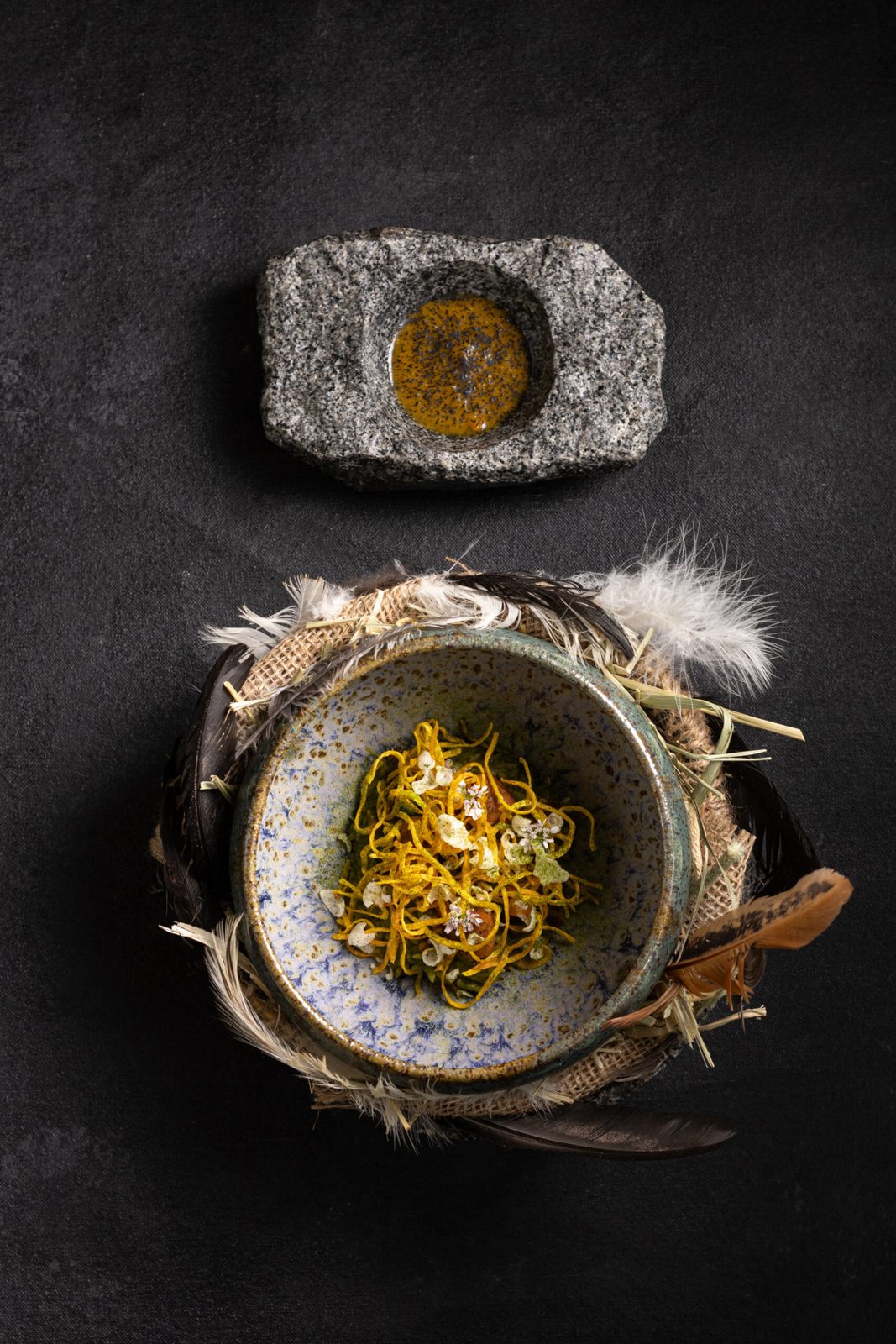
Image context: the lead image uses an official Mayta dish photograph because this article is about concentration. Mayta's plates are dense with sauce, texture, and visual control; the drinks need to keep that density legible without flattening the menu into one continuous register.[4][5]
1. The published pairing lanes reveal a restaurant that wants choice without vagueness
The strongest signal is simply the way the menu is presented. Mayta does not list one standard wine pairing and leave the rest to improvisation. It names three lanes clearly and prices them publicly alongside the tasting menu itself.[1] That tells the guest something important before any bottle is opened: the restaurant expects the same food to support multiple beverage logics.
Those logics are not interchangeable. "Special Vintages" implies a reading based on maturity, cellar depth, and the pleasure of time stored in glass. "Unique Vineyards" points instead toward site, character, and the way origin can sharpen the edges of a dish. The non-alcoholic lane completes the picture by showing that the house wants structure and pacing even when wine is removed from the equation.[1] In other words, Mayta is not only asking what pairs. It is asking what kind of evening the guest wants the menu to become.
That is a sophisticated move for a restaurant whose public identity is so tied to land. If the food is an ode to Peru, then the drinks do not need to translate that idea in only one dialect.[3][4]
2. The pisco-bar identity keeps the article from turning into a wine-only story
It would be easy to read "Special Vintages" and "Unique Vineyards" as proof that Mayta's beverage ambition lives mainly in wine. The restaurant's own public materials complicate that reading. The chef page explicitly describes Mayta as a pisco bar as well as a contemporary Peruvian restaurant.[4] Latin America's 50 Best goes further, saying the venue also functions as a pisco bar and that the drinks offer is handled by an esteemed team of bartenders working with inventive variations on Peru's national spirit.[5]
That matters because it changes the emotional center of the beverage program. At many global fine-dining rooms, pairing discourse quickly narrows into cellar prestige. At Mayta, the presence of a pisco-bar identity keeps local liquid culture inside the restaurant's top-end hospitality language.[4][5] The beverage program can move toward mature vintages or vineyard specificity, but the house still signals that Peruvian drinking culture is part of the experience rather than a side annex.
This is why the three-lane pairing structure feels coherent rather than split. One lane can privilege age, another can privilege terroir, and the broader room can still remain anchored in Lima through cocktails, bartending, and pisco as a public part of the brand.[4][5]
3. Timing is part of the pairing logic, because Mayta publishes the windows
Mayta's contact page gives unusually practical information for reading the beverage program. Lunch runs Monday to Sunday, 12:00 to 15:00; dinner runs 18:00 to 22:00; and the tasting menu has narrower start windows of 12:00 to 13:30 and 18:00 to 20:30.[2] Those details make the pairings easier to understand. A restaurant that publishes defined tasting-menu windows is thinking carefully about tempo.
Tempo is exactly where a three-lane beverage structure becomes useful. A vintage-led pairing can slow perception down and make the meal feel ceremonial. A vineyard-led pairing can make the guest read the food in terms of contour, acidity, and mineral detail. A non-alcoholic pairing can keep the pace bright, exact, and physically lighter over the same sequence.[1][2] The food has not changed, but the time signature has.
This is one reason the prices matter so much. When the top pairing sits at 740 PEN against a 998 PEN menu, the message is clear: Mayta does not see drinks as a modest add-on tucked beneath the kitchen's authority.[1] The house is pricing interpretation as a major share of the experience.
4. Mayta's rise helps explain why the beverage program is being stated so openly
Mayta's public history also helps here. The restaurant says it entered Latin America's 50 Best Restaurants in 2019, won the Highest Climber Award in 2020, and entered The World's 50 Best Restaurants list in 2022.[3] Latin America's 50 Best repeats that arc and ties it to the restaurant's more mature identity in its current premises.[5] The 50 Best Discovery profile places Mayta at No. 39 in The World's 50 Best Restaurants 2025 and No. 11 in Latin America's 50 Best Restaurants 2025.[6]
Restaurants at that level are rarely casual about what they publish on the menu page. When Mayta chooses to name these three beverage paths explicitly, it is making a claim about what it wants to be known for.[1][5][6] The house is telling guests that the culinary story is not complete at the plate. The liquid side carries its own authorship.
That authorship also matches the restaurant's Peru-centered language. The concept page calls Mayta an ode to land; the chef page emphasizes native-product traceability; the 50 Best profile describes a room where colorful Peruvian ingredients stay front and center.[3][4][5] A beverage program built around multiple readings is an efficient way to preserve that focus. It keeps the food from becoming generic "international tasting menu" luxury, because every pairing choice asks what kind of Peru-forward experience the guest wants to inhabit.
How to read the pairings before you book
Choose Special Vintages if you want the menu to feel weighted by maturity and collection value, with the meal read through the pleasures of age and cellar patience.[1] Choose Unique Vineyards if you want the sharper, more locational version of the argument, where the drinks likely lean into site character and a more etched sense of origin.[1] Choose the non-alcoholic pairing if what interests you is the architecture of pacing itself, because Mayta's public materials make clear that the house sees beverage structure as part of hospitality, not a wine-only privilege.[1][2]
That is why Mayta's beverage program is worth singling out in 2026. The restaurant is not merely offering drinks next to a notable Lima tasting menu. It is offering three disciplined ways to read the same menu while keeping Peru, pisco, and product-traceability language at the center of the room.[1][3][4][5][6]
Sources
- Mayta official menu page, covering the current 10-course tasting menu at 998 PEN and the three published beverage lanes: Special Vintages pairing, Unique Vineyards pairing, and Non-alcoholic pairing.
- Mayta official contact page, covering lunch and dinner hours, the tasting-menu service windows, and the Miraflores address.
- Mayta official concept page, covering the meaning of "Mayta," the restaurant's Peru-centered identity, and its 2019, 2020, and 2022 milestone timeline.
- Mayta chef page, covering Jaime Pesaque's positioning of the restaurant as a contemporary Peruvian restaurant and pisco bar in Lima with a focus on native-product traceability and local ingredients.
- Latin America's 50 Best Restaurants 2025 profile for Mayta, covering the restaurant's current framing, the role of colorful Peruvian ingredients, and the venue's pisco-bar and bartending identity.
- 50 Best Discovery profile for Mayta, covering its 2025 placements, address, lunch-and-dinner service, and the signal that wine enthusiasts should notice the Special Vintages pairing.