There is a dead version of luxury French dining that every big financial city knows how to produce. You walk into a hotel, the room glows softly, the service is polished, the wine list is deep, and by the end of dinner you remember expense more clearly than identity. Caprice still avoids that fate. The useful way to read it in 2026 is not as a generic three-star trophy inside the Four Seasons Hong Kong, but as a restaurant that keeps classical French fine dining active by letting three systems talk to one another at full strength: Guillaume Galliot's cooking, a room built around harbour-facing theatre and product ritual, and a beverage program strong enough to shape the meal rather than merely follow it.[1][2][3][4][5][6]
The public record already points in that direction. The current Four Seasons pages still frame Caprice as one of Hong Kong's premier three-Michelin-starred French restaurants, note current dinner service from Tuesday to Sunday, and foreground a wine-and-cheese culture rather than a purely plate-led identity.[1] 50 Best Discovery then fills in the present-tense outline: Caprice sits over Victoria Harbour, Guillaume Galliot has led the kitchen since 2017, the restaurant was No. 35 in Asia's 50 Best Restaurants 2026, and the current offer is still organized around a tasting-menu format.[2] Michelin's listing pushes the same visual impression from a different angle, describing an elegant, glamorous room whose harbour view remains part of the experience.[4] Taken together, these are not the signals of a house coasting on old silverware. They are the signals of a restaurant still trying to make French formality feel alive in one of the fastest rooms in Asia.
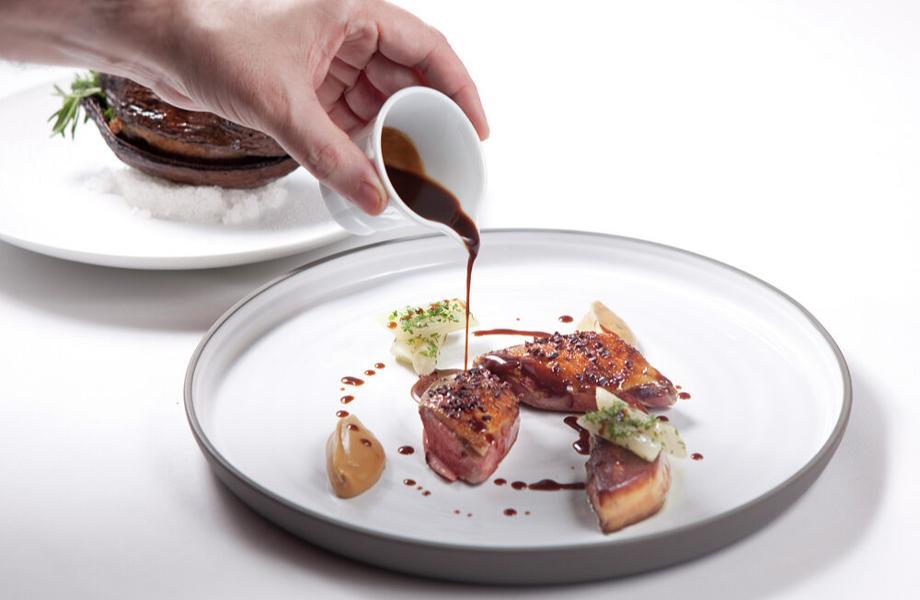
Image context: the lead image uses 50 Best Discovery's Caprice dining-room photograph instead of a plated close-up. That choice fits the article because Caprice's point starts before the first course. The room, the view, and the spacing of the tables establish the meal's rhythm and tell you this is a place where service architecture matters as much as any one dish.[2]
1. Guillaume Galliot keeps the room from turning into a museum
Caprice's strongest asset in 2026 is that it does not present Frenchness as a sealed historical package. The Four Seasons dining pages describe Galliot's food as classic French savoir-faire with global flair, which is a hotel phrase on the surface but a useful one underneath.[5] It suggests a restaurant that wants to keep the grammar of French haute cuisine while loosening its borders enough to stay relevant in Hong Kong. 50 Best Discovery gives that idea a more concrete body, naming dishes such as wagyu and oyster tartare with Kristal caviar and Alaskan king crab with crustacean, then pairing those with a dessert as classically indulgent as banana chocolate mille feuille.[2] That lineup matters because it shows the house does not confuse classicism with narrowness. Luxury here is filtered through French technique, but the product language is unmistakably international.
That is also why the harbour matters. Michelin calls Caprice one of Hong Kong's most elegant dining rooms and emphasizes that the experience remains consistently impressive.[4] The 50 Best page is more atmospheric, calling it quintessential French fine dining with outstanding Victoria Harbour views.[2] Those descriptions are easy to flatten into travel-copy glamour, but they point toward something more specific. Caprice is a French restaurant that knows it is in Hong Kong, a city whose dining culture has long prized both polish and intensity. The room has to project calm without going sleepy; the cooking has to feel exact without becoming conservative. Galliot's tenure since 2017 matters because it suggests the restaurant has had time to stabilize that balance instead of constantly resetting its identity around a new chef.[2]
2. The physical room gives the luxury a working spine
Caprice also benefits from something many high-end hotel restaurants quietly lack: infrastructure you can describe in concrete terms. The Four Seasons Hong Kong brochure presents the restaurant as a French room with an open kitchen, a renowned global wine collection, and Hong Kong's first cheese cellar devoted to artisanal French cheeses.[6] The older hotel facts sheet is even more direct, describing a 77-seat dining room, a wine cellar holding up to 1,400 bottles, and a cheese program built from French affineur relationships.[7] Some of those documents predate the current Michelin cycle, but the structural picture remains useful because it explains why Caprice does not feel like a hotel restaurant that happens to have strong cooking. The space was designed to make product display, service, and indulgence visible all at once.
That visibility changes the tone of the meal. An open kitchen lets guests read the restaurant as labor instead of only as polish.[6][7] A cheese cellar means the classic French meal does not have to end in automatic petit-fours-and-memory; it can widen into an additional domain of maturation, sourcing, and table-side judgment.[6][7] Even the adjoining Caprice Bar matters in this ecosystem. The official page describes it as a place for extensive wines and French cheeses right beside the main dining room, which implies that the restaurant's identity does not stop at the edge of the tasting menu.[1] The whole floor becomes one controlled argument about French hospitality translated into Hong Kong scale.
This is where many three-star rooms flatten out. They have expensive ingredients, careful lighting, and a hushed staff, but the physical proposition is thin. Caprice reads differently because the luxury is attached to working objects: the kitchen, the cellar, the cheeses, the harbour-facing tables. The restaurant gives diners things to look through, not just things to look at.
3. The wine program has enough authority to shape the cuisine
What makes Caprice especially interesting right now is that its beverage side is not playing a secondary role. Four Seasons' March 19, 2026 press release says Caprice retained its three Michelin stars for the eighth consecutive year, then immediately turns to the stronger current signal: Floriane Hureau, senior sommelier, won the 2026 Michelin Sommelier Award.[3] The same release says the beverage program includes more than 1,200 labels from France and around the world, and describes Hureau's pairings as creating a seamless dialogue between cuisine and terroir.[3] That language could have read like celebratory PR if it stood alone. It does not stand alone.
The current Caprice page already foregrounds the wine side by introducing Victor Petiot, tracing his route from Burgundy through Paris, and placing the wine program in the same breath as the restaurant's French-cheese identity.[1] The hotel-wide award-winning dining page reinforces the same hierarchy when it presents Caprice not only as a three-star restaurant, but as a place where Galliot's cooking and the surrounding beverage seriousness belong to one prestige proposition.[5] Once those sources are read together, the Sommelier Award looks less like an ornamental extra and more like confirmation of Caprice's actual operating model.
That matters because classic French fine dining has always depended on sauce, cheese, and wine as much as on the central protein. Caprice appears to understand that older truth at a level many contemporary luxury rooms have thinned out. Instead of treating wine as an optional high-margin supplement, it keeps the cellar close to the restaurant's public identity and lets the service team carry part of the authorship.[1][3][5][6][7] In a city where diners can get spectacle, speed, and ingredient bragging almost anywhere at the top end, that fuller table culture becomes a real differentiator.
4. Why Caprice still feels current
Caprice is therefore worth reading as more than "French fine dining with a view." The 2026 evidence suggests a house that has stayed relevant by refusing two easy failures. It has not melted classical French dining into vague cosmopolitan luxury, and it has not embalmed it as a museum performance either. Galliot's long stewardship gives the cooking a stable center.[2][5] The room's open kitchen, cheese cellar, and harbour-facing elegance keep the restaurant tactile and legible.[4][6][7] The beverage program now has formal Michelin recognition of its own, which confirms that the table's liquid side is being treated as real creative work.[3]
That combination is why Caprice still lands. The restaurant does not ask Hong Kong to slow down and pretend it is in Paris. It takes French luxury's old supports, keeps them visible, and puts them under a sharper urban light. The result is a room that still feels ceremonious, but never asleep.[1][2][3][4][5][6][7]
Sources
- Four Seasons Hotel Hong Kong, "Caprice" - official restaurant page covering current three-Michelin-star status, Tuesday-Sunday dinner service, Victor Petiot's Burgundy background, and the restaurant's wine-and-French-cheese framing.
- 50 Best Discovery, "Caprice - Hong Kong - Restaurant" - current profile covering Guillaume Galliot's leadership since 2017, Asia's 50 Best 2025 and 2026 rankings, harbour-facing positioning, tasting-menu format, and representative dishes.
- Four Seasons Hotel Hong Kong, "Four Seasons Hotel Hong Kong Shines with Seven Michelin Stars and a Michelin Sommelier Award" (March 19, 2026) - press release confirming Caprice's eighth consecutive three-star year, Floriane Hureau's 2026 Michelin Sommelier Award, and the 1,200-label beverage program.
- MICHELIN Guide, "Caprice - Hong Kong - a MICHELIN Guide Restaurant" - current listing covering the restaurant's elegant and glamorous room, Victoria Harbour outlook, and overall experience framing.
- Four Seasons, "Award-Winning Dining" - current brand page describing Caprice as Chef Guillaume Galliot's classic French savoir-faire with unique global flair within the group's Michelin-starred dining portfolio.
- Four Seasons Hotel Hong Kong, A Modern Classic eBrochure - hotel brochure describing Caprice's open kitchen, global wine collection, and Hong Kong's first cheese cellar full of artisanal French cheese.
- ATI Travel, FOUR SEASONS Hong Kong facts sheet PDF - property fact sheet describing Caprice's 77-seat room, open kitchen, 1,400-bottle wine cellar, and French cheese cellar.