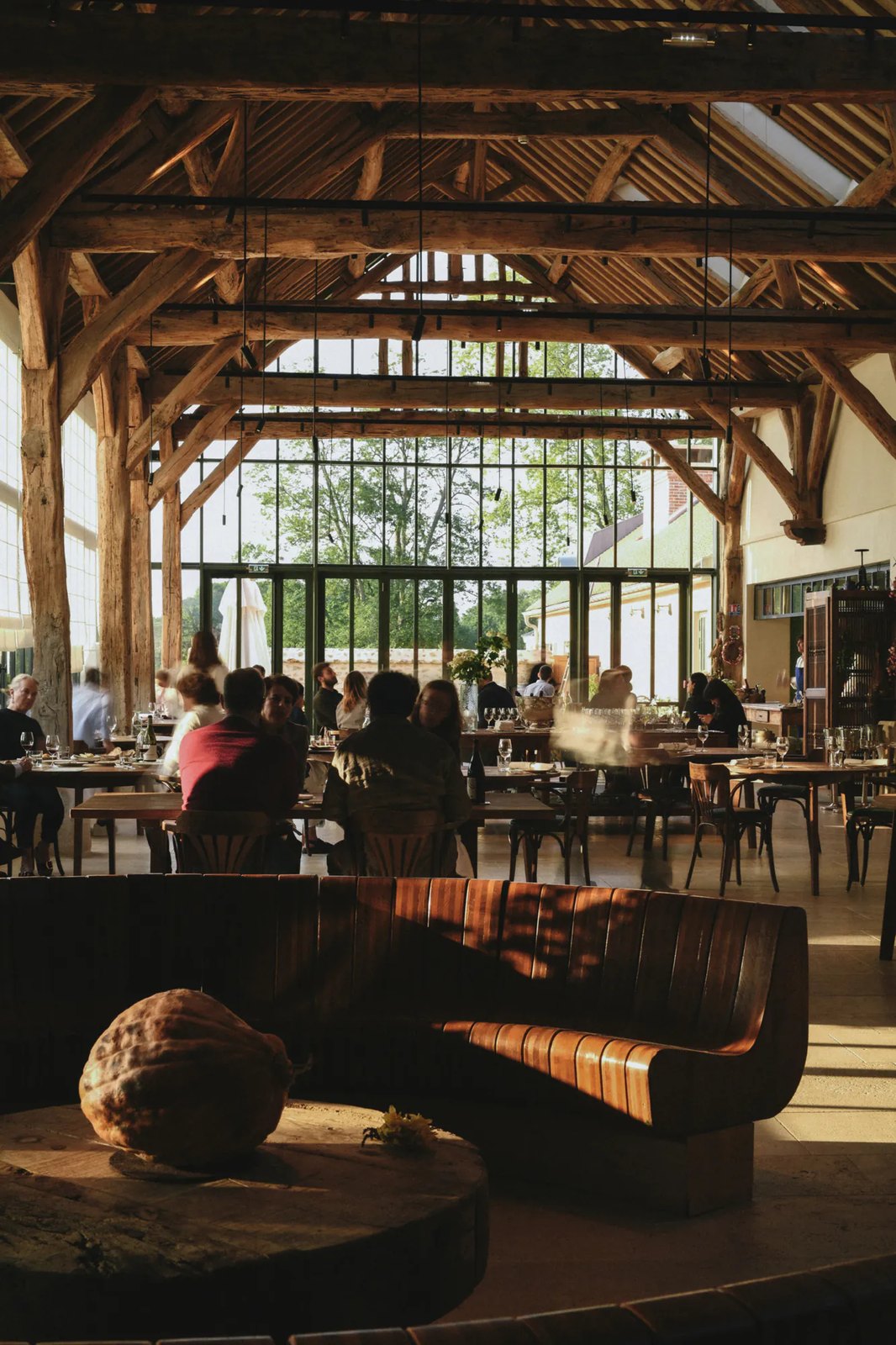
Le Doyenne is easy to romanticize as a country escape: restored stables, guest rooms, a chateau estate south of Paris, and a dining room that looks straight toward the land. That picture is real, but it is not the main reason the restaurant matters. The more useful way to read Le Doyenne is as a ripeness machine. The potager does not decorate the menu after the fact. It edits the menu before the kitchen begins plating.[2][3]
As of April 26, 2026, the restaurant's own public language remains unusually explicit. The official restaurant page says the potager is the "beating heart" of the project, that seasons and micro-seasons shape the menu, and that each morning the team harvests vegetables and fruits at their peak.[2] The same page currently shows a EUR95 Friday lunch and a EUR135 carte blanche menu, with wine pairings at EUR65 and EUR80 respectively, while the bookings page lists dinner on Thursday and Monday and lunch-and-dinner service from Friday through Sunday, with a EUR50 deposit for restaurant reservations.[2][4] At this level, farm-to-table cannot remain soft mood language. It has to behave like a supply system.
Image context: this post uses Le Doyenne's own dining-room photograph rather than a close-up of one finished plate because the article's claim sits upstream from the pass. The important visual fact is the room's direct exposure to the estate: the meal begins with what can be seen growing and changing outside the windows, not with a late-stage luxury flourish.[1]
1. The potager is an upstream editor, not a pastoral backdrop
The official history page gives the crucial sequence. James Henry and Shaun Kelly began the project in 2017, revived the estate's historic potager after roughly 60 years of dormancy, restored the former stables into a restaurant and guesthouse with 11 rooms, and built the agricultural side before full restaurant service was in place.[3] The same page says the team planted hundreds of fruit trees and shrubs plus hundreds of varieties of heirloom vegetables and herbs, and that in 2019, while the restaurant was still under construction, they were already supplying a handful of Paris chefs from the garden.[3]
That chronology matters. A lot of ambitious restaurants add farming once the dining room story already exists. Le Doyenne grew the supply logic first. FOUND Paris's 2026 note sharpens the point: the project now works with more than a hundred varieties of heirloom fruits and vegetables, and dishes are built from ingredients picked from the land only hours before service.[7] Read together, the sources suggest a restaurant where ingredient sourcing is not a procurement detail at the back door. It is the first draft of the menu.
This is why Le Doyenne feels different from generic producer-driven luxury. The key gain is not just freshness in the abstract. It is timing authority. If the grower notices a narrow window in peas, herbs, tomatoes, or fruit, the kitchen is close enough to answer before that window flattens into one more seasonal cliche.[2][3][7]
2. Micro-seasons only matter if the menu accepts asymmetry
The restaurant page is valuable because it refuses the fantasy that one enclosed estate can supply every need in the same way all year. In summer, the menu may come predominantly from the garden; in autumn, vegetables may sit beside wild mushrooms and game; in winter, the kitchen may choose to highlight the Atlantic at its peak.[2] That is a stronger claim than total self-sufficiency. It says the estate sets the timing, while the broader French food chain fills out the arc.
The 50 Best Discovery profile makes that visible at dish level. Its description of Le Doyenne keeps returning to straight-from-the-estate produce, heirloom fruit trees, and views of the cottage garden, but then places those products alongside line-caught Biscay squid, scallops in mushroom jus, and Doyenne pork with fermented fig and fresh ginger.[5] Another Aspect's 2025 interview with James Henry adds the same realism from a different angle: the farm produces a large share of what the house uses, including pigs, yet the restaurant also benefits from being based in what Henry calls a produce-rich part of France.[6]
That combination is exactly what gives the sourcing story credibility. A weaker restaurant would turn the farm into a purity myth. Le Doyenne uses the farm as the menu's clock. The point is not to prove that nothing enters from outside. The point is to make outside sourcing answer to the same seasonal pressure that governs the garden.[2][5][6]
3. Regenerative practice changes taste before taste arrives
Le Doyenne's agricultural language would be easy to dismiss if it stayed at the level of aspiration. The official history page goes further. It says the team chose not to till, and instead relies on compost and mulch to preserve microbial life, capture carbon, and rebuild the soil that had been lying dormant for decades.[3] FOUND Paris uses similar language when it describes regenerative methods and the revival of old fruit-and-vegetable varieties on the estate.[7]
In a tasting-menu context, that matters because no-till practice does more than flatter a conscience. It changes how the kitchen experiences abundance and scarcity. A menu built from a living potager is forced to accept awkwardness: glut, fragility, short windows, imperfect size, weather pressure, and the need to preserve or redirect what arrives all at once. The result is that "seasonality" stops being a decorative noun and starts behaving like an editor with veto power.[2][3][7]
The 50 Best profile quietly supports that reading by describing a room where diners look toward the garden while eating beneath restored wooden eaves.[5] That architecture is not just attractive. It keeps the origin point psychologically close. When the land is visible, the menu has less room to fake generic luxury and more pressure to explain why today's ingredients, and not some other day's, are on the plate.
4. What the current ticket actually buys
The most interesting current prices at Le Doyenne are not flashy by Paris luxury standards, but they are highly revealing. A EUR95 Friday lunch and a EUR135 carte blanche menu suggest that the restaurant is not selling one giant once-in-a-lifetime spectacle only.[2] It is selling access to a daily-edited agricultural loop at different levels of commitment. The bookings page reinforces that reading: the dining room runs on a narrow weekly rhythm, deposits are real, and the guesthouse remains structurally tied to the restaurant even when room bookings and table bookings are handled separately in summer months.[4]
That makes the money easier to read. You are not mainly paying for imported trophy ingredients or palace service density. You are paying for a revived potager, a restored stable, a small service calendar, a kitchen that accepts micro-season volatility, and a room organized closely enough to let those variables register without chaos.[2][3][4] In other words, the luxury is not excess. The luxury is controlled ripeness.
Why this sourcing model matters now
Farm language has become easy branding in fine dining. That is exactly why Le Doyenne still feels sharp in 2026. The evidence here is operational rather than rhetorical: a project begun in 2017, an old potager brought back after decades of inactivity, morning harvests, no-till regenerative practice, estate-grown produce already supplying other chefs before the full restaurant opened, and a public menu philosophy that openly shifts from garden-heavy summer to Atlantic-heavy winter.[2][3][7]
That is a narrower and more persuasive definition of luxury than the usual one. Le Doyenne is not trying to prove that the estate can replace France. It is proving that one restaurant can let the estate set the pace strongly enough that the rest of the supply chain must follow its rhythm.[2][5][6] The result is a meal whose most expensive ingredient is often not rarity. It is timing.
Sources
- Le Doyenne, "Gallery" - official image gallery containing the dining-room photograph used for the lead image.
- Le Doyenne, "Restaurant" - official philosophy and current menu page covering the potager, micro-seasons, morning harvests, current menu examples, and current Friday lunch / carte blanche pricing.
- Le Doyenne, "About" - official history page covering the 2017 start, the restored stables, the 11-room guesthouse, the dormant historic potager, no-till regenerative practice, and the 2019 pre-opening supply relationship with Paris chefs.
- Le Doyenne, "Bookings" - official reservations page covering current opening days, deposits, room-booking notes, and cancellation terms.
- 50 Best Discovery, "Le Doyenne - Saint-Vrain" - profile covering the restored stables, estate-grown produce, regenerative agriculture, dining-room garden views, and representative dishes such as Biscay squid, pork with fermented fig, and garden crudites.
- Another Aspect, "Life With James Edward Henry" - 2025 interview framing Le Doyenne as a restaurant, guesthouse, and farm, and describing the estate's own production alongside France's wider produce landscape.
- FOUND Paris, "Open fields" - January 30, 2026 note covering the Saint-Vrain project, more than a hundred heirloom fruit-and-vegetable varieties, regenerative methods, and dishes built from ingredients picked just hours earlier.