The easiest way to make Maito smaller than it is is to call it fusion and stop there. The label is not wrong. It is just too thin for a restaurant whose whole force lies in making Panama's mixed history taste coherent without flattening it into generic cosmopolitanism. The official Maito site says the restaurant expresses the country's multicultural culinary identity, where Afro, Asian, and Caribbean influences turn into a menu of criollo flavors drawn from sea, mountain, and Panamanian soil.[1] Latin America's 50 Best 2025 stretches that map even further, describing a room where Caribbean, Indigenous, Asian, Creole, Afro-Antillean, and American influences all remain legible at once.[4] Put those claims together and the restaurant stops looking like a stylish blend. It starts looking like a lineage project.
That is the better way to read Maito in 2026. Mario Castrellon has spent more than a decade building restaurants that "reflect the identity of Panama," as the official site puts it, but Maito remains the clearest place to see the underlying argument.[1] It is a flagship because it does not chase purity. It chases a usable grammar for a country shaped by coastlines, migration, trade, and the long afterlife of the canal.[4][5]
The language Castrellon now uses for that grammar is Chombasia. In a 50 Best feature from 2024, he describes it as the name he gave to the flavor profile produced by the coexistence of Creole cooking, Afro-Caribbean curry logics, Cantonese food, and Indian curry inside Panama's history.[5] The article also quotes him saying that the country's story can be divided into before and after the Panama Canal.[5] That is a strong framing device, but Maito works because the kitchen does not treat it as branding copy. It uses the idea to organize the menu.
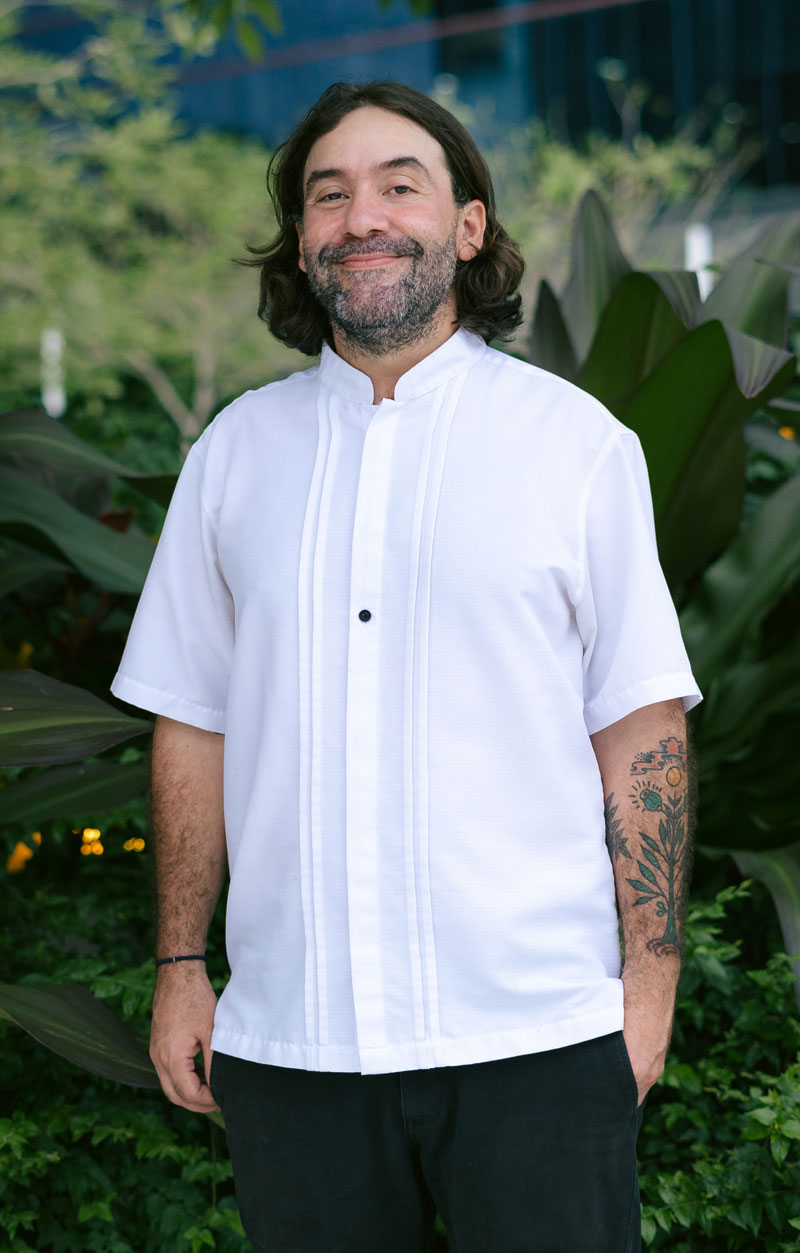
Image context: the lead image uses an official Mario Castrellon portrait because this piece is about authored lineage rather than anonymous trend. Maito reads best when you see it as a chef-built system for editing a national pantry with multiple historical parents.[1]
1. Maito turns Panama's crossroads into a house language
Many restaurants in port cities can list influences. Fewer can decide which of those influences should remain visible on the plate and which should be compressed into structure, heat, sauce, or sequence. Maito's strength is that it does both. The official site speaks in broad terms about Panama's multicultural identity, while Latin America's 50 Best adds more specificity: the restaurant is a meeting point for the country's diversity of cultures, flavors, and ingredients, and the dining room itself takes design cues from the architecture of the Panama Canal.[1][4] Even the room is being asked to carry the historical argument.
That matters because Panama is unusually vulnerable to shallow culinary storytelling. A transit country can be romanticized as a crossroads until it becomes formless. Maito avoids that trap by repeatedly giving the mixture a center of gravity. The current 50 Best ranking page says Castrellon was trained in European cuisine, but invented his own identity through producers, Panamanian ingredients, and a distinctly local sense of possibility.[4] That is the crucial turn. European training is present in the polish, pacing, and confidence of the room, yet it does not get to define the deepest flavor logic.
What defines that logic instead is Panama's double coastline, tropical produce, and mixed migrant inheritance. The 50 Best page is explicit that Castrellon's love of the sea and tropical products is justified by the country itself, and the Discovery profile says sustainable products from Indigenous communities enter the kitchen alongside dishes grounded in traditional cuisine.[3][4] Maito is not selling rootlessness. It is selling a version of rootedness that admits Panama was built by encounter.
2. "Chombasia" matters because it names an old route, not a new gimmick
The most persuasive part of the Chombasia idea is that it arrives late. Castrellon did not invent Panama's crossings; he named a pattern that already existed in Panamanian eating and then tightened it into a flagship vocabulary.[5] The 2024 50 Best story makes that plain by tracing one of the restaurant's key dishes, pesca chombasia, to fish cooked with Afro-Caribbean techniques and finished in a Chinese wok.[5] That is not a random collision built for novelty. It is a route made visible.
The February 2026 menu shows how deep that route now runs.[2] The starters alone read like an atlas of migration filtered through kitchen discipline: Afro Pao with hampao and pork chombasia; Ha Kao with shrimp and Caribbean coconut sauce; Pani Puri One and One with tamarind, beef stew, and crema fresca; duck dumplings served in a browned-butter broth; and Pato con Yuca, where yuca tortillas, sliced duck, and pineapple bring tuber, bird, and tropical sweetness into a single bite.[2] These dish names are important because they refuse to hide their parents. Maito does not pretend that a dumpling, a puri shell, and a Caribbean sauce all came from the same ancestral drawer.
What keeps the menu from becoming a clever museum of references is editing. The dishes are short, punchy, and restaurant-legible. They belong to a room that knows pleasure matters as much as thesis. Castrellon's own formulation in the 50 Best feature is that Chombasia is a "frequency of happiness" as much as a cultural description.[5] That line could sound soft. On the menu it reads as method: keep the crossings vivid, keep the plate direct, and do not let history become homework.
3. The house still depends on everyday Panamanian anchors
Maito would be less convincing if its multicultural language lived only in tasting-menu abstraction. What makes the restaurant feel durable is that it keeps returning to dishes and ingredients with wider social memory. The Discovery profile points specifically to sancocho soup as one of the restaurant's emblematic references.[3] The live menu confirms that instinct. Sancocho con arroz, cooked over nance wood, appears alongside Arroz Negro Maito 2010 with squid, shrimp, achiote, and recao; Guachito Caribeño with seafood and plantains; Bistec Picado with chombasia sauce; and Pesca Panamenier, where the day's fish meets a curried-lentil meuniere.[2]
This is the section of the menu where Maito stops being merely stylish and becomes persuasive. A restaurant can talk about multicultural identity all night long. It becomes believable only when the kitchen is willing to work through the dishes people already know in some form: rice dishes, broths, chopped beef, fish with sauce, plantain sweetness, coconut depth. Castrellon is not importing prestige into Panama from the outside. He is pressing old local recognitions through a sharper restaurant frame.[2][3][4]
Even the dessert language holds to that logic. Discovery notes regional fruits such as cocona, lulo, and sachatomate in the sweet courses, while the current menu offers Lulo Lamastus, geisha sediments, coconut sorbet, and other desserts that keep Panama and the surrounding region present all the way to the end.[2][3] In a weaker restaurant, dessert is often where the territorial argument disappears into generic luxury. At Maito, it continues.
4. Why Maito still matters now
As of 2025, Maito sits at No. 18 in Latin America's 50 Best Restaurants and holds the title of The Best Restaurant in Panama 2025.[4] Discovery lists the degustation menu from $297, while the official site continues to present Maito as the flagship of a larger group led by Castrellon.[1][3] Those facts explain stature, but they do not explain why the restaurant remains worth reading closely.
The deeper reason is that Maito has done something harder than opening a successful destination restaurant. It has given Panama a fine-dining house style that does not need to deny mixture in order to feel serious. The menu can move from Ha Kao to Afro Pao, from Pani Puri to sancocho, from coconut to achiote to wok vegetables, and the meal still feels authored rather than scattered.[2][5]
That is the lineage piece. Chombasia is the late name; Panama's crossings are the older reality; Maito is the room where the route becomes legible enough to survive repetition. If you want doctrinal regional purity, other restaurants will satisfy that appetite more cleanly. Maito's achievement is different. It makes a canal country taste like itself, not by cleaning away the traffic, but by teaching the traffic to move in one direction.[1][4][5]
Sources
- Maito official homepage, covering the restaurant's multicultural-identity statement, Mario Castrellon's role, and the official portrait used here.
- Maito, "Menú Febrero 2026" PDF, covering the current a la carte dish names, dessert names, and live menu structure.
- 50 Best Discovery, "Maito" (Panama City profile), covering the degustation-menu pricing, Indigenous-community sourcing, the sancocho reference, and the fruit-led dessert framing.
- Latin America's 50 Best Restaurants 2025, "Maito", covering the restaurant's 2025 regional rank, Best Restaurant in Panama title, Panama Canal-inspired room design, and Castrellon's producer-led contemporary Panamanian framing.
- The World's 50 Best Restaurants, "Tuning in to the Chombasia frequency with Chef Mario Castrellón" (February 2, 2024), covering Castrellon's definition of Chombasia, the before-and-after-canal framing, and the Afro-Caribbean-to-Chinese-wok logic behind pesca chombasia.