L'Enclume is easy to praise in trophy language: three Michelin stars, a Green Star, a destination village, a tasting menu with enough quiet confidence to make Cartmel feel like a culinary capital.[3][4] That vocabulary is accurate, but it misses the more interesting machinery. The restaurant's strongest luxury is not display. It is control over time.
As of April 20, 2026, the public structure is unusually legible. L'Enclume lists The L'Enclume Experience at £275 for lunch and dinner, plus a shorter £125 lunch menu during the peak growing season from April 1 to October 31.[1] Michelin continues to identify the restaurant as Three Stars and farm-to-table, while L'Enclume's own 2026 awards note says the house retained both its three stars and its Green Star.[3][4] Those facts matter because they place the restaurant's farm language under pressure. At this level, "seasonal" cannot mean a vague preference for nice produce. It has to behave like an operating system.
That operating system begins less than a mile from the dining room. The official Our Farm page describes a project built to strengthen the link among food, development, and environment; it says growers and chefs work side by side, and it frames the farm as an extension of the kitchen rather than a scenic supplier.[2] Michelin adds the harder figure: Simon Rogan describes a 12-acre farm designed "by chefs, for chefs," with local suppliers covering meat and fish while the kitchen keeps extending the period in which it can rely on its own growing through preservation.[4] Read together, the sources point to a restaurant where ingredient sourcing is not procurement at the back door. It is menu authorship.
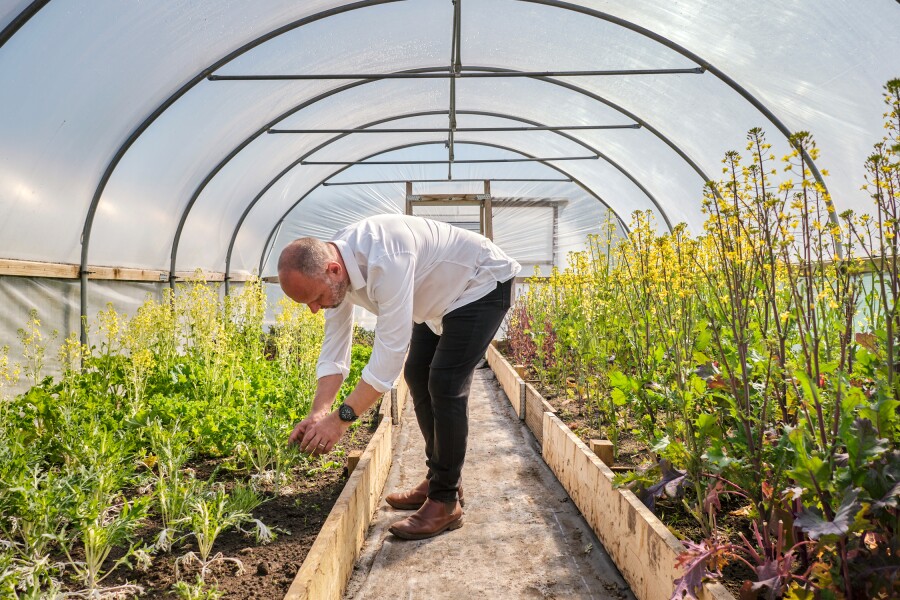
Image context: this post uses AFAR's farm photograph rather than a plated-course close-up because the article's claim sits upstream from the pass. The visual value is in the polytunnel, the raised beds, and the chef's body bent into the growing space: L'Enclume's flavor does not start when the tweezers come out; it starts when the crop clock is set.[6]
1. The farm is a development kitchen, not a garden
Many high-end restaurants maintain gardens. L'Enclume's public materials describe something more consequential. On the Dine page, the restaurant says every dish begins either at Our Farm, with an ingredient at its peak, or with a wild ingredient or trusted local producer; those ingredients then move through senior-team discussion and Aulis, the development kitchen, before reaching the L'Enclume menu.[1] That sequence is the key. The farm does not merely decorate the story after a chef has already imagined the dish. It supplies the first constraint.
The Our Farm page makes the same claim in more physical language. Year-round growing methods give the restaurant flexibility and productivity across the seasons, while growing ingredients in-house gives the team more control over what it uses.[2] The page also says the farm is less than a mile from the restaurant and that ingredients can be picked for service freshness.[2] This is a short-distance system, but the point is not only mileage. The point is feedback speed. If the grower sees a crop moving ahead, the kitchen can start thinking. If a leaf, flower, herb, or vegetable peaks for a narrow window, the menu can answer before the moment has passed.
That is why L'Enclume's sourcing feels different from the softer "chef visits market, chef gets inspired" template. Market inspiration is episodic. A farm-development loop is continuous. It lets the restaurant treat ripeness, shortage, preservation, and menu rhythm as one connected problem.[1][2][4]
2. Seasonality becomes discipline when there is a shorter lunch
The most revealing current detail may be the seasonal lunch format. L'Enclume now publishes the shorter lunch only during the peak growing season, from April 1 through October 31, Wednesday through Saturday and on Bank Holiday Sundays.[1] That is a small commercial line with a large editorial meaning. The restaurant is not simply saying, "We have a tasting menu." It is saying that when the land is most generous, the house can open a second doorway into the same sourcing logic.
This matters because tasting menus often become fixed monuments. They can drift toward signatures, reprises, and luxury expectation even when the menu claims to be seasonal. L'Enclume's current public split is more agile. The full experience carries the restaurant's maximal arc, while the seasonal lunch gives peak produce a lighter, more available frame.[1] It also changes the diner's practical reading of the year. A spring or summer visit is not just warmer travel weather. It is a different supply condition.
50 Best Discovery helps explain why this works. Its profile says dishes change with the farm's crop output, while a few beloved staples, including the aged-cheese pudding caramelized in birch sap and the Anvil dessert, remain as recurring anchors.[5] That balance is the trick. A restaurant with no anchors can feel formless; a restaurant with too many anchors can make seasonality ornamental. L'Enclume appears to use stable memories as hinges, then lets the farm move the surrounding grammar.[1][5]
3. Preservation is what keeps the farm from becoming a postcard
The romantic version of farm-to-table cooking peaks in the morning harvest basket. L'Enclume's stronger version depends on what happens after the perfect moment passes. Michelin's restaurant page quotes Rogan on preserving methods developed over more than a decade so the restaurant can extend the time it relies on its own growing.[4] That line is essential. Without preservation, seasonality can become either frantic or sentimental. With preservation, the farm produces not only fresh flavor but stored weather.
AFAR's 2023 feature adds useful texture from the growing side. It reports that Our Farm had become self-sufficient and off-grid, says a large share of L'Enclume's menu came from the farm at that point, and describes regenerative practices, composting, and a wide crop vocabulary inside greenhouses and beds.[6] Some of those operational numbers belong to that reporting moment, not to a permanent guarantee. The durable point is the same one the current L'Enclume pages still make: the farm is built for continuity, not photo-friendly tokenism.[2][6]
Preservation also changes the taste of restraint. If the kitchen can ferment, pickle, dry, store, infuse, and reuse what the land gives it, acidity does not have to arrive by generic citrus, sweetness does not have to arrive by imported softness, and bitterness does not have to be a garnish. The local pantry gains depth because time has been worked into it.[4][6]
4. Cartmel turns sourcing into a village system
L'Enclume's building history matters here. The official Our Farm page notes that the name means "the anvil" and that the building dates back to the early 13th century as a family-run blacksmith site, with original features such as furnaces, beams, and thick stone walls retained.[2] 50 Best Discovery similarly frames the restaurant as opening in 2002 inside the village's former blacksmith.[5] This could easily become quaint heritage copy. In practice, it gives the restaurant a useful physical metaphor: old workshop, current farm, modern development kitchen, one village circuit.
That circuit now includes Aulis Cartmel, described by L'Enclume as a six-guest "behind the scenes" dining experience where guests watch chefs work through L'Enclume dishes and ingredients from Our Farm.[1] It also includes farm tours on request in spring and summer, and a summer 2026 "A Day at Our Farm" experience that turns the growing site itself into a public-facing part of the restaurant's identity.[1][2] The result is a compact ecosystem. The guest can eat in the old workshop, see the development logic at Aulis, and, in season, trace the crop source back into the valley.
That is the part other restaurants cannot copy by buying better vegetables. L'Enclume's sourcing advantage is spatial and organizational as much as agricultural. The farm sits close enough to shape service. The development kitchen sits close enough to translate crop changes into dishes. The village is small enough for the whole thing to feel like one address spread across several rooms.[1][2][5]
What the money buys
For a diner, the practical question is not whether L'Enclume is "worth it" in the abstract. It is what kind of luxury the meal is selling. The sources point to a clear answer: the price buys a controlled relationship among land, labor, preservation, development, and service.[1][2][4] A more flamboyant restaurant can overwhelm you with spectacle. L'Enclume's claim is quieter and more exacting. It wants the season to feel edited.
That makes the restaurant especially interesting in 2026, when farm language has become easy branding across fine dining. L'Enclume has the awards, but the awards are not the core evidence. The evidence is the working loop: a 12-acre farm, daily picking, preservation practice, crop-output menu changes, Aulis development, farm tours, and a seasonal lunch format that appears only when the calendar can support it.[1][2][4][5] The romance of Cartmel is real, but the restaurant's deeper achievement is operational. It has turned a village, a farm, and a tasting menu into one clock.
Sources
- L'Enclume, "Dine" - current menu structure, £275 L'Enclume Experience, April 1-October 31 seasonal lunch, Aulis Cartmel, farm-to-table development flow, dietary notice, and farm-tour availability.
- L'Enclume, "Our Farm" - official description of Our Farm's purpose, year-round growing methods, less-than-a-mile location, chef-grower collaboration, summer 2026 farm experience, and building history.
- L'Enclume, "All Stars Retained at Michelin Guide 2026 Great Britain & Ireland Awards" - February 2026 confirmation that L'Enclume retained three Michelin stars and a Green Star.
- MICHELIN Guide, "L'Enclume - Cartmel" - current Three Stars listing, farm-to-table category, daily-picked Our Farm description, 12-acre farm quote, preservation framing, service hours, and facilities.
- 50 Best Discovery, "L'Enclume - Cartmel, Nr Grange-over-Sands" - profile covering the former blacksmith setting, 2002 opening, 165+ produce varieties at Our Farm, crop-output menu changes, and recurring dishes.
- Katherine LaGrave, "How a Tiny English Village Became a Destination for Fine Dining," AFAR (2023) - reported Cartmel and Our Farm context, regenerative-farming details, farm share at the time of reporting, and the Cris Barnett photograph used as the article image.