At plenty of expensive French restaurants, sauce still reads as the finishing touch, the elegant flourish that confirms the dish has been cooked seriously. At Plénitude, sauce is asked to do much more than that. The official restaurant site is blunt about the hierarchy: sauce takes center stage, the menu is built around fragrant "Absolues," and the dishes are said to be in tune with the sauces rather than the other way around.[1] That is not decorative language. It is the operating system.
As of April 19, 2026, the public record still lines up around that same thesis. The official site continues to present two menu lanes, Symphony and Sail Away Together, while 50 Best Discovery still describes Arnaud Donckele's approach as closer to an artist or chemist than a conventional chef and notes that the restaurant holds the maximum three Michelin Stars.[1][2] Michelin's own longer features then supply the crucial detail: this is a house where a library of sauces, bouillons, jus, vinaigrettes, sabayons, and emulsified liquids is not hidden in the kitchen but brought into service, explained to guests, and used to control the rhythm of the evening.[3][4]
The useful way to understand Plénitude, then, is not as generic Paris palace luxury with excellent saucing on top. It is as a technique-driven restaurant that has tried to reverse the usual order of fine dining. The liquid arrives first in the concept, first in the kitchen logic, and almost first in the guest's mind.[1][2][3]
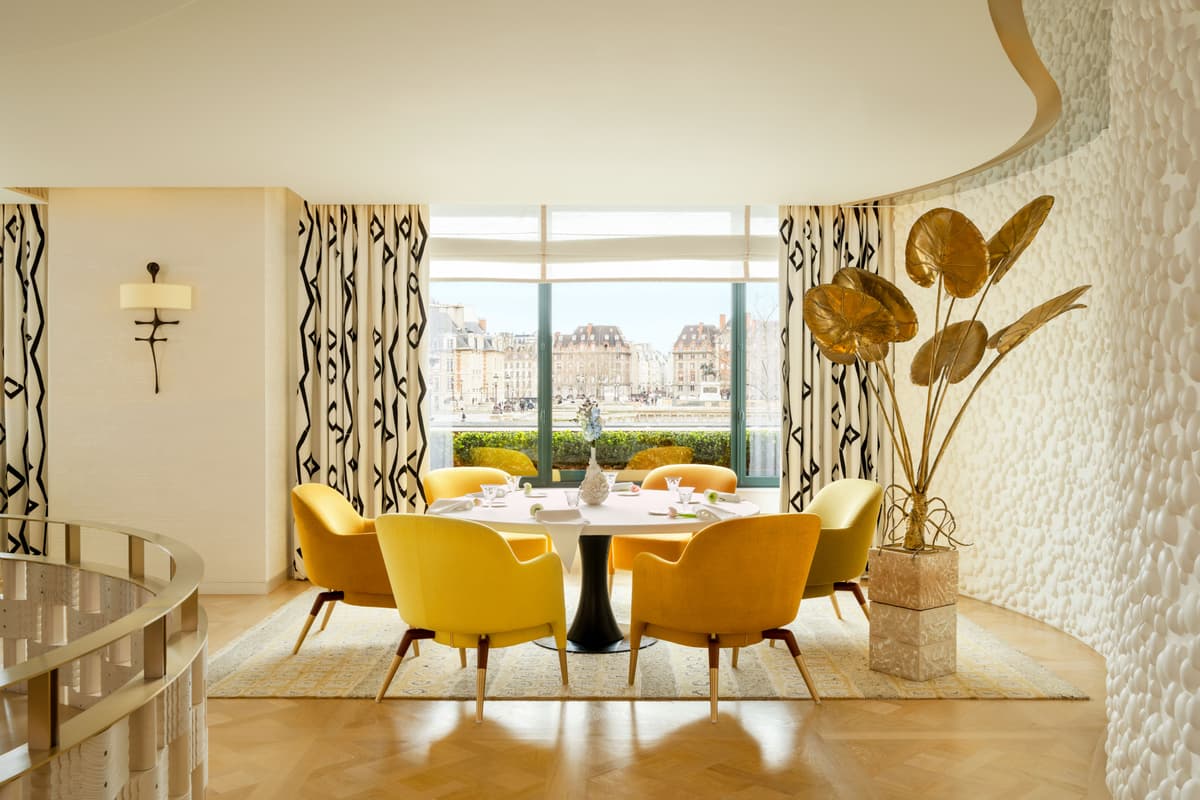
Image context: the lead image uses the official dining-room photograph from Plénitude's site rather than a glamour close-up of one plated course. That choice fits the article because the core technique here is not one secret reduction. It is a whole room designed to let sequencing, explanation, and liquid memory register clearly over the length of a meal.[1]
1. The dish follows the sauce, not the reverse
The single most important sentence on the official site is also the simplest: "here, the dishes are in tune with the sauces, and not the other way around."[1] Many restaurants claim a signature sauce or a gifted saucier. Plénitude claims something more structural. The menu categories themselves are organized like movements in a score, and the liquids are described as the force that awakens, perfumes, and elevates what is on the plate.[1]
50 Best Discovery confirms that this is not merely house poetry for the website. Its profile says the tasting menu "zeroes in on sauces," cites langoustine in an air-light sabayon and sardine with sauce center-stage, and frames the dining room as the place where those liquids become the restaurant's defining luxury.[2] That matters because it changes how you read the craft. The point is not that a great fish arrives with a good sauce. The point is that the fish has been chosen, portioned, and staged to carry a particular liquid argument.
This is also why Plénitude feels distinct from the more predictable luxury register of modern French dining. A lot of rooms promise impeccable product and then use sauce to deepen or polish it. Plénitude's public materials suggest a stricter sequence: the liquid defines the emotional weather first, and the solid components are arranged so that weather can be understood.[1][2] Once you see that, the restaurant stops looking like a menu of expensive ingredients and starts looking like a repertoire.
2. "Absolues" turn sauce into a fragrance library
The official site gives the house vocabulary in unusually explicit terms. These liquids are called "Absolute Blends" or "Absolues"; there are said to be around a hundred timeless fragrances; and they are described with top, middle, and bottom notes like perfume.[1] The site also says some blends combine as many as twelve ingredients, many of which would be hard to identify blindly.[1] That language is not metaphor pasted over ordinary jus work. It tells you how Donckele wants concentration to function.
Michelin's February 2026 feature on the return of the French saucier sharpens the technical side. It says Donckele builds sauces like cognac blends or perfumes, uses cold infusions to extract flavor slowly while preserving aromatic purity, and reduces those extractions into concentrated "absolus." It then gives dish-level examples, including the famous red mullet preparation and a revised cardinal sauce for San Remo gamberoni.[4] Read next to the official site, the message becomes clear. Plénitude is not trying to make sauce heavier or richer than its peers. It is trying to make sauce more legible as aroma architecture.
That distinction matters because heavy reduction alone is not a philosophy. Plenty of classic French restaurants can produce depth. Plénitude's claim is that depth should unfold in stages, the way scent unfolds. A guest should encounter first notes, then deeper tones, then a longer trailing memory.[1][4] The restaurant's odd-seeming mixture of culinary and olfactory language suddenly becomes practical. It is teaching diners how to pay attention.
3. Double liquids and tableside explanation are part of the technique
Michelin's 2022 portrait of Plénitude, published when the restaurant won three stars, is still the most revealing document about how the system reaches the table. Michelin says Donckele often pairs two liquids on a plate, "a sauce and an emulsified jus," and that these elixirs are left at table while a pedagogical guide helps guests understand their composition.[3] That is an extraordinary service choice. It means the restaurant does not treat its sauces as backstage mystery. It wants them studied.
The same Michelin piece goes even further, describing a library of roughly a hundred preparations and emphasizing that guests experience not only the liquids themselves but also the hospitality structure around them: tailor-made welcome, explanatory material, and a feeling of rare exclusivity.[3] In other words, the pedagogy is not an add-on for enthusiasts. It is central to the guest experience. Plénitude has decided that explanation intensifies luxury rather than breaking the spell.
The official site supports that reading from another angle by naming Alexandre Larvoir and describing the service team as "balletic," able to recite the blends and use them to set the beat of the meal.[1] That phrase is important. Most service teams are asked to pace courses. Plénitude's is asked to pace comprehension. The explanation, pour, and pause are part of the craft in the same way that reduction and infusion are part of the craft.[1][3]
This is where the restaurant becomes especially interesting. Plenty of fine-dining houses say the dining room must understand the kitchen. Plénitude appears to have built a format in which the dining room is one of the kitchen's tools. If the guest cannot read the sequence of liquids, the technique has not finished its work.
4. The format protects the method from turning diffuse
Publicly, Plénitude keeps the current offer surprisingly tight. The official site shows two menu lanes, Symphony and Sail Away Together, and states that the restaurant opens Tuesday through Saturday from 7:30 pm.[1] 50 Best Discovery translates that into a guest-facing structure: a three-course set menu with optional cheese, or the six-course Symphony for the fullest expression of Donckele's vision.[2] The point is not only luxury or price. The point is editorial control.
That control matters because a restaurant built around so much liquid complexity could easily drift into overload. Instead, the public menu architecture suggests a narrower, more musical discipline. The official page groups the meal into Preludes, Salty and Sweet Waters, Meadows and Country Lands, and Sweet Fragrances.[1] Michelin's 2022 article complements that structure with a specific example: a red mullet course supported by both a richly aromatic rock-fish fumet and a companion sabayon, two related liquids giving the same plate different registers.[3]
This helps explain why Plénitude's technique does not read like a stunt. The restaurant is not serving more liquids simply to show range. It is restricting the experience tightly enough that each one can carry dramatic weight.[1][2][3] The menu names, the room's composure, and the service script all exist to stop abundance from dissolving into blur.
Why Plénitude still feels singular
The simplest reading of Plénitude is that it is a three-star Paris restaurant where the chef happens to be obsessed with sauce. The sources point to something stricter and more persuasive. The house has built a full liquid discipline: perfume-like Absolues, double-liquid plate construction, a service team trained to explain the blends, and a menu architecture designed to keep those explanations emotionally coherent.[1][2][3][4]
That is why the restaurant matters beyond ordinary luxury signaling. It is not using sauce as nostalgia for classical French grandeur, and it is not using aroma language as branding froth. It is making a technical argument about what fine dining can organize around. Product still matters, of course. Michelin is clear about the quality of the fish, shellfish, herbs, and regional terroir underneath the system.[3][4] But the real authorship appears one layer above raw ingredient quality. It appears in the way liquids are imagined, paired, poured, and remembered.
For diners, that means Plénitude is best read as a restaurant of calibration. If you want maximal theater or raw ingredient shock, Paris offers louder rooms. If you want to see what happens when a French three-star house treats sauce as composition, pedagogy, and memory all at once, Plénitude still looks unusually complete in 2026.[1][2][3][4]
Sources
- Plénitude official site - current public presentation of the restaurant, including the "Absolues" framing, Symphony and Sail Away Together menu lanes, Tuesday-Saturday 7:30 pm service, Alexandre Larvoir's dining-room role, the claim that dishes follow sauces, and the official dining-room image used here.
- 50 Best Discovery, "Plénitude - Paris - Restaurant" - current profile covering Donckele's sauce-centered method, the six-course Symphony tasting menu, the three-course set option, 2024/2025 ranking positions, and the modern light-filled dining room.
- MICHELIN Guide, "Zoom sur les 2 nouveaux trois étoiles du Guide MICHELIN France 2022" - Michelin's portrait of Plénitude covering the 2022 three-star award, the library of roughly a hundred sauces, the pairing of sauce plus emulsified jus, the pedagogical guide given to diners, and the house's tailored hospitality.
- MICHELIN Guide, "Le grand retour des chefs sauciers dans la gastronomie française" - 2026 feature explaining Donckele's perfume-like sauce construction, cold infusions, concentrated "absolus," and example dishes such as red mullet and San Remo gamberoni.