Many three-star restaurants can be explained as upward refinements of an established metropolitan grammar: better product, quieter rooms, more exact service, deeper cellars. La Marine makes less sense that way. Its public language remains stubbornly local. The official site still asks the guest to come all the way to L'Herbaudiere and "embark on a new voyage," then describes a small house on the port with white walls, blue shutters, and a dining room meant to evoke an exceptional cruise rather than a palace.[1] On the current restaurant page, the menu is framed not around classical luxury categories but around land, beach, fire, and sea spray, with two current tasting lengths, NO.1 at six episodes and NO.9 at nine, each presented as a unique menu at every service.[2]
Outside descriptions confirm that this is not just coastal mood-setting. The World's 50 Best Discovery page calls La Marine fish-heavy, but the more important detail is the explanation of how Alexandre Couillon built a distinct style by referencing the island itself, to the point that a squid-inked oyster can stand for the Erika oil spill and a stripped mackerel skeleton can become part of the restaurant's visual language.[3] Michelin's 2023 announcement of the third star then gives the broader technical shape: an authentic exploration of the ocean and edible coastal plants, with braising as a defining method and service, led by Celine Couillon, essential to the whole philosophy.[4]
The most useful way to read La Marine, then, is not as "seafood French fine dining" plus island scenery. It is as a house that spent years compressing Noirmoutier into syntax.
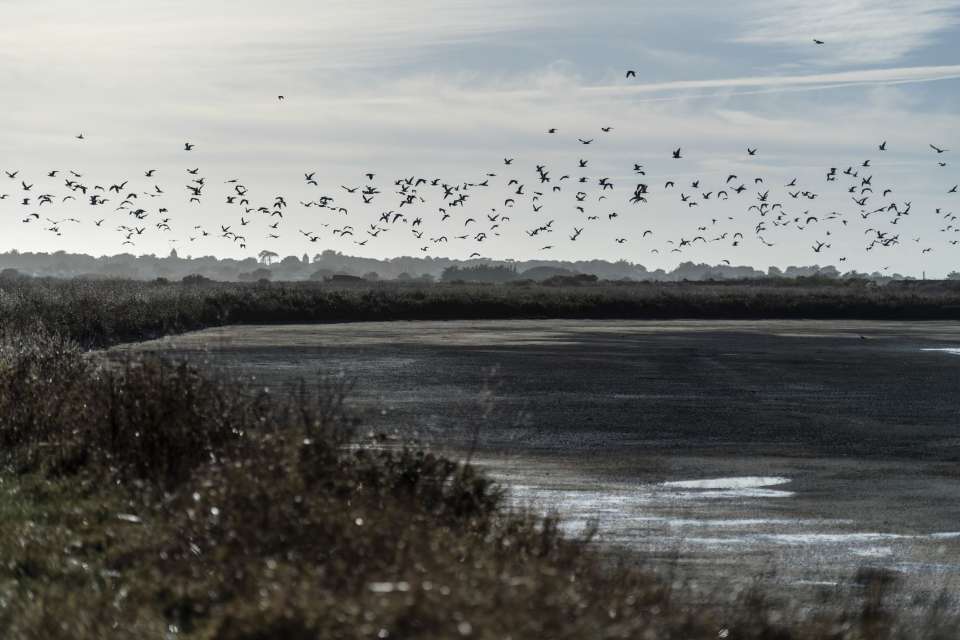
Image context: the lead image uses an official shoreline photograph rather than a plated course because the article's claim starts before the pass. La Marine's cuisine is easier to understand once the marsh edge, tidal exposure, and weathered openness are visible as active forces rather than as postcard backdrop.[1][6]
1. The house style begins at the port
La Marine's lineage is architectural before it is decorative. The official site keeps returning to the same image: a modest port-side house whose sobriety conceals new horizons, and a room that turns the chef's story into a journey close enough to create memory.[1] That sounds romantic until you compare it with the island tourism board's description, which is far more practical. There, La Marine is presented as a harbor-view restaurant that lives to the rhythm of the tides, grounded in a terroir harvested and fished daily on Noirmoutier.[6] Put together, the point becomes clearer. The restaurant does not merely overlook the harbor. It organizes itself by harbor time.
This matters because seaside fine dining often falls into one of two traps. It either becomes generic luxury with some shellfish on top, or it turns "terroir" into a sentimental fog. La Marine avoids both by narrowing its subject. On the current restaurant page, Couillon's cooking is described as a festival of tastes born from his environment and his memories, and the restaurant is explicitly called Marine & Vegetal.[2] Michelin's third-star note sharpens that into a more legible culinary proposition: seafood and shore plants, yes, but filtered through exact braising and a sustainable philosophy rather than through brute abundance.[4]
That is the lineage worth tracing. La Marine did not become distinctive by adding more luxury to island produce. It became distinctive by deciding that the island itself already had enough tension in it: salt and sweetness, exposure and shelter, tide and waiting, catch and scarcity. The restaurant's style grew by learning how to stage those tensions without smoothing them away.[1][2][4][6]
2. Marine and vegetal is a grammar, not a theme
The phrase Marine & Vegetal could easily have become a branding cliché. At La Marine it behaves more like a sentence structure. On the official restaurant page, the progression from land to beach to fire to sea spray shows a kitchen that does not isolate the sea from everything around it.[2] Michelin's 2023 text makes the same point more rigorously by pairing ocean with edible coastal plants and by noting that braising predominates.[4] That pairing matters. A lot of luxury seafood cooking chases clarity through quick sear, raw purity, or immaculate steaming. Braising introduces another register: patience, absorption, and a thicker relation between liquid, flesh, and memory.
The current public menu reinforces that reading. As of May 11, 2026, the restaurant still presents its meals as episode counts rather than as named degustation narratives, with NO.1 at 240 euros and NO.9 at 350 euros, each a single menu for that service.[2] Even without seeing every course in advance, the structure says something about authorship. The meal is not offered as a consumer-facing catalog of signatures. It is offered as a sequence that changes with arrivals and conditions.[2]
This is where La Marine's lineage separates itself from the noisier performance traditions of contemporary fine dining. The house is not built around maximal surprise. It is built around controlled marine compression. Sea ingredients meet shore plants; braise meets salinity; memory meets daily product. The result is a cuisine that feels severe in its editing but not austere in its intent.[2][4]
3. The Erika oyster turned catastrophe into memory
Every great restaurant eventually needs one dish that explains its moral weather. At La Marine, that dish is the Erika oyster. The 50 Best Discovery page gives the compact version: squid ink on an oyster tells of the devastating Erika oil spill.[3] Michelin's dish-history page goes further and makes the association explicit in the title itself, treating the oyster as inseparable from La Marine and tracing it to ecological catastrophe on the coast.[5]
That is a sharper move than ordinary terroir signaling. Plenty of restaurants evoke landscape through herbs, shells, or decorative references to tides. La Marine chose to encode damage as well as beauty. The oyster does not simply say "we are near the sea." It says the sea also arrives with contamination, accident, cleanup, and memory. Once that dish exists, the restaurant's marine language becomes harder and more interesting. The island is no longer a pretty source of ingredients. It becomes a place that has marked the house historically.[3][5]
This helps explain why La Marine feels different from restaurants that treat localism as purity. Couillon's island modernity is not innocent. It knows that coastlines are worked, injured, repaired, and reread. The restaurant's lineage therefore runs through incident as well as inheritance. When Michelin and 50 Best both single out the Erika reference, they are pointing to more than one notable plate. They are identifying the hinge where La Marine's cooking stops being scenic and becomes historical.[3][5]
4. Celine's room turns severity into hospitality
The final piece is the dining room, because La Marine's style could easily become too severe without it. The official site makes this unusually clear. On the team page, Alexandre frames his daily mission around giving, receiving, and transmitting, while Celine is described as present everywhere in the house, deeply invested, gentle on the surface, and central to the signature of the place.[1] The site's values page then says the house tries to put the other person at the center of its attention.[1]
Michelin's third-star announcement confirms that this is not mere house poetry. It specifically points to service orchestrated by Celine Couillon as essential to making the restaurant's sustainable and island-rooted philosophy legible.[4] In other words, hospitality is not an afterthought added to an already complete cuisine. It is one of the mechanisms by which the cuisine can be read at all.
That matters because La Marine cooks with enough compression to risk distance. Braised mackerel, sea lettuce sorbet, squid ink on oyster, edible coastal plants, and shifting episode menus could all drift toward conceptual coolness in the wrong room.[3][4] What keeps the house emotionally live is the opposite force: the feeling, visible across the official pages, that this is a demanding restaurant built by people who still believe care is part of precision.[1][4]
Why La Marine matters in 2026
As of May 11, 2026, the public record still describes La Marine in the same tight terms: a small port house on Noirmoutier, current six- and nine-episode menus, a dining room shaped like a voyage, an island terroir harvested and fished daily, and a three-star identity built from ocean, shore plants, braising, and hospitality rather than from generic grandeur.[1][2][4][6] That consistency is what makes the restaurant worth writing about now.
La Marine did not arrive at significance by abstracting itself away from place. It did the opposite. It became world-class by letting Noirmoutier stay difficult inside the cooking: tides, weather, fish, plants, harbor labor, ecological damage, and memory. The Erika oyster is the clearest emblem of that choice, but the whole house appears to follow the same rule. Beauty is welcome, but it has to carry history.
That is why La Marine's lineage matters beyond one island or one chef. It shows how a fine-dining restaurant can become more modern by getting narrower, saltier, and more answerable to where it stands.
Sources
- Alexandre Couillon official site, covering the port-side house in L'Herbaudiere, the voyage framing, the room's cruise-like atmosphere, the values of the house, and Celine Couillon's central role in hospitality.
- Alexandre Couillon official restaurant page, covering the "Marine & Vegetal" framing, the land-beach-fire-sea-spray language, the current NO.1 and NO.9 tasting-menu formats, menu prices, and the single-menu-per-service structure.
- The World's 50 Best Discovery, "La Marine," covering Noirmoutier as the setting, the fish-heavy cooking, the Erika oil-spill oyster reference, the stripped mackerel presentation, and Couillon's early reference to his mother's apple pie.
- Michelin corporate release, "MICHELIN Guide 2023 - France - La Marine restaurant is highlighted with Three MICHELIN Stars," covering the third-star recognition, the ocean-and-edible-coastal-plants thesis, braising, the Green Star context, and the role of Celine Couillon's service.
- MICHELIN Guide, "Un plat, une histoire : l'huître Erika d'Alexandre Couillon," covering the restaurant's emblematic Erika oyster and its link to ecological disaster on the Noirmoutier coast.
- Ile de Noirmoutier tourism board, "La Marine - Gastronomic Cuisine," covering the harbor-view setting, the rhythm-of-the-tides framing, the daily harvested and fished terroir, and the restaurant's current local presentation on the island.