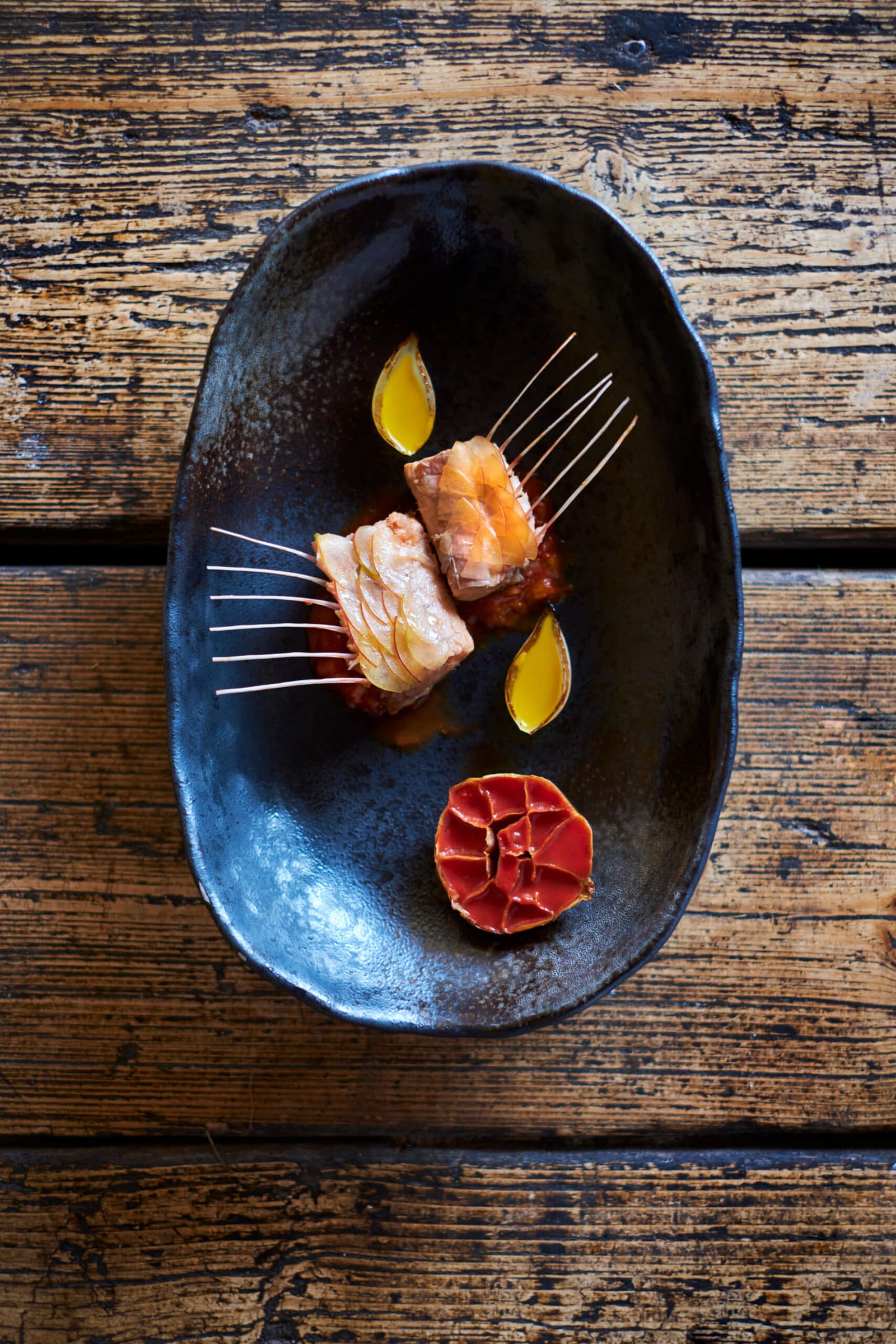
At Mullixhiu, the argument begins before a plate arrives. Wheat clicks through stone mills inside a wood-lined room near Tirana’s Grand Park. Dark bread leaves the oven. On the current menu, the old Albanian pasta forms petka, rosnica, and jufka sit beside veal brain with pickled cabbage, baby goat, and a dinner sequence called Metamorphosis.[2][4][6] This is not nostalgia staged behind glass. It is heritage made to survive prep, payroll, appetite, and another night of service.
That distinction is the center of chef Bledar Kola’s work. After leaving Albania as a teenager and training in European kitchens, he returned with techniques but without a complete written canon to apply them to. The knowledge he needed was dispersed among home cooks, farmers, remembered shortages, regional vocabulary, and dishes that had lost social prestige. Mullixhiu, which opened in 2016, became restaurant, mill, workshop, and public argument at once.[3][4][7]
What follows is a reported Q&A synthesis, not a newly conducted interview. The answers are written in the third person and reconstructed from Kola’s published interviews, the restaurant’s current materials, independent reporting, and its cookbook preview. No first-person reply has been invented.
Why is a mill more useful than a manifesto?
A manifesto can declare respect for grain. A mill has to produce flour every day.
Mullixhiu means “miller,” and the restaurant makes that name physical. Its stone mills are not rustic set dressing added to soften a fine-dining room. They connect several parts of Kola’s thesis: endangered or neglected grains, small producers, the smell and texture of freshly milled flour, bread as Albanian hospitality, and a menu in which cereal is structure rather than a basket placed on the side.[1][3][4]
That structure is visible in the food. The restaurant’s live menu lists fli with sour cream and chestnut honey; meatballs with trahana; petka with chicken and porcini; rosnica with chicken and zucchini; and jufka with porcini and mishavinë cheese.[2] These are not interchangeable starch courses. Each form carries a different technique—layering, fermenting, drying, pan-toasting, simmering—and therefore a different way for memory to become texture.
The mill also prevents “local” from floating away as a luxury adjective. Grain arrives, is transformed on site, and leaves evidence: sound, flour dust, dense crumb, the cook’s repeated labor. Kola can change a garnish or refine a broth, but the restaurant still has to answer a blunt question every morning: what are we milling, and who grew it?
What do you do when the archive is a person?
You begin by admitting that a chef’s résumé is not authority over somebody else’s memory.
When Kola and his brother Nikolin tried to recover older Albanian cooking, they found gaps that professional technique could not fill. AramcoWorld reports that they were directed toward a gjyshe—a grandmother—and that Monda Kalenja became a crucial teacher. Her knowledge came through family access to dishes and methods that many Albanians had not been able to preserve through the communist period’s scarcity and leveling of regional foodways.[3]
The important move was not to extract a few recipes and turn their source into a sentimental footnote. Kalenja remained a named teacher. The brothers widened the work through RRNO, a nonprofit established in 2018 to help define Albania’s culinary heritage. A Tirana event paired 12 grandmothers with 12 chefs; later training brought grandmothers into culinary classrooms to teach students how to roll jufka.[3] In that model, the archive has hands, preferences, disagreements, and the power to correct the chef.
This changes the ethics of “reinvention.” The restaurant may alter proportion, sequence, temperature, or presentation, but it should keep the dependency visible. Kola’s carp tava can become more composed without pretending that the kitchen invented carp, earthenware cooking, or the dish’s regional memory. Fine dining earns room to edit only after it has learned whom to credit.
What did northern Europe give Kola—and what could it not give him?
It gave him permission to take modest ingredients seriously. It could not tell him what Albanian food meant.
Kola’s career is often compressed into a familiar prestige route: migration, London kitchens, stages at Noma and Fäviken, return home. The more useful reading is about tools. The cookbook account describes the impact of kitchens that pursued simplicity through intense work, and Kola’s realization that a region could build contemporary authority without defaulting to foie gras, French cheese, or somebody else’s symbols of luxury.[6] La Vanguardia similarly frames his return as an answer to the prejudice he encountered as an Albanian migrant and to the idea that refinement had to arrive from elsewhere.[7]
But copying a Nordic surface would only replace one imported hierarchy with another. Birch, foraging rhetoric, and pale ceramics cannot reconstruct an Albanian pantry. Kola had to bring the discipline home, then surrender the subject matter to local evidence: bread scarcity remembered from childhood, Ottoman and Mediterranean crossings, mountain dairy, freshwater fish, pasta forms, wild greens, fruit, offal, and the testimony of cooks who never needed a tasting-menu vocabulary.[3][4][6]
That is why his term “gastrodiplomacy” is more interesting than branding.[4][7] A country is not promoted by making its food look French or Scandinavian enough to be legible abroad. It becomes legible when its own ordinary ingredients receive the concentration, research, and hospitality that elite dining has long granted imported luxury.
How can a dish change without becoming rootless?
Keep the relationship, not every historical surface.
Mullixhiu’s official philosophy says preservation requires development, and the current menu makes that claim testable.[1][2] Fli remains fli, but olive-leaf tea can enter its tasting-menu setting. Petka keeps its identity as a local pasta form while chicken, porcini, or wild boar changes the immediate register. Trahana can bind meatballs or appear as its own movement. Carp tava can retain fish, vessel, and memory while being taken apart and recomposed.
The boundary is not “old plate good, new plate bad.” Nor is it “the chef may do anything.” A convincing revision preserves enough of the dish’s grammar that the change creates recognition rather than merely borrowing a name. Ingredient, technique, social use, vessel, sequence, and flavor relationship are all possible anchors. Not every one must remain fixed, but at least some must do real work.
The restaurant’s sharing language matters here. Its own site says the seasonal dishes are designed to be shared.[1] That decision protects a social behavior while individual plates become more controlled. The kitchen can refine a sauce, but if every revision turns communal food into an isolated chef’s monologue, it has preserved ingredients while losing the meal.
Can success make preservation harder?
Yes. A living archive can be crowded out by the economy that discovers it.
The romantic version of Mullixhiu ends with renewed pride: international attention arrives, diners learn unfamiliar names, producers gain demand, and younger cooks see a future in Albanian food. The operating version continues into staff schedules and purchase prices.
In a 2025 interview recounted by Il Fatto Quotidiano, Kola described restaurant workers leaving Albania for better opportunities abroad and called staffing a central problem. He also said he had closed a small farm because its workload had become unsustainable. At the same time, he reported sharp increases in the cost of mishavinë cheese and goat—precisely the kinds of place-specific products that make the restaurant’s thesis tangible.[5] These are Kola’s reported figures and judgments, not a complete survey of Albania’s hospitality economy, but the mechanism is credible: tourism can raise demand for local distinctiveness while making the labor and ingredients behind it harder to retain.
That pressure exposes the difference between an archive and an ecosystem. A recipe can survive as text after a cook leaves. A restaurant tradition needs somebody who can recognize the dough, judge the ferment, call the farmer, train the next station cook, and explain a dish without turning dinner into a lecture. If those people cannot build durable lives around the work, publicity preserves the idea while the practice thins out.
Is Kola’s real legacy a menu?
The menu is the most visible part. The stronger legacy would be a chain of transmission that no longer depends on him.
Mullixhiu’s menu will and should change. The more durable achievements described in the reporting are distributed: Monda Kalenja teaching Kola, Nikolin Kola gathering food history, grandmothers working beside chefs, culinary students learning jufka, farmers finding buyers for grain, and diners discovering that Albanian cuisine is neither a sealed national box nor an underdeveloped copy of its neighbors.[3]
That is also the best test of the restaurant’s success. If the work produces only one famous chef, it has converted scarcity into authorship. If it produces more cooks who can research, disagree, adapt, pay suppliers, and teach, it has converted memory into capacity.
The mills make a good final image because they refuse abstraction. Stones turn only when grain and labor meet. The same is true of a culinary archive. It stays alive not because a dish is declared authentic, but because someone returns tomorrow and knows how—and why—to make it again.
Sources
- Mullixhiu, official restaurant site — current philosophy, seasonal-sharing frame, mill-and-bread identity, and source page for the official reinvented carp tava photograph.
- Mullixhiu, “Menu” — current à la carte dishes, Metamorphosis dinner sequence, Albanian wine list, and listed prices.
- Tristan Rutherford, “Reviving Albanian Traditional Food,” AramcoWorld, January–February 2024 — Kola’s work with Monda Kalenja, RRNO, recipe transmission, culinary education, and communist-era food scarcity.
- “Balkan Beauty: A Gourmet Guide to Albania,” Food and Travel — reported visit to Mullixhiu covering the room, stone mill, bread-centered vocabulary, Kola’s return, and his gastrodiplomacy argument.
- “Bledar Kola parla del turismo in Albania,” Il Fatto Quotidiano, July 7, 2025 — accessible report of Kola’s Gambero Rosso interview on staffing, ingredient costs, the closed farm, and mass-tourism pressure.
- Bledar Kola and Ursula Heinzelmann, New Albanian Cuisine: Mediterranean, Modern, Mullixhiu — publisher’s English cookbook preview covering Kola’s background, kitchen influences, restaurant origins, grain, and recipes.
- Beatriz Navarro, “Bledar Kola, alta cocina albanesa para derribar prejuicios,” La Vanguardia, December 24, 2022 — profile on migration, prejudice, return, culinary pride, and gastrodiplomacy.