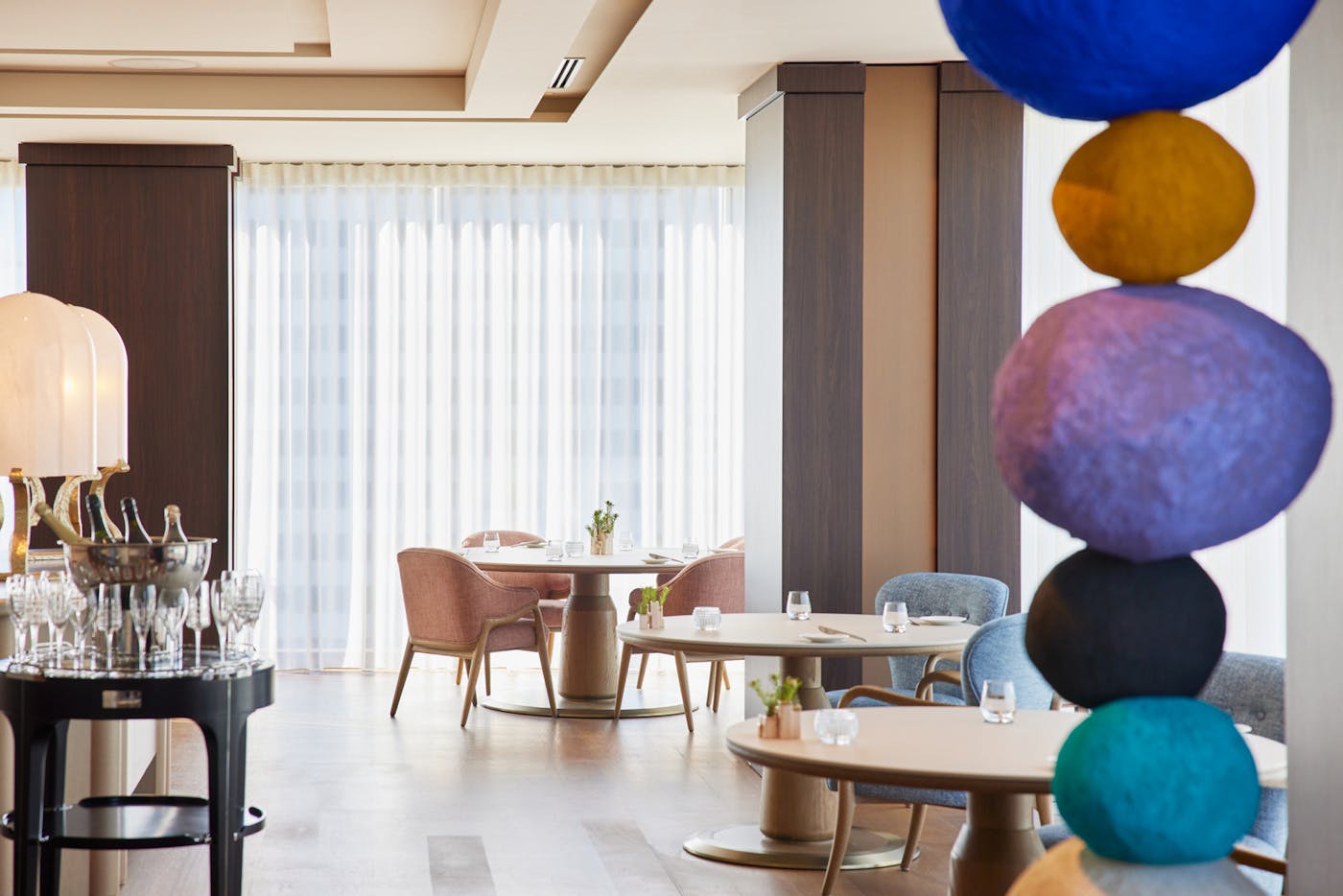
The most interesting thing about SÉZANNE right now is that the restaurant has reached the stage where it has to prove it is bigger than its founding celebrity. As of April 2, 2026, the official team page lists Stephen Lancaster as executive chef, while 50 Best Discovery still frames the room through Daniel Calvert's rise and keeps the restaurant visible at No. 16 in Asia's 50 Best Restaurants 2026 and No. 7 in The World's 50 Best Restaurants 2025.[3][5] That slight split in public materials is not a problem. It is the real test.
Restaurants that are held together mainly by one chef's personal voltage often feel uncertain at exactly this moment. SÉZANNE reads differently because so much of its identity already lives outside biography. The menu language remains fixed on Japan's finest seasonal ingredients, the room still stages French luxury as calm rather than theater, and the bench underneath the top job is unusually strong.[1][2][3][4][6] The better way to read SÉZANNE in 2026 is not as a shrine to a departed signature. It is as a Tokyo restaurant whose grammar is now strong enough to survive a handoff.
1. The new chef matters, but the house style matters more
Lancaster's official biography is revealing because it does not promise a disruptive reset. It describes a cook shaped by technically exacting kitchens such as Midsummer House, Oaxen Krog, and the opening of Poise in Singapore, then defines his food in Tokyo through Japanese seasonality, refined French techniques, and a measured use of fermentation for depth, harmony, and clarity of flavor.[3] That is not the language of a restaurant trying to tear up its foundations. It is the language of continuation through craft.
The current menu page pushes in the same direction. SÉZANNE describes every meal as a celebration of Japan's finest seasonal ingredients and says each dining experience is carefully curated around the time of year and product availability.[2] That sentence matters because it locates authorship in the system before it locates it in the individual. The restaurant is not promising one frozen canon of greatest hits. It is promising a method: French technique, Japanese product calendar, and constant adjustment.
Ashley Caley's current role strengthens that reading. The official team page lists him as executive sous chef and emphasizes the same things Lancaster's bio does from another angle: exceptional produce, seasonality, and a background that runs through Per Se, Marcus Wareing at The Berkeley, Restaurant Sat Bains, and INUA in Japan.[4] In other words, the handoff is landing inside an already international, already disciplined structure. The room has senior muscle memory.
That is why the transition looks credible rather than fragile. SÉZANNE does not need to pretend the founding phase never mattered. It needs to show that what mattered most was not one person's aura, but a way of composing luxury that the next team can continue to sharpen.[3][4]
2. The dining room is part of the argument, not just the backdrop
Plenty of restaurants with French ambitions still overplay grandeur. SÉZANNE's room is more intelligent than that. 50 Best Discovery describes it as minimalist and immaculate, with pastel pink and blue moving across a cream interior designed by Andre Fu.[5] Michelin's inspector feature goes further, describing a Champagne-themed color scheme, matte wooden floors, light-toned carpets and chairs, tall windows softened by lace curtains, and tables finished with Baccarat candles, Christofle silverware, and Raynaud white porcelain.[6]
The important point is not that the room is expensive. Many rooms are expensive. The important point is that SÉZANNE spends its money to lower the pulse. Michelin's inspector says the space feels like being invited into the home of a well-heeled friend rather than pushed into a museum of reverence.[6] That is exactly the right description for a restaurant whose food depends on nuance. A loud room would make the cuisine read smaller. This room gives delicacy a proper acoustic.
The official location page supports that reading more practically. SÉZANNE currently publishes compact service windows: Wednesday to Sunday, 12:00pm to 2:00pm for lunch with last order at 1:30pm, and 6:00pm to 8:00pm for dinner with last order at 6:30pm.[1] That schedule suggests, as an inference from the published hours, a restaurant protecting pacing rather than maximizing turns. SÉZANNE wants the room to stay composed enough that the smallest detail can still register.
3. French technique only works here because Japan sets the calendar
The menu claim about seasonal Japanese ingredients would be generic if the food did not bear it out. Michelin's October 2024 inspector feature is useful because it shows how the house translates that principle into concrete plates.[6] The Comte gougeres have stayed in place since opening, which gives the meal an anchor. Around that anchor, the cooking moves widely: a foie gras terrine that uses Japanese-raised chicken and Chinese soy sauce and spices; duck from Toyohashi, Aichi Prefecture, dried for several days, honeyed on the skin, paired with duck-liver sauce and silky Dijon mustard; and side elements that change with the season, plus a duck-bone soup or duck-thigh stew folded into the same course as part of a zero-waste ethic.[6]
What makes those examples convincing is that none of them read like easy fusion. They read like a restaurant that understands product, technique, and cultural borrowing as one continuous problem. 50 Best Discovery lands on the same pattern from a different angle, describing dishes such as bouillabaisse with Saga saffron and fugu from Yamaguchi Prefecture with fugu shirako and roasted kegani sauce.[5] The official menu page's insistence on curation by season stops sounding like publicity once you put it next to that level of specificity.[2][5][6]
This is where SÉZANNE separates itself from rooms that merely import French prestige into Tokyo. The Japanese side is not garnish. It is the calendar, the ingredient logic, and the constraint that keeps the French side honest.[2][3][6]
4. Why SÉZANNE still feels worth booking now
The rankings tell you SÉZANNE is visible.[5] The official site tells you the room still knows what it wants to be.[1][2][3] Michelin's inspector feature tells you the restaurant has already built a persuasive language of atmosphere, service, and food.[6] Put together, those signals make the present moment less risky than it first appears.
Book SÉZANNE if you want a fine-dining room that keeps authority without stiffness, and if you care about how atmosphere can make precision easier to feel. Book it if you like French cooking most when it accepts other influences without turning them into slogans. Think twice if what you want from Tokyo is extroverted table theater or a meal built around deliberate excess. SÉZANNE's pleasure is quieter than that.
That quiet is exactly why the restaurant looks durable. The handoff matters, but the stronger fact is structural: SÉZANNE already knows how to be itself. In 2026, that may be the most valuable luxury it offers.[1][2][3][4][5][6]
Sources
- SÉZANNE, "Hours & Location." Official page with current address and service windows at Four Seasons Hotel Tokyo at Marunouchi, plus the dining-room photograph used here as image provenance.
- SÉZANNE, "Menu." Official page describing the restaurant's current menu philosophy as a seasonally curated celebration of Japan's finest ingredients and noting dietary-accommodation limits.
- SÉZANNE, "Stephen Lancaster." Official team page naming Lancaster as executive chef and describing his background, Japan-seasonality focus, refined French technique, and measured use of fermentation.
- SÉZANNE, "Ashley Caley." Official team page naming Caley as executive sous chef and outlining his produce-focused, seasonality-driven background across Per Se, Marcus Wareing, Restaurant Sat Bains, and INUA.
- 50 Best Discovery, "Sézanne, Tokyo." Current profile covering the restaurant's 2025 and 2026 ranking markers, Daniel Calvert-era framing, Andre Fu's dining room, and representative dishes.
- MICHELIN Guide, "Inspector Reveals All on SÉZANNE, Tokyo's New Three MICHELIN Stars Restaurant." Inspector feature covering the room design, service atmosphere, signature dishes, seasonality, and the restaurant's rise to three stars.