The Ledbury's second life is easy to tell as a Michelin comeback story. A famous Notting Hill restaurant closed during the pandemic, reopened in 2022, regained two stars in the 2023 guide, and reached three stars in the 2024 guide.[3][4] That arc is true, but it is not the most useful way to read the restaurant now. The more interesting story is operational: The Ledbury became more ambitious after reopening without becoming bigger, louder, or more ceremonial.
That restraint matters in London, where top-end dining can drift toward two kinds of excess. One is visible spectacle: more rooms, more theater, more design signals. The other is invisible overload: more services than the team can sustain, more substitutions than the kitchen can absorb, more bookings than the room can make feel personal. The Ledbury's public evidence points in the opposite direction. Brett Graham talks about the third star as a team result, notes that the restaurant was only open for seven services a week at the time of the award, and frames the goal not as one-time trophy dining but as a place guests return to for special occasions.[3]
That is the key to the current Ledbury. The restaurant's luxury is not sprawl. It is pressure held inside a finite room.
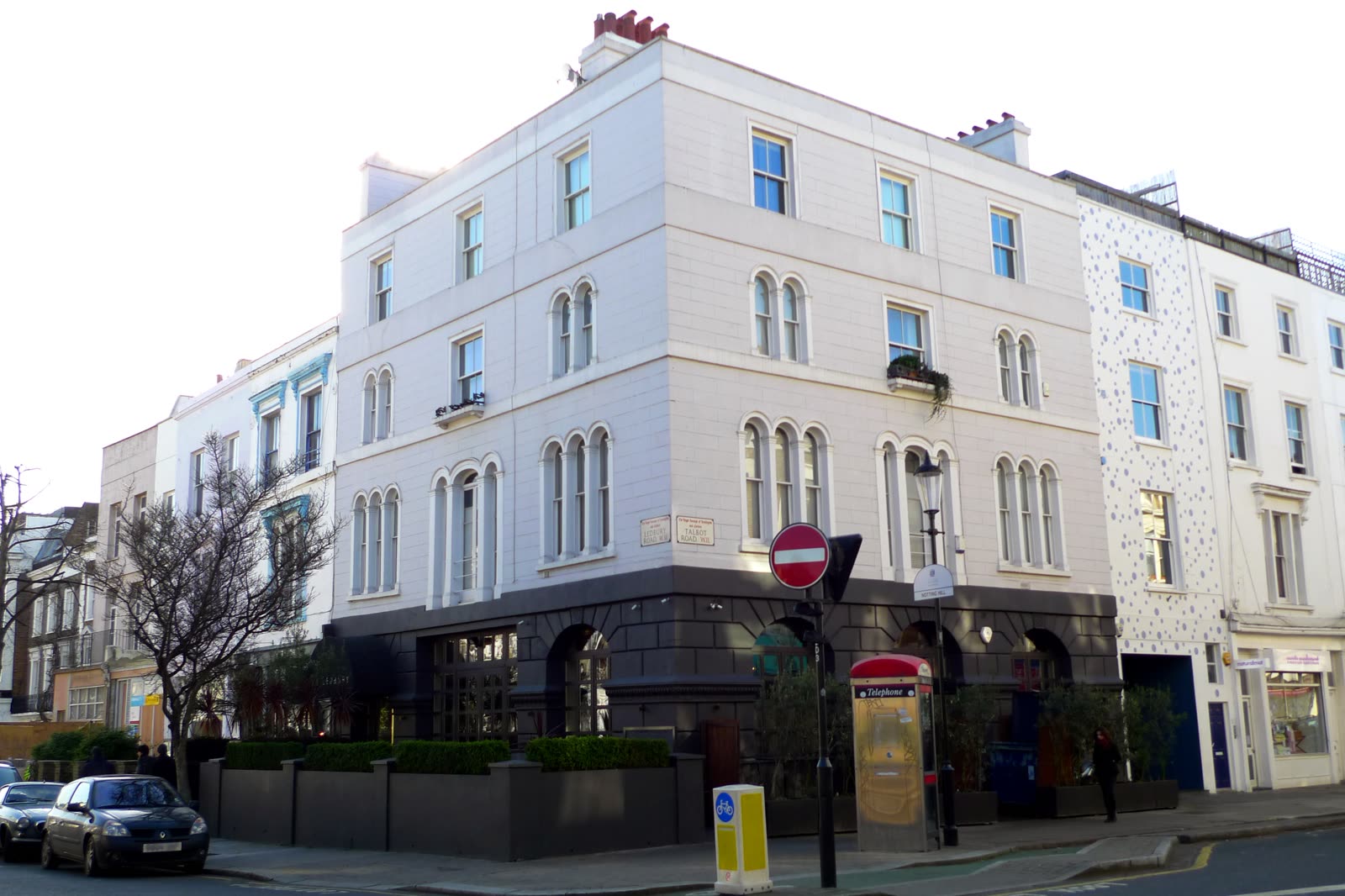
Image context: the cover image shows The Ledbury in 2011, long before the 2022 relaunch and 2024 third star. That older exterior is useful because it keeps the restaurant's scale honest. The current story is not about a new grand address. It is about how a neighborhood room on Ledbury Road rebuilt its internal machinery after a forced pause.[1][6]
The comeback was not just reopening
Great British Chefs' account of the 2024 Michelin announcement gives the public chronology cleanly. The Ledbury opened in 2005, gained its first star within a year, added a second in 2010, closed from 2020 to 2022 because COVID restrictions made its old model impractical, regained two stars in 2023, and then joined the UK's three-star tier in 2024.[4] Those facts explain the headline. They do not explain the mechanism.
The mechanism starts with refusing to treat the hiatus as simple interruption. In Restaurant Online's interview after the third star, Graham says the restaurant had improved significantly over the prior 18 months and that the reopened version had become a longer, more intense tasting-menu experience.[3] That is an important distinction. The Ledbury did not come back by pretending the old restaurant could simply be switched on again. It came back by tightening the product until the higher ambition had an operating base.
The most revealing number in that interview is not the star count. It is the service count. Graham says The Ledbury was open seven services per week, and that even an occasional soft Tuesday or Wednesday mattered financially at that level.[3] That line is more candid than normal prestige messaging. It reminds diners that a three-star restaurant is still a scheduling machine. Staff, mise en place, produce, cellar, rent, and table demand all have to meet at the same time. A room can be globally acclaimed and still feel the economics of one underfilled service.
The third star therefore should not be read as a magic finish line. It is a load test. After the announcement, Graham said hundreds of bookings arrived within an hour.[3] That surge is flattering, but it also creates a new problem: how to absorb demand without letting the restaurant become a victory lap for people who only want to collect the badge. Graham's answer in the interview is telling. He wants guests to return, to use the restaurant for milestones, and to feel that The Ledbury can be "their place" rather than a once-only conquest.[3] That is a service philosophy, not just a marketing line.
The senior team is part of the product
Chef profiles often turn restaurants into single-name stories. The Ledbury resists that flattening because the current evidence keeps pointing to a bench. Graham names head chef Tom Spenceley, general manager Jack Settle, and head sommelier Jan Van Heesvelde as central to the restaurant's improved post-reopening performance.[3] Great British Chefs similarly describes the kitchen as Graham working with Spenceley, sous chefs, and a wider leadership group rather than as one chef alone holding the whole system together.[4]
That matters because the reopened Ledbury is selling a more intense meal than before.[3] Intensity can fail in two directions. It can become kitchen vanity, where the courses escalate but the guest feels managed rather than hosted. Or it can become service softness, where the room is charming but the menu lacks force. The Ledbury's current claim is that it can keep both sides aligned: a longer, sharper tasting menu and a room that still reads as discreet, welcoming, and quietly outstanding.[3][5]
The Staff Canteen's profile gives the longer formation behind that balance. Graham's early route ran from Australia to The Square, where Phil Howard and the team taught him ingredient quality, seasonality, and preparation; The Ledbury then opened in 2005 in a discreet Notting Hill location.[5] That lineage helps explain why the restaurant's present-tense confidence does not look like new-money theatricality. Its grammar is still season, product, sauce, game, vegetables, herbs, and room discipline.
The point is not nostalgia for the two-star era. The point is continuity under changed conditions. The post-2022 restaurant can be more ambitious precisely because its old strengths were never only dishes. They were supply judgment, staff memory, calm service, and a neighborhood scale that keeps the room human.
Produce is an operating system, not a garnish
The most concrete way to see that system is through Capability Graham, the produce and farming network founded by Brett Graham.[2] The official Capability Graham site describes a supply world built around venison, Jersey beef, Iberian pork, charcuterie, wildflower honey, cold-pressed rapeseed oil, and dried floral work, with a stated ethos of regeneration, seasonality, and reverence for the natural world.[2] It also names the project as connected to The Ledbury and The Harwood Arms, and frames Graham as both chef and farmer-collaborator.[2]
That supply story matters because it turns The Ledbury's luxury away from generic rarity. Many expensive restaurants can buy fine ingredients. Fewer can make the ingredient chain feel like part of the restaurant's operating identity. Capability Graham's account of rare white hart deer, Britain's first Iberian pig herd under its ownership, soy-free feed development, Shropshire farming partnerships, rapeseed oil, and dried floral installations shows a restaurant orbit that extends beyond purchasing.[2]
The article should be careful here: Capability Graham is not the same thing as claiming The Ledbury grows or raises everything itself. That would be the wrong purity myth. The stronger claim is organizational. The Ledbury's best product language appears to come from long relationships, producer specificity, and a willingness to treat supply as creative infrastructure rather than a procurement afterthought.[2][5]
This also explains why the room can avoid shouting. If the ingredient chain is strong, the restaurant does not need every course to announce importance through visual noise. Graham's profile in The Staff Canteen emphasizes contemporary French cooking with British seasonal ingredients, game, intriguing vegetables, and obscure herbs and roots.[5] Those are not random luxury words. They are the vocabulary of a restaurant that wants depth to arrive through selection and repetition.
Why seven services tell the story
The most useful Ledbury detail for diners is still the seven-service week.[3] It says that the restaurant is managing scarcity on several fronts at once: table inventory, team stamina, menu intensity, and financial pressure. A more obviously commercial response to post-award demand would be to expand aggressively. Graham's interview suggests a more cautious calculation. More services were possible, but only as a group decision because people have families and lives outside work.[3]
That line is rare in luxury restaurant discourse because it treats staff bandwidth as part of quality control. Fine dining often romanticizes sacrifice until the operating cost disappears from view. The Ledbury's current public posture is more adult. It recognizes that a great room is not sustained by one heroic sprint. It is sustained by a schedule that lets the kitchen, dining room, cellar, and suppliers keep performing at the same level after the announcement fades.
Seen this way, The Ledbury's comeback is less about restoration than calibration. It restored the address, but it changed the pressure inside it. It regained prestige, but it now has to keep that prestige from distorting the room. It deepened the tasting-menu ambition, but it also keeps talking about repeat guests, team credit, produce relationships, and service count.[2][3][4]
That is why The Ledbury still feels interesting in 2026. The restaurant is not trying to make three-star dining feel casual. It is trying to make it feel inhabitable. The difference is large. Casualness would undercut the work. Inhabitability makes the work easier to receive. A guest can feel the seriousness without being trapped inside ceremony.
The Ledbury's strongest current argument is therefore not that it returned to the top. It is that it returned with a tighter sense of what the top requires: a finite room, a serious team, a produce system with roots outside the city, and enough restraint to keep the meal from turning into a monument to its own comeback.[1][2][3][4]
Sources
- The Ledbury, official homepage, current address, contact details, site structure, and image-credit notice.
- Capability Graham, official "Our Story" page, covering Brett Graham's farming and produce network, regenerative ethos, venison, Jersey beef, Iberian pigs, rapeseed oil, floral work, and supplier relationships.
- Joe Lutrario, "Brett Graham: 'It's not my award, it's the whole team's'," Restaurant Online, February 6, 2024, interview covering the third star, team structure, seven-service week, booking surge, and repeat-guest philosophy.
- Great British Chefs, "The Ledbury awarded three stars in 2024 Michelin guide," February 5, 2024, covering the closure, reopening, regained stars, third-star milestone, leadership team, and historical context.
- The Staff Canteen, "3 Michelin Star Chefs: Brett Graham, The Ledbury," February 11, 2024, covering Graham's career path, The Square lineage, Notting Hill opening, cooking style, seasonal British ingredients, and awards history.
- Wikimedia Commons, "File:Ledbury, Notting Hill, W11 (5499132198).jpg," source page for the archival exterior photograph used as the article image.