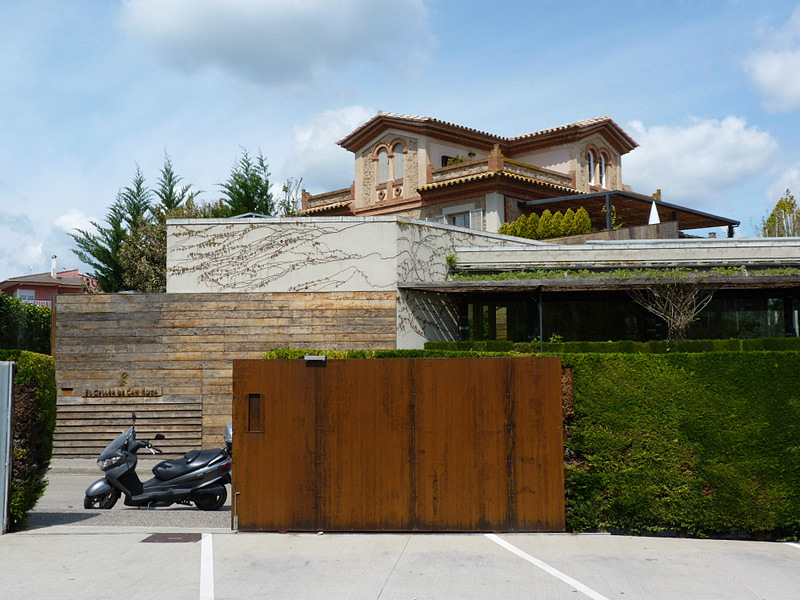
El Celler de Can Roca is usually described through a three-brother shorthand: Joan cooks, Josep pours, Jordi finishes. That is accurate enough for a reservation-site thumbnail, but it understates the most interesting thing about the restaurant. The wine program is not an accessory to Joan's savory kitchen or Jordi's desserts. It is one of the ways the meal thinks.
The official site frames El Celler as a project that has evolved for more than 35 years around repetition, innovation, generosity, and hospitality.[1] That language sounds broad until Josep Roca's role comes into focus. The restaurant's own biography of him says wine at El Celler does not merely accompany the dining room; it becomes inspiration for the conception of dishes.[3] In other words, the pairing is not a final matching exercise after the menu is finished. It is part of the restaurant's grammar.
That distinction explains why El Celler's beverage service has survived the restaurant's long fame. When a cellar becomes famous, the predictable danger is display: a heavy book, trophy bottles, and a guest made to feel either wealthy enough or underprepared. El Celler's stronger move is educational, not ornamental. The restaurant's winery page explicitly rejects wine as luxury label theater and instead describes a cellar visit that should work for wine lovers, teetotalers, children, and older guests alike.[2] The point is not to flatten expertise. It is to make expertise hospitable.
The Pairing Starts Before The Pour
The pairing begins with family architecture. Joan and Josep opened El Celler in 1986 next to their parents' bar, Can Roca; Jordi later joined the project, completing the now-famous three-part structure.[4] The timeline matters because El Celler's wine culture did not arrive as a sommelier department bolted onto an already complete chef's restaurant. Josep's role grew inside the same family system as Joan's cooking and Jordi's pastry.
That is why the best way to read the pairing is not as a list of interesting bottles. It is a service rhythm. A dish can point backward to Catalan memory, sideways to perfume or music, and forward to a dessert logic that has not arrived yet. The drink has to hold those directions without turning the meal into a lecture. When El Celler's own winery page says wine can be tasted, smelled, felt, and even heard, the claim could sound theatrical in isolation.[2] At the table, it becomes practical: the guest needs a language for why a glass changes the temperature, tempo, or emotional color of a course.
This is where Josep's presence is different from the stereotype of the grand-cellar sommelier. His official profile calls him a "wine waiter" while also emphasizing the dining room as one of his two native talents.[3] That pairing of humility and authority matters. The job is not only selection; it is pacing, explanation, permission, and recovery. A great pairing should make an uncertain guest feel more confident, not more examined.
Wine As A Fourth Ingredient
Sotheby's profile captures the mechanical side of this system: the wine list is large enough to require separate white and red volumes brought on trolleys, and the cellar is described at 87,000 bottles.[6] Conde Nast Traveler gives a more diner-facing version, noting a walk-in cellar of about 60,000 bottles and pairings that can include sake as well as wine.[7] The exact count matters less than the operating implication. A cellar at that scale can become a museum. El Celler instead treats it like a pantry with memory.
That pantry changes what the kitchen can write. The official timeline notes a 2010 development that sounds small but is revealing: cooking wine in the dining room, using wines converted into steam to perfume and cook products in front of the diner.[4] Once wine can move from glass to vapor to ingredient to explanation, the usual pairing boundary breaks. The drink is no longer only beside the plate. It can become atmosphere, heat, aroma, and staging.
The same timeline also shows why El Celler's beverage logic is not just about grandeur. Before global rankings, the restaurant was already working on low-temperature cooking, sous-vide precision, perfume translation, smoke, mood, and sensory effects.[4] A wine program in that context has to do more than flatter protein and sauce. It has to deal with texture, scent, memory, and surprise. A sherry can make game feel older and deeper. A Riesling can echo fruit and vegetable notes without making the dish sweeter. Sake can offer a different grain, umami, or temperature logic when grape wine would shout too loudly.[6][7]
The high-wire act is restraint. A famous cellar tempts a restaurant toward maximalism; every course could become an opportunity to prove range. El Celler's better argument is that the cellar gives the room more ways to be exact. Sometimes that means a canonical pairing. Sometimes it means a local bottle whose value is not price but landscape. Sometimes it means giving the guest a non-wine path through the same sensory idea. The winery page's insistence that the cellar should be approachable even to non-drinkers is not a side note. It is a clue to the restaurant's hospitality philosophy.[2]
Geography Becomes Service
The most persuasive detail in the wine program is the way place is turned into service. The official winery page describes five spaces dedicated to five varieties, where visitors can encounter the landscape and sensations those wines evoke.[2] Sotheby's adds that Josep uses regional videos and soil examples in the cellar, turning geography into a kind of sensory classroom.[6] That could be gimmicky if the meal stopped at information. El Celler's advantage is that the geography is brought back to the table as pacing.
This matters because many luxury pairings confuse rarity with meaning. A rare bottle can still be a lazy pairing if it says only, "Look what we have." El Celler's stronger pairings appear to ask a more useful question: what does this glass make legible about the dish? If the answer is acidity, salt, oxidation, soil, flower, smoke, or time, the guest has been given a tool rather than a status symbol.
The restaurant's Michelin listing underscores the same integrated identity from another angle: El Celler remains a three-star Girona restaurant whose 2026 frame is inseparable from the Roca brothers' 40-year anniversary.[5] That longevity changes the job of the wine program. A younger restaurant can shock guests with novelty. A mature restaurant has to keep discovery alive without pretending it was born yesterday. Wine is one of El Celler's best instruments for doing that, because each pairing can connect the old family story to a new bottle, producer, climate, or memory.
The Pairing Is Also A Reservation Argument
For diners, the practical question is not whether El Celler has a great wine program. It is whether the pairing changes the value of the meal enough to matter. Conde Nast Traveler is blunt on the reservation reality: dates open far ahead and demand is intense.[7] If a table requires that much planning, the beverage decision should not be treated as an afterthought made under pressure after the first snacks land.
The best reason to choose the pairing is not simply that the cellar is large. It is that El Celler is unusually built for a guided beverage experience. Josep's role, the dining-room culture, the geographic cellar design, the history of wine as dish inspiration, and the restaurant's long habit of sensory translation all point in the same direction.[2][3][4][6] Ordering one bottle may still be right for a diner who wants control, budget clarity, or a slower relationship with a single region. But the restaurant's full logic is clearest when the glass is allowed to move with the menu.
The pairing also explains why El Celler can remain warm despite its legend. The World's 50 Best places the restaurant in its "Best of the Best" group after No. 1 rankings in 2013 and 2015.[9] Awards at that altitude can harden a dining room. El Celler's beverage program points the other way: toward conversation, farmer stories, terrain, family memory, and the guest's own level of comfort. The cellar is huge, but the ambition is smaller and more difficult. It tries to make each glass feel like a door, not a test.
That is the real beverage lesson from Girona. A pairing is not a scoreboard of bottles. At El Celler de Can Roca, it is a room script: who speaks when, what the guest notices next, how memory crosses from food to glass, and how a famous restaurant keeps hospitality ahead of spectacle.
Sources
- El Celler de Can Roca official homepage, current English site overview of the restaurant project and Roca universe.
- El Celler de Can Roca, "The winery of the Celler," official explanation of Josep Roca's cellar philosophy, sensory approach, and five dedicated wine spaces.
- El Celler de Can Roca, "The Roca Brothers," official biographies covering Joan, Josep, Jordi, Josep's dining-room role, and wine as an inspiration for dishes.
- El Celler de Can Roca, "Roca Timeline," official chronology covering the 1986 opening, 2007 relocation, third Michelin star, wine-steam dining-room technique, and World's 50 Best milestones.
- MICHELIN Guide, "El Celler de Can Roca - Girona," current listing for the restaurant's three-star status and 2026 anniversary framing.
- Sotheby's, "The Epicurean's Atlas: El Celler de Can Roca," profile covering the brothers' roles, the large wine cellar, pairings, and cellar education context.
- Conde Nast Traveler, "El Celler de Can Roca," restaurant review covering reservations, cellar scale, wine pairings, sake, and dining-room experience.
- Wikimedia Commons, "File:El Celler de Can Roca exterior.jpg," 2012 exterior photograph by e_calamar via Flickr, used as the article image.
- The World's 50 Best Restaurants, "Best of the Best: El Celler de Can Roca," awards profile covering the restaurant's No. 1 rankings in 2013 and 2015.