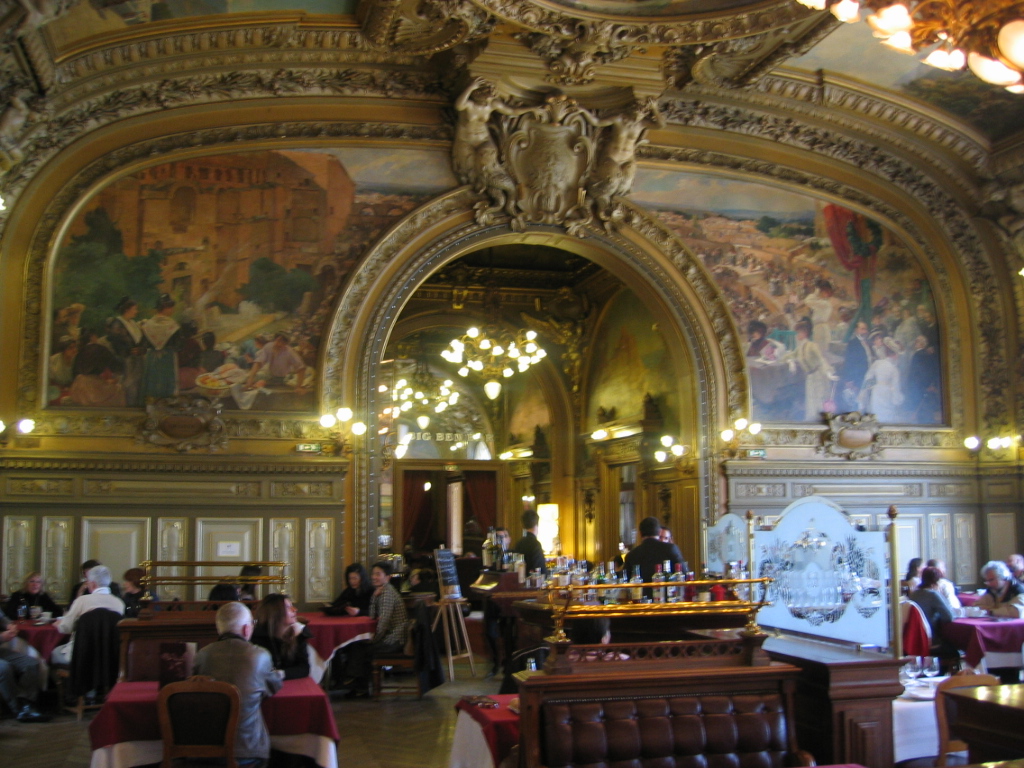
Le Train Bleu should not work as well as it does. A railway-station restaurant is supposed to be practical before it is beautiful: a coffee before the platform, a sandwich after a delay, a table chosen because the bags are heavy and the clock is rude. Le Train Bleu, on the first floor of Paris's Gare de Lyon, keeps that transit logic but dresses it in chandeliers, gilding, murals, red upholstery, and the theatrical confidence of a room that knows people will look up before they look at the menu.[1][2]
That tension is why the restaurant remains useful to talk about in fine dining. It is not the most experimental table in Paris, and treating it like a hidden gastronomic laboratory misses the point. Its achievement is stranger: it turns the old station buffet into a ceremony without severing it from the station. The room can host a birthday lunch, a business dinner, a tourist pilgrimage, or a traveler with one carefully protected hour. The luxury is not escape from movement. The luxury is movement made graceful.
A Buffet Built To Impress
The official history places the restaurant's origin in the 1900 Universal Exhibition moment, when the station buffet was built as part of Gare de Lyon's grander public face; architect Marius Toudoire, already tied to the station's clock tower and facade, was given the job.[1] It opened in 1901 under President Emile Loubet and began as the "Buffet de la Gare de Lyon," a name that sounds plain only if you ignore what railway stations meant in the Belle Epoque: engines, empire, luggage, timetables, resort travel, and the promise that modern speed could still have manners.[1]
The later name matters. In 1963 the buffet became Le Train Bleu, a reference to the Paris-Vintimille line and the Riviera-bound train imagination attached to it.[1] That renaming did not merely add romance. It clarified what the room had been selling all along: not only lunch, but departure as a mood. The murals of destinations and landscapes turn the walls into a map of elsewhere. The station outside supplies the sound of real travel. Between them sits the diner, temporarily convinced that a sauce, a carving trolley, or a glass in the bar can stretch a schedule into an occasion.
The French state has treated the room as more than restaurant decor. The Ministry of Culture's heritage notice for Gare de Lyon identifies the station buffet, including the golden salon, main room, Tunisian and Algerian salons, passageways, and their decor, as protected by a 1972 classification order; it calls the buffet an example of official art from 1900 and notes that it now houses Le Train Bleu.[3] That legal frame changes the stakes. The restaurant is not simply maintaining a brand look. It is feeding people inside a protected decorative argument about public grandeur.
The Food Has To Behave Like The Room
Le Train Bleu's current positioning is smart because it does not pretend the correct answer is tiny, silent food. The official site presents the kitchen in collaboration with Michel Rostang and describes a cuisine rooted in French tradition, seasonal ingredients, broths, stocks, stews, sauces, sharing, carving, and flambeed service.[2] Those words are not incidental. They are exactly the kind of cooking that can survive a huge room.
A whispery tasting menu would be swallowed by the ceiling. What the room wants is visible hospitality: a server carving with intent, sauce carried with confidence, a dish that can meet gilding without looking embarrassed. The food has to offer enough classical weight to avoid becoming background catering, but enough flexibility to serve the mixed clientele that a station produces. That is the Le Train Bleu contract. It is grand, but not monastic. It is theatrical, but it still knows that someone may have a train.
Michelin's guide to the return of Paris brasseries and bouillons makes the broader context clear, placing Le Train Bleu among rooms where spectacle, history, and accessible conviviality still matter in the city; the guide singles out its setting above Gare de Lyon and its gilt-trimmed interior rather than presenting it as a chef-counter laboratory.[4] That is the right category. Le Train Bleu is a luxury brasserie with a monument's memory, not a temple of tasting-menu abstraction.
This is also why the station location is a feature, not a compromise. In a closed destination restaurant, time often belongs to the kitchen. At Le Train Bleu, time is negotiated among the kitchen, the server, the table, and the railway clock. The restaurant's published hours, including lunch, dinner, and a lounge bar that starts earlier and runs through the evening, keep it connected to practical use as well as ceremony.[2] The room may look removed from daily Paris, but its operating shape remains useful.
Why It Still Feels Alive
Preserved rooms can become embalmed. Le Train Bleu avoids that fate when service keeps the decor in motion. A mural only asks to be admired; a dining room asks to be used. The difference is the clink, the coat rack, the bag tucked beside a banquette, the server judging whether a table wants performance or speed, the way a lunch reservation can still carry the faint anxiety of a departure board downstairs.
That living friction is the restaurant's best defense against nostalgia. The protected decor gives it authority, but the station gives it interruption. People arrive with different levels of attention. Some have come to inspect the ceiling. Some have come because a parent remembered it. Some have come for the old-fashioned pleasure of a carved or sauced dish in a room that refuses minimalism.[2][5] Some are simply between places. Le Train Bleu has to make all of those uses feel plausible under the same painted sky.
The room also makes an argument about what fine dining can preserve. Preservation is often discussed as if the object were the only thing at risk: the painting, the molding, the chandelier, the classified salon. But the more fragile object may be a style of public restaurant service that accepts grandeur without embarrassment. Many contemporary restaurants solve intimacy by shrinking the room and narrowing the menu. Le Train Bleu solves it by hosting scale. It makes a big public interior feel personal enough for a table of two because the choreography is legible: greeting, seating, water, wine, carving, sauce, dessert, bill, departure.
There is a trap here, of course. A beautiful room can forgive too much. Diners may accept ordinary cooking because the ceiling is extraordinary. The serious version of Le Train Bleu has to resist that temptation by making the classic repertoire feel cared for rather than merely available. The official emphasis on stocks, broths, seasonal products, and tableside gestures is promising precisely because those are labor signals.[2] They tell the guest that the spectacle is not only overhead.
The Case For Going Now
Le Train Bleu matters now because fine dining has become very good at controlled intimacy. The 12-seat counter, the chef's table, the deposit-only menu, the silent plating room, the single narrative arc: these are familiar prestige tools. Le Train Bleu belongs to another lineage. It is public, loud by comparison, architecturally excessive, historically burdened, and impossible to detach from ordinary travel. That makes it feel newly interesting.
The best meal there is probably not the one in which a diner asks whether it can compete with Paris's sharpest gastronomic rooms. The better question is whether any other room can deliver this particular overlap: a working train station, a protected Belle Epoque interior, classical French service, and the sense that lunch can be both pause and departure.[1][2][3] The answer is not many.
That is why Le Train Bleu's luxury is more durable than novelty. Novelty has to keep changing the plate. Le Train Bleu has to keep a ritual alive without letting it harden into museum behavior. When it works, the room does not freeze time. It civilizes it for ninety minutes, then sends you back downstairs to the platforms.
Sources
- Le Train Bleu, "History" - official account of the restaurant's 1900 construction, 1901 opening, architect Marius Toudoire, 1963 renaming, and 1972 historical-monument recognition.
- Le Train Bleu, official home page - current restaurant positioning, Michel Rostang collaboration, French-service language, cuisine in sauces, stocks, broths, sharing, carving, flambeed dishes, and opening hours.
- French Ministry of Culture, POP notice PA00086570, "Gare de Lyon" - heritage listing for the Gare de Lyon buffet rooms and decor that now house Le Train Bleu.
- Michelin Guide, "The Return of Brasseries and Bouillons in Paris" - contextual placement of Le Train Bleu within Paris's brasserie revival and station-room spectacle.
- Arnaud 25, "Train bleu 05.jpg," Wikimedia Commons - 2008 public-domain photograph of the Le Train Bleu dining room used as the article image.