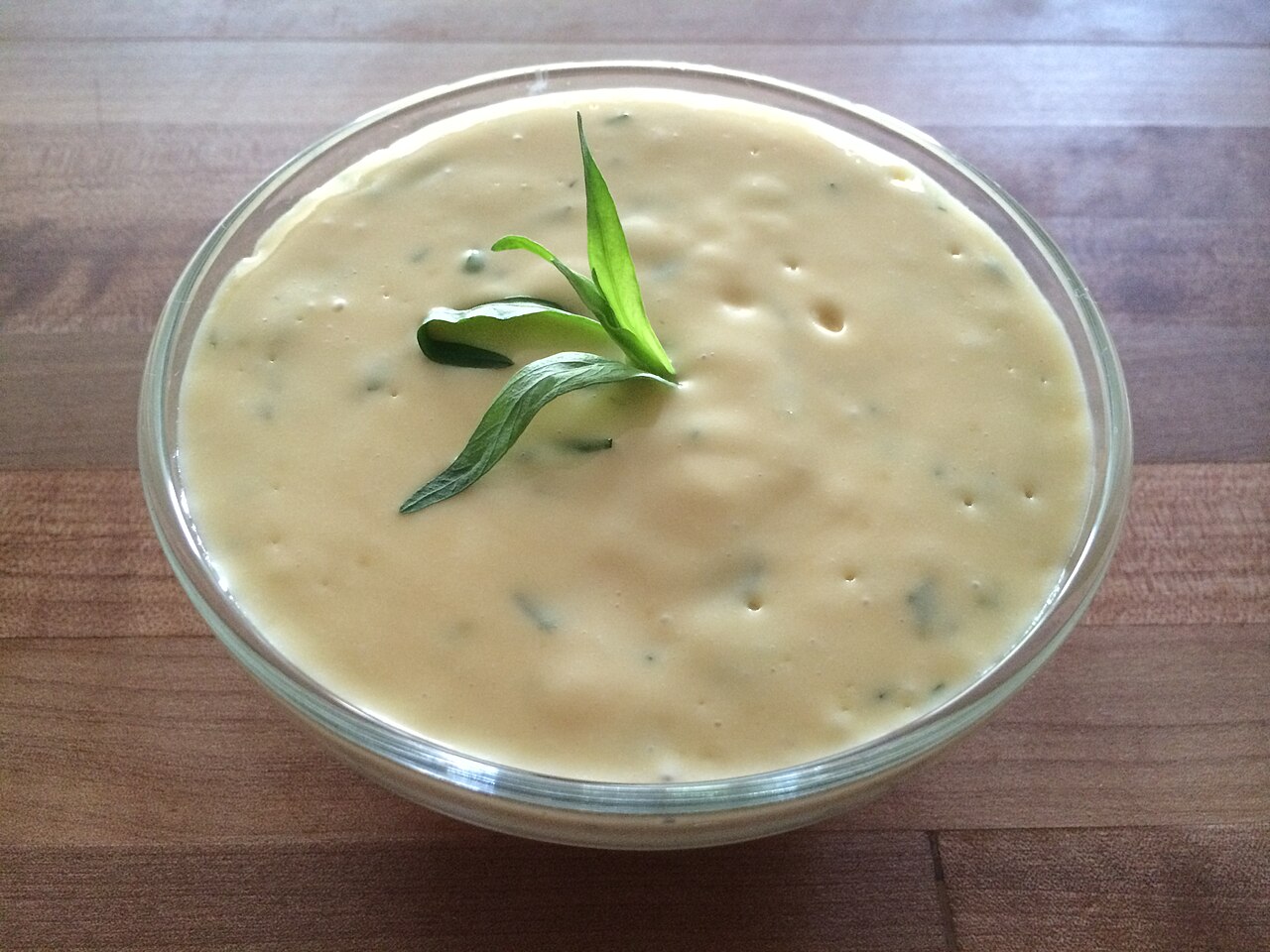
Bearnaise is often treated as the steakhouse answer to luxury: yellow sauce, grilled beef, a little tarragon, the reassurance of old French technique. That undersells it. The sauce is interesting because it is unstable by design. It asks acid, herb perfume, egg yolk, heat, and butter to hold together in a warm state just long enough for the plate to make sense.
That instability is what gives Bearnaise its fine-dining value. Caviar can be spooned. Truffle can be shaved. A sauce like this has to be made, held, watched, and served while its structure is still alive. It is not expensive because the ingredient list is extravagant. It is expensive because the room is buying attention.
Great British Chefs' method gives the practical skeleton: white wine vinegar, lemon juice, tarragon, shallot, egg yolks, clarified butter, seasoning, and a reduction that is boiled down before the yolks and butter enter the picture.[1] Escoffier Online's version keeps the same family resemblance, with butter, peppercorns, onion, eggs, tarragon, parsley, lemon, tarragon vinegar, water, salt, pepper, and cayenne.[2] The lists vary, but the grammar does not. Bearnaise begins as a sharp, aromatic reduction and ends as a butter sauce that still remembers the sharpness.
That is the key. A weak Bearnaise tastes like melted butter wearing herbs. A good one tastes like butter disciplined by vinegar.
The sauce starts before the butter
The first craft decision is the reduction. Shallot, pepper, vinegar, wine or lemon, and tarragon stems are not garnish. They are the frame that prevents the finished sauce from becoming heavy. Great British Chefs reduces the vinegar, lemon, tarragon, and shallot mixture by half, then cools and strains it before whisking in yolks over gentle heat.[1] That sequence matters because the acidity must be concentrated before the emulsion is built.
Fine dining loves reductions because they compress flavor without adding bulk. Bearnaise makes that logic unusually visible. The reduction is small, almost invisible in the finished sauce, but it decides whether the butter has direction. Too little reduction and the sauce turns plush but dull. Too much and the sauce becomes sharp in a way that fights the steak, fish, asparagus, or potato underneath it.
This is why the herb choice matters. Epicurious frames Bearnaise as a descendant of hollandaise but separates it by its acid and seasoning: white wine vinegar rather than the cleaner lemon profile, plus shallots, black pepper, and tarragon rather than hollandaise's simpler seasoning lane.[3] Tarragon is not just a green fleck here. Its anise-like edge gives the sauce a high note that can survive the butter.
Warmth is the danger
Bearnaise belongs to the family of sauces that punish impatience. The yolks need enough heat to thicken and bind. They cannot take so much heat that they scramble. The butter has to enter slowly enough to disperse into the water phase held by the yolks. The cook is not merely mixing ingredients; the cook is managing a boundary.
That boundary is why the sauce still reads as restaurant craft in an age of sous-vide precision, pacojets, centrifuges, and hydrocolloids. The technique is old, but the failure mode is immediate. A split Bearnaise does not hide. The surface turns greasy, the mouthfeel becomes coarse, and the plate suddenly feels neglected.
The New Yorker essay on Bearnaise is useful because it treats those failures as part of the sauce's identity: breaking, thickening too far, and balancing acid against richness are not side problems but the work itself.[4] That is exactly why a proper dining room can make the sauce feel luxurious without changing its basic form. The luxury is controlled risk.
Tarragon keeps the butter honest
Bearnaise is also a reminder that richness needs opposition. Butter gives gloss and roundness. Yolks give body. Vinegar gives cut. Pepper gives a low prickle. Tarragon gives lift. When those pieces are in balance, the sauce does not sit on top of food like a blanket. It lengthens it.
With steak, Bearnaise works because the vinegar and herb sharpen fat instead of adding more fat for its own sake. With fish, it can be more delicate: the sauce has to be lighter, warmer than hot, and bright enough not to smother the flesh. With asparagus or potatoes, it becomes a lesson in restraint. The sauce should make the vegetable feel more complete, not turn it into a delivery system for butter.
Daily Maverick's discussion of the Larousse version helps explain why the herb profile can feel more complex than the simplified steakhouse memory suggests: alongside expected tarragon, the recipe context includes herbs such as chervil, thyme, and bay in some formulations.[5] Those variations are not random embellishment. They show the same underlying aim: aromatic structure has to keep the emulsion from becoming merely rich.
Why it still belongs in fine dining
Bearnaise survives because it makes service visible without requiring theater. There is no flame, press, trolley, or tableside carving. The drama is subtler: a sauce arrives smooth, warm, fragrant, and temporary. It tells the diner that someone paid attention at the stove and then kept paying attention until the plate left the pass.
That makes it a useful test for contemporary restaurants. Many tasting menus now build drama through scarcity, fermentation, foraged ingredients, or highly designed plating. Bearnaise comes from a different school. It says that a room can earn luxury by executing a short sequence with no hiding place: reduce, strain, warm, whisk, emulsify, season, hold, serve.
The sauce also resists the fake humility of "just classic" cooking. Classics are not easier because they are familiar. They are harder because diners already know what failure tastes like. A broken Bearnaise, a dull hollandaise, a heavy beurre blanc, or a gluey mayonnaise all reveal the same truth: emulsion is not a recipe category so much as a promise of care.
That is why Bearnaise still feels alive. Its ingredients are ordinary enough to make the craft legible, and its structure is fragile enough to make the craft matter. When it works, the sauce does not announce modernity or nostalgia. It simply holds acid, herb, egg, heat, and butter in one glossy sentence, then asks to be eaten before the sentence falls apart.
Sources
- Great British Chefs, "How to Make a Bearnaise Sauce" - ingredient ratios and classic reduction, yolk, and clarified-butter method.
- Escoffier Online, "Bearnaise Sauce Recipe" - classical ingredient set including butter, peppercorns, onion, eggs, tarragon, parsley, lemon, tarragon vinegar, and seasoning.
- Epicurious, "Bearnaise Sauce" - explanation of Bearnaise as a hollandaise descendant distinguished by vinegar, shallots, pepper, and tarragon.
- Helen Rosner, "Bearnaise, the French Sauce That Makes Ordinary Food Spectacular." The New Yorker, 2020 - essay on the sauce's pleasure, failure modes, and balance of acid, butter, and technique.
- Tony Jackman, "Throwback Thursday: Bearnaise." Daily Maverick, 2022 - discussion of Larousse-style Bearnaise, tarragon, reduction, and herb complexity.
- Wikimedia Commons, "File:Bearnaise sauce with Tarragon garnish.jpeg" - real photographic image used for this article.