At Lasai, the expensive surprise is not the price of dinner. It is how little of the usual fine-dining machinery you are asked to admire.
This is a two-star restaurant in Rio de Janeiro that has moved in the opposite direction from large-room prestige. Michelin's current listing describes a house with just 10 seats, a synchronized start for every guest, and a vegetable-led opening sequence built from the chef's gardens in Itanhangá and Vale das Videiras.[2] Michelin's travel profile adds the key operational fact behind that feeling: after opening in 2014, Lasai later shrank from 45 covers to 10, relocating only a few meters away but rebuilding the night around an intimate L-shaped marble counter.[3] That choice explains why Lasai matters in 2026. The restaurant is not trying to prove Brazilian fine dining can imitate the grand European room. It is proving that luxury can feel calmer, smaller, and more direct without losing intensity.[1][2][3]
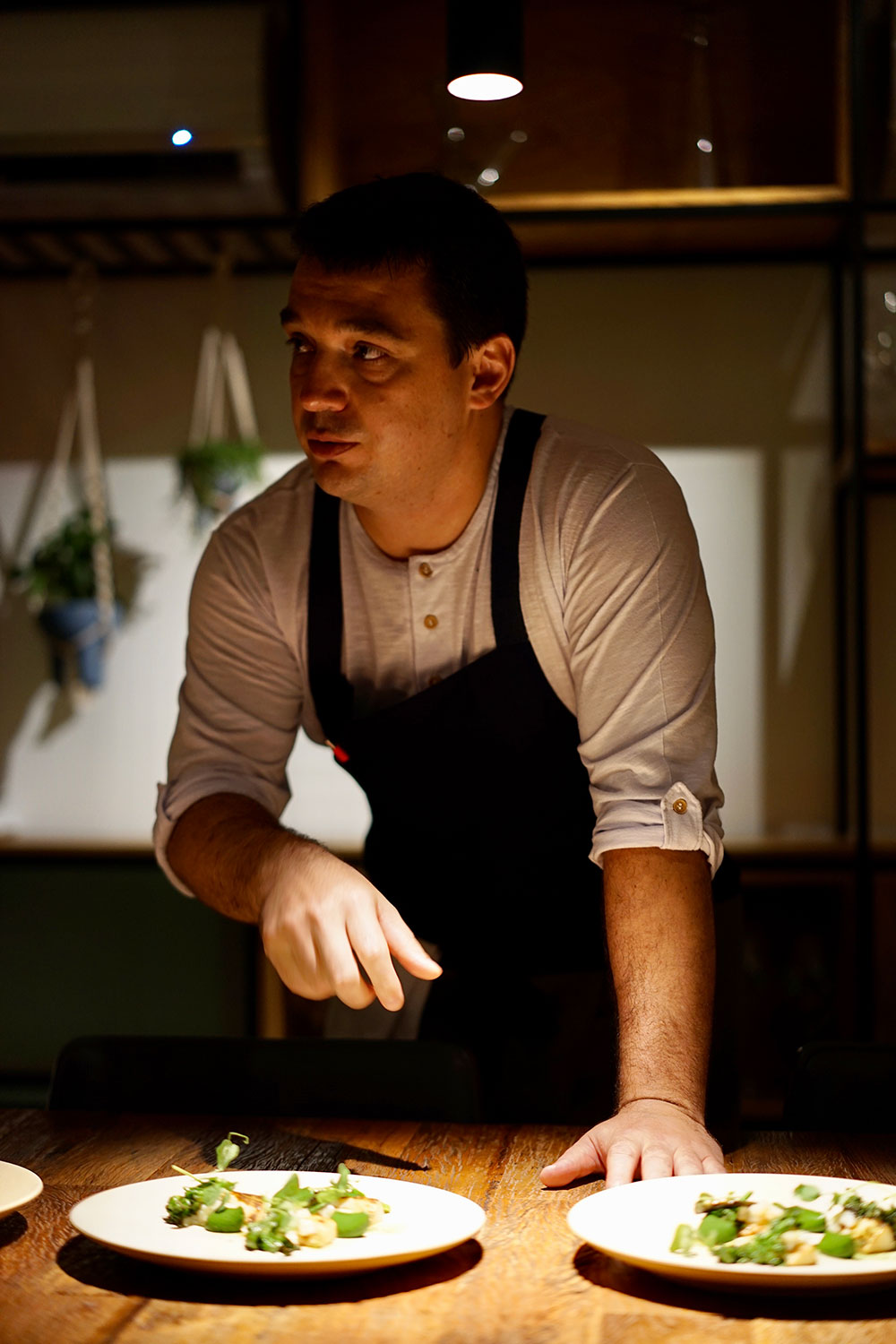
Image context: the lead image uses an official Lasai photograph of chef Rafa Costa e Silva plating at the counter. It works because this restaurant's identity lives in direct, close-range interaction between chef, guest, and plate rather than in a distant dining-room spectacle.[5]
The small room is the philosophy
Lasai's own English homepage already points toward this in its tone. The restaurant describes itself as vibrant and sensual, rooted in Brazilian ingredients from the chef's own gardens and small farmers in Rio de Janeiro, while insisting that service should be efficient and "without bravado," leaving the food as protagonist.[1] That last phrase is more important than it looks. Plenty of restaurants say hospitality is warm; far fewer define warmth as the refusal of theatrical ego.
Once you place that sentence beside Michelin's current write-up, the room starts to make more sense.[1][2] A 10-seat counter means there is almost nowhere for empty choreography to hide. Every move is visible. Every delay is legible. Every course arrives under conditions where conversation between the kitchen and the guest can stay precise rather than ceremonial. Michelin's inspectors describe the dinner as "like attending a show," but the useful part of that comparison is not spectacle; it is proximity.[2] Lasai gives you the front row, then strips away the stiffness that often comes with that seat.
The 2025 Michelin travel feature sharpens the point further by describing the present Lasai as an intentionally more personal room than the original address, with many dishes meant to be eaten by hand and a spirit that is "laid-back yet refined."[3] In other words, the reduction in seats was not a defensive downsizing move. It was the house becoming more exactly itself.
The gardens are not backdrop; they are the house grammar
The phrase "farm to table" is so overused in restaurant writing that it often stops telling you anything. At Lasai, the sourcing system still has explanatory power because the restaurant keeps making it operational. The homepage says the two gardens are the basis of inspiration and constant menu change, with each new season pushing the team toward new dishes.[1] Michelin's listing confirms that the opening vegetable sequence is sourced mainly from those same gardens and presented in multiple textures and forms.[2]
That combination matters because it tells you where the meal gets its authority. The produce does not arrive as a moral decoration or a token opening act before the expensive proteins take over. It sets the grammar of the evening. Even the 50 Best Discovery page, which necessarily compresses the story into a short profile, presents Lasai as a farm-to-table experience operating from a restored colonial townhouse, with vegetable-led cooking and warm hospitality as part of the identity rather than side notes.[4]
This is where Lasai separates itself from restaurants that use local produce as soft branding while still building the emotional center of the meal around imported prestige. Michelin's travel piece is unusually direct about that divide: Lasai foregrounds local ingredients rather than globally coded luxury products such as truffles and caviar.[3] That does not mean asceticism. It means editorship. The restaurant narrows the field of attention so Brazilian produce can arrive with more force.
Basque training matters here because it is used as an editing tool
Lasai means "tranquil" in Euskera, the Basque language, and both the official site and Michelin link that name to Rafa Costa e Silva's formative years abroad before returning home.[1][2] Michelin's travel profile fills in the larger arc: he spent ten years outside Brazil and worked with major international chefs, including Andoni Luis Aduriz at Mugaritz, before opening Lasai in Rio.[3]
That history could have produced a familiar kind of cosmopolitan fine dining, one where local ingredients are filtered through imported hierarchy until the room feels globally interchangeable. Lasai seems more interesting because the training is used differently. The Basque connection does not erase Rio; it gives the chef a tighter editing discipline for Rio. You can feel that in Michelin's description of dishes built from only a few pristine ingredients and in the official site's insistence on an atmosphere that is modern and elegant yet still welcoming and informal.[1][3]
The result is a restaurant that feels internationally fluent without sounding translated. The techniques are modern, the sequencing is exact, and the room clearly understands contemporary global fine dining. Yet the center of gravity stays local: gardens, small farmers, Brazilian seafood, and a service style that refuses overstatement.[1][2][3]
Why the night feels calm instead of solemn
Many ambitious tasting-menu restaurants confuse seriousness with heaviness. Lasai appears to understand that intimacy works better when pressure is removed from the wrong parts of the evening. The synchronized service start noted by Michelin creates discipline, but the tone remains relaxed because the room is so small and the service brief is so clear.[2] The official site's phrase "without bravado" becomes almost a management principle here.[1]
That matters for the guest experience. In the larger fine-dining economy, exclusivity often arrives wrapped in friction: long explanations, luxury-signaling ingredients, or a dining room that asks the guest to admire the institution before the cooking. Lasai seems to invert that order. The 50 Best Discovery page emphasizes warm hospitality, while Michelin's travel profile presents the current room as one where refinement is filtered through carioca ease rather than through cold ceremony.[3][4]
Even the wine side fits that reading. Michelin's listing specifically points to pairings chosen by Maíra Freire.[2] In a room this small, that detail matters because pairing is no longer an auxiliary department attached to the food; it becomes part of the same tightly edited conversation. The whole dinner reads less like a parade of luxury signals and more like one continuous argument about what Brazilian fine dining can feel like when almost every unnecessary layer has been removed.
Why Lasai matters now
By 2026, Lasai no longer needs to be framed as an emerging curiosity. Michelin's current two-star listing gives it one axis of authority, and 50 Best Discovery places it inside the current global and Latin American conversation around elite dining.[2][4] But those accolades are only the surface reason to care. The deeper reason is that Lasai has found a way to make compression feel abundant.
Ten seats sounds narrow. Two gardens sounds modest. A menu built around vegetables before anything else sounds restrictive if you read it through old luxury assumptions. At Lasai, those same constraints create concentration. The smaller room increases attention. The gardens intensify seasonality. The lighter hand on ceremony lets the guest notice texture, pacing, and ingredient identity more clearly.[1][2][3]
That is why the restaurant profile resolves around calm. "Tranquil" is in the name, but it is also in the operating system.[1][2] Lasai's luxury is not based on quantity, noise, or distance. It is built from closeness: chef to guest, garden to counter, ingredient to plate. In a fine-dining era that often mistakes escalation for progress, that feels like a durable idea.[1][3][4]
Sources
- Lasai, official English homepage and restaurant overview, including the house description, service philosophy, and notes on the two gardens in Itanhangá and Vale das Videiras.
- MICHELIN Guide, "Lasai - Rio de Janeiro - a MICHELIN Guide Restaurant," current listing covering the 10-seat format, vegetable-led opening sequence, the chef's gardens, Maíra Freire's pairings, and synchronized service timing.
- MICHELIN Guide, "A Culinary Journey Through Rio de Janeiro with Chef Rafa Costa e Silva," on Lasai's 2014 opening, the later move from 45 covers to 10, the L-shaped marble counter, and the restaurant's local-ingredient focus.
- 50 Best Discovery, "Lasai - Rio de Janeiro - Restaurant," discovery profile noting the restored townhouse setting, current list placements, and Lasai's vegetable-led identity and hospitality.
- Lasai official gallery photograph of chef Rafa Costa e Silva at the counter, used as this article's lead image.