Istanbul's most convincing fine-dining story is not a race to imitate Paris, Copenhagen, or Tokyo at higher prices. It is a quieter and more interesting line about what happens when Turkish memory, Anatolian product, and metropolitan confidence start speaking the same language.[1][2][3][4] There is no formal manifesto office for this movement, and the phrase "New Anatolian" does not function like a protected school name. The lineage has to be reconstructed from how the restaurants describe themselves. Read side by side, though, the sequence is hard to miss. Mikla named the ambition in 2012. Neolokal pushed that ambition toward preservation and inheritance. TURK made it hotter, more personal, and more visibly chef-authored.[1][2][3][4]
That sequence matters because it explains why Istanbul feels different from cities whose luxury rooms still rely mainly on imported codes. Here, the strongest restaurants are trying to make local product, local memory, and local speech patterns carry the prestige load. The result is not one uniform style. It is a family resemblance: ingredients from across Anatolia, an insistence that old recipes still have unfinished future value, and a refusal to treat Turkishness as rustic background while "serious" technique happens elsewhere.[1][2][3][4]
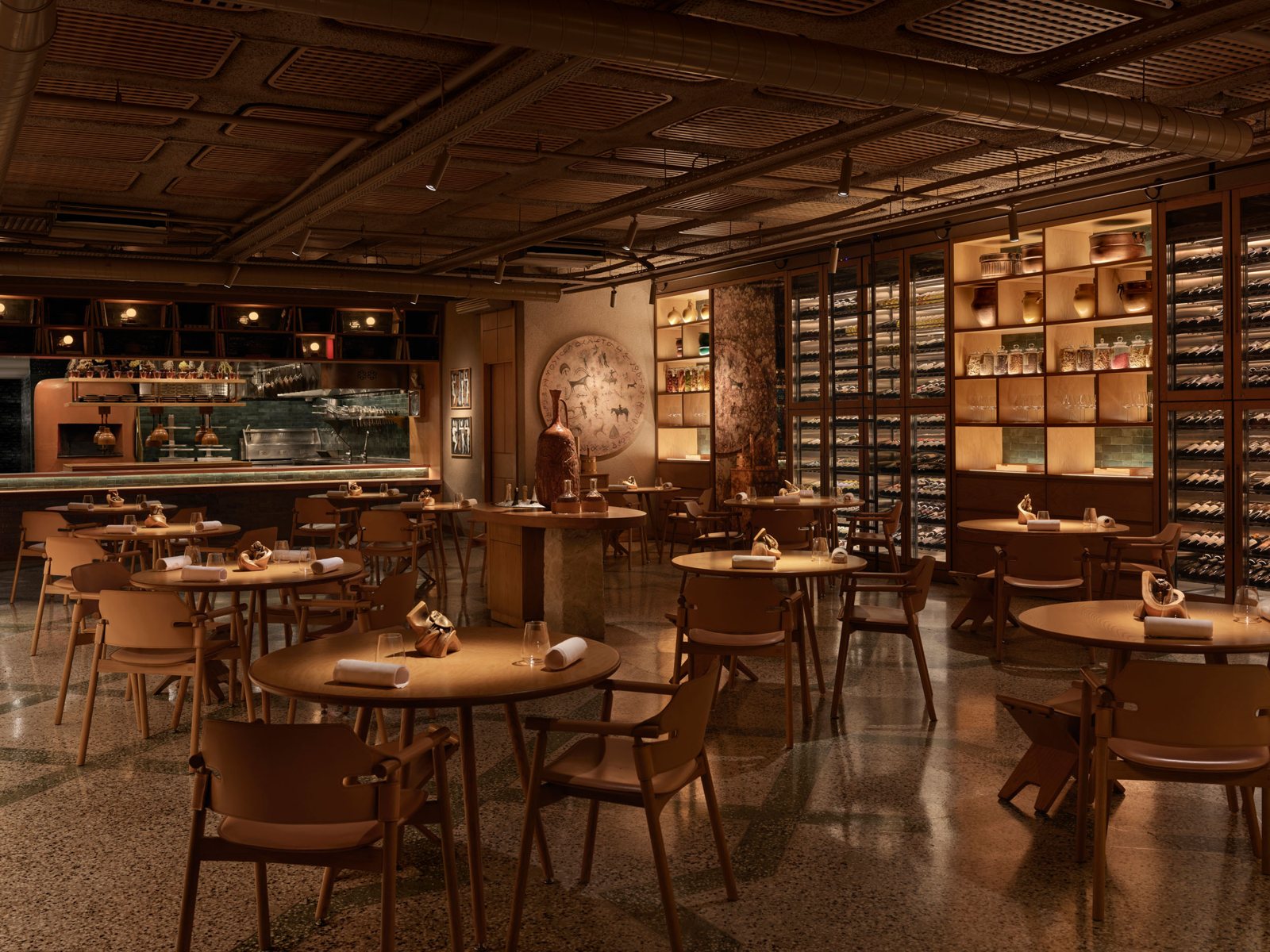
Image context: the cover uses an official TURK dining-room photograph. It belongs here because the room shows what this lineage now looks like in practice: open-kitchen sightlines, shelves that make preservation visible, and a polished urban setting that never stops pointing back to Turkish ingredients.[3]
Mikla gave the line its metropolitan confidence
Mikla's role is easiest to see because the restaurant states it so directly. On its own page, Mikla says it opened in October 2005 as a contemporary Istanbul restaurant and then, in August 2012, introduced "New Anatolian Cuisine" as an added layer to its mission.[1] That timeline matters. It marks the moment when a leading Istanbul fine-dining room stopped treating Anatolia as a pantry to borrow from occasionally and started treating it as the restaurant's governing language.[1]
The wording on the page stays revealing. Mikla says every ingredient in its menu reflects the traditions of Anatolia's lands and people, and that the restaurant's job is to reinterpret those carefully selected ingredients with contemporary respect.[1] That sounds simple until you place it in the city's luxury context. Mikla did not hide this argument in a side room. It staged it inside one of Istanbul's most cosmopolitan dining settings, with rooftop glamour, bar energy, and a view large enough to make the city itself part of the pitch.[1] In other words, Mikla solved a confidence problem. It made Anatolian ingredients look fully at home in an international high-end room.
That is why the restaurant matters beyond its own menu. Mikla's real contribution was grammatical. It showed that a Turkish fine-dining sentence could begin with urban polish and still keep its subject in local product. It did not need to choose between national memory and contemporary form. The point was to make them reinforce one another.[1]
Neolokal made the inheritance argument more serious
If Mikla supplied the metropolitan frame, Neolokal tightened the moral and historical pressure inside it. The restaurant's public language is less about debut and more about custody. Its English page says those who preserve and care for traditions ensure a brighter future, that the house is a bridge between old and new, and that it serves dishes linked to traditions "threatened by extinction."[2] This is a stronger claim than simple reinterpretation. It suggests that the restaurant is not only modernizing inherited material. It is trying to keep vulnerable culinary memory in circulation.[2]
Neolokal's phrasing also changes the emotional temperature of the lineage. Mikla sounds like a restaurant giving Istanbul a new vocabulary. Neolokal sounds like a restaurant asking what must be saved before vocabulary itself thins out.[1][2] The page insists on first-hand sourcing, mother-earth language, endangered foods from local heritage, and a future-oriented responsibility to pass food culture onward.[2] Put bluntly, preservation becomes part of the pleasure proposition. The meal is meant to feel current, but it is also meant to carry archive work inside it.[2]
That shift matters because it prevents New Anatolian cooking from collapsing into brand style. Once preservation enters the picture, the restaurant can no longer treat local reference as decorative atmosphere. It has to decide which ingredients, techniques, and memories are still alive, which are fading, and how much intervention a modern dining room should apply before the old thing disappears into pure chef ego.[2] Neolokal's importance lies in pushing the lineage toward that harder question.
TURK made the line more intimate, forceful, and personal
TURK Fatih Tutak takes the same broad language and drives it with more pressure. The homepage says the restaurant is dedicated to respecting and protecting the roots and traditions of its cuisine, using products from its geography to create "a new alphabet for Turkish cuisine" in a modern, elegant, and simple way.[3] That phrase matters because it sounds like both a continuation and an escalation. Mikla named New Anatolian cuisine. TURK proposes a new alphabet, which implies a more total rewrite of how Turkish fine dining can speak.[1][3]
The chef biography explains why the room feels more personal. Fatih Tutak's path runs through Bolu Mengen Culinary School, Paul Pairet in Turkey, major kitchens in China, Marina Bay Sands in Singapore, Nihonryori Ryugin in Tokyo, Noma in Copenhagen, and then The House on Sathorn in Bangkok, where he introduced a menu based on Turkish cuisine and built a signature reinterpretation of manti called "From my Mom."[4] When he returned to Istanbul in December 2019 to open TURK, the project was already charged with a different kind of energy from the start.[4] This was no longer only about placing Anatolian product inside a modern room. It was about bringing a globally sharpened chef back home to test how much of his own memory, and how much of the country's product map, could survive extreme fine-dining pressure.[4]
That is why TURK reads as the most intense current point on the line. The restaurant's public self-description keeps returning to roots, geography, curiosity, and technique.[3] Yet because the chef biography ties those words to Tutak's own movement across Asia and Europe, the room never feels like heritage museum cooking. It feels like heritage under voltage.[3][4] The old dishes are not simply being preserved. They are being rewritten at high heat by someone who left, learned elsewhere, and came back wanting Turkish cuisine to sound unmistakably like itself in a world-class room.[4]
What this line says about Istanbul now
Put together, these three restaurants describe a clear progression. Mikla made New Anatolian cooking legible as metropolitan luxury.[1] Neolokal insisted that the same project had to answer to preservation, extinction risk, and first-hand sourcing.[2] TURK turned the line into a more autobiographical and high-pressure form, where geography and memory are pushed through the personality of one returning chef.[3][4] That is enough to count as a real lineage, even if the chefs do not sign one document and call it a movement.
It also gives diners a more useful way to choose. Go to Mikla if you want the city-scale overview, the moment when Anatolian product first took the microphone in a cosmopolitan Istanbul room.[1] Go to Neolokal if you want the preservation argument made with the most explicit seriousness, where endangered food memory and future responsibility sit inside the meal.[2] Go to TURK if you want the loudest emotional charge, the version where Turkish fine dining becomes most visibly personal, technically sharpened, and willing to turn memory into theater.[3][4]
The common thread is stronger than the differences. Istanbul's most persuasive fine-dining rooms are not asking whether Turkish cuisine can borrow luxury status from somewhere else. They are asking how much local inheritance can carry once the room, the service, and the technique are finally confident enough to trust it.[1][2][3][4]
Sources
- Mikla Restaurant, "Mikla Restaurant" - official page covering the October 2005 opening, the August 2012 introduction of "New Anatolian Cuisine," and the restaurant's product-first contemporary Istanbul positioning.
- Neolokal, "Neolokal Istanbul: Bridging Past and Future" - official page on preserving traditions, acting as a bridge between old and new, working with endangered foods of local heritage, and sourcing ingredients first-hand.
- TURK Fatih Tutak, homepage - official philosophy page on protecting roots and traditions, using products from the restaurant's geography, and creating a "new alphabet" for Turkish cuisine.
- TURK Fatih Tutak, "Fatih Tutak" - official chef biography covering Tutak's training path, his Turkish-cuisine menu at The House on Sathorn, the "From my Mom" manti, and his December 2019 return to Istanbul to open TURK.