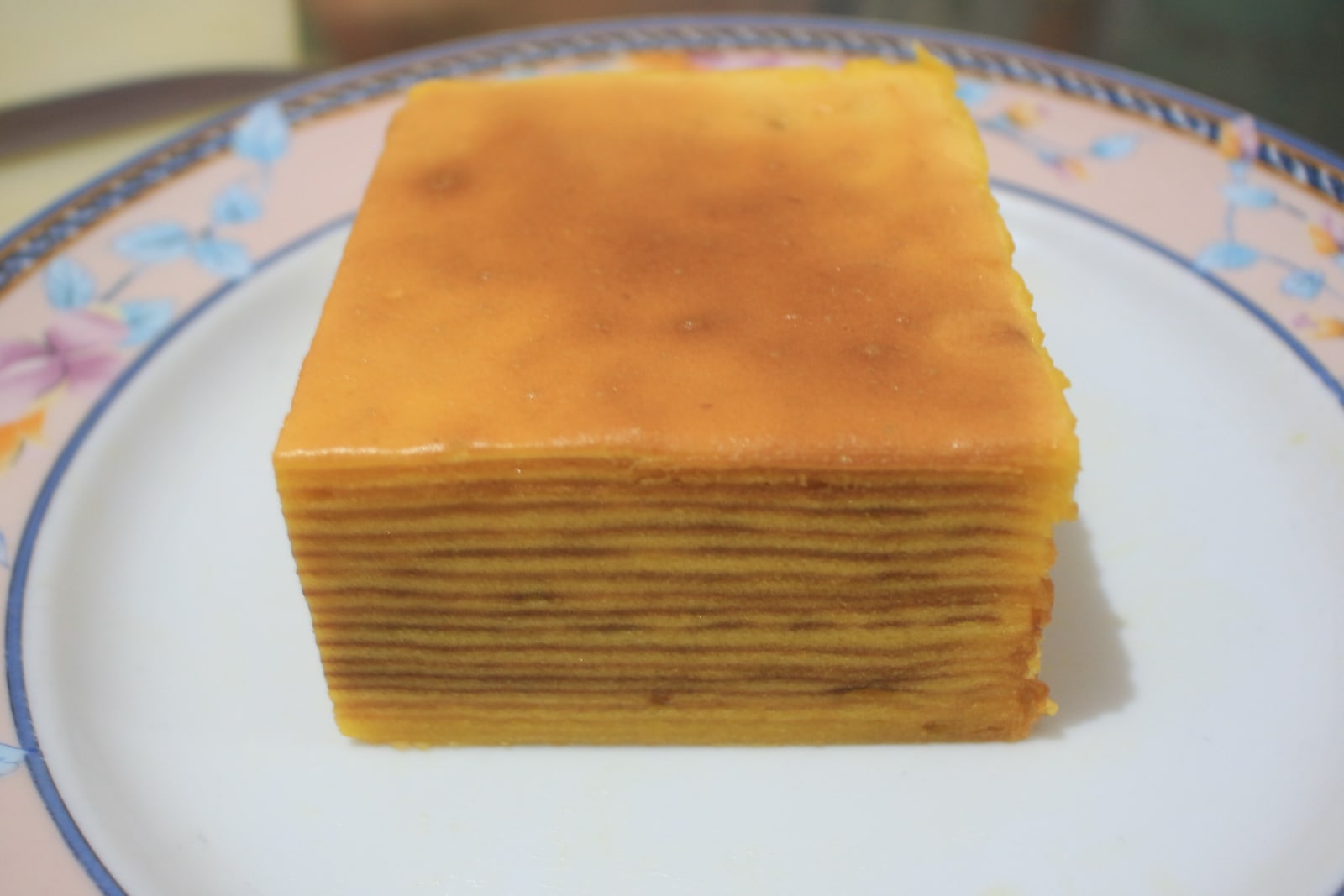
The cut face of lapis legit makes a quiet spectacle: pale gold crossed by fine brown lines, butter cake arranged with the precision of a stack of letters. Each line records a visit to the heat. In the single-batter version, the baker grills one thin layer, then covers its browned surface with the next. The finished slice carries those former surfaces all the way through.[1]
That is the pleasure to keep in mind while looking at this Indonesian celebration cake. Its elaborate appearance grows out of a repeated kitchen action. A small piece lets the diner encounter the work in cross-section.
Richness before height
Start with the proportions. Sammie, the Indonesian-Singaporean baker behind Sweet Samsations, publishes a formula with 500 grams of butter, 600 grams of egg yolks and just 90 grams of flour. Reading the weights makes the cake's richness easier to grasp than counting eggs alone. Her method beats the butter mixture and the yolk mixture separately before combining them and folding in the dry ingredients.[2]
Recipes vary considerably. A 2019 baking demonstration recorded by Kalis Kukis uses 900 grams of yolks, several fats, flour, milk powder and cornflour. The Pontianak variation accompanying this article is identified in the photograph's description as flourless.[3][5] Lapis legit therefore resists being reduced to one mandatory ingredient ratio. The recurring technical question is how to build a fine, coherent stack from a rich batter.
Those proportions also help explain the appeal of a modest serving. The slice can remain visually intricate without needing the height or volume of a large wedge. Its scale invites attention to the narrow bands.
Give each surface its turn
Kalis Kukis measures 70 grams of batter for each addition. The first layer cooks with heat from below; subsequent additions cook with heat from above. This is a useful distinction: establishing the base and extending the stack are separate jobs.[3]
Once the base exists, the next portion needs to cover it evenly. The pan returns to the upper heat, the new surface colors, and another measured portion follows. The sequence places a browned boundary inside the cake every time the baker adds batter. Pouring everything in at once would remove the very operation that produces those boundaries.[2][3]
The regularity begins at the spoon or scale. Equal portions give the baker a repeatable starting point, though spreading still matters. A mound in one corner and a thin patch in another cannot become an even layer merely because their combined weight is correct. The clean cut face is the cumulative result of these small decisions.
The last layer is closer to the grill
There is a complication in all that repetition: the cake gets taller.
Sammie's practical notes warn that the rising surface approaches the upper element, so later layers may cook faster. Time, heat or rack position may need adjustment. She also describes the competing failures: insufficient heat prolongs browning and can dry the cake; excessive heat burns the layer. Her guide treats the surface's behavior as something to watch throughout the bake.[2]
This makes lapis legit an exercise in sustained attention. A successful early layer establishes a reference for color and thickness, but the baker still has to recognize when the conditions change. The repeated action remains familiar while the distance to the heat keeps shrinking.
Press before covering
Pressing brings another kind of control. In his account for Singapore's National Library Board, food writer and cooking teacher Christopher Tan describes flattening the cooked layers and removing bubbles. He also cites Mrs Leong Yee Soo's method of pricking each layer, which helps the next addition adhere.[1]
The point is to prepare a sound surface for what follows. A blister left standing becomes an obstacle beneath the next pour. Gentle correction, repeated while the cake is being built, helps preserve the close, orderly structure seen when it is finally sliced.
Tan also distinguishes the fine layers of single-batter lapis legit from versions of spekkoek that alternate plain and spiced batters. Names sometimes overlap, but a striped cake need not contain two differently colored mixtures.[1] Heat itself can draw the lines.
What the small slice contains
At Jakarta's Happy Bakery, the work has a measurable duration. In Kiki Siregar's February 2021 report for CNA, second-generation owner Liena Gusman said a cake took roughly two and a half to three hours to make. She described imported Dutch butter as a distinguishing ingredient; the bakery's range varied in price with its butter content.[4]
That account gives the richness two dimensions: ingredients and time spent handling them. A premium fat is still waiting for somebody to spread, brown and judge the next layer. The recipe becomes a finished cake through a succession of decisions that remain visible after the oven is switched off.
CNA also records the cake's association with multiple fortunes at Chinese New Year.[4] Its layers can carry that festive meaning while showing something immediately tangible. Look along a slice: each narrow brown line was once the top, exposed to the grill and awaiting the baker's next move.
Sources
- Christopher Tan, “Love Is a Many-Layered Thing,” BiblioAsia, National Library Board Singapore, January 1, 2021 — firsthand baking account, pressing, and distinctions between lapis legit and spekkoek.
- Sammie, “All About Lapis Legit — Recipe & Tips on the Indonesian Layered Cake,” Sweet Samsations, January 3, 2013 — tested formula, measured layers and changing conditions beneath the grill.
- Kalis Kukis, “Lapis Legit Original (Resep Chef terkenal),” February 28, 2019 — a documented baking demonstration, ingredient weights and the transition from lower to upper heat; in Indonesian.
- Kiki Siregar, “Butter makes all the difference for 45-year-old thousand layer cake bakery in Jakarta,” CNA, February 7, 2021 — reporting from Happy Bakery on butter, labor and festive meaning.
- Ariefz, “Lapis Legit Pontianak,” photograph taken January 26, 2020, Wikimedia Commons — a documented flourless variation; CC BY-SA 4.0.