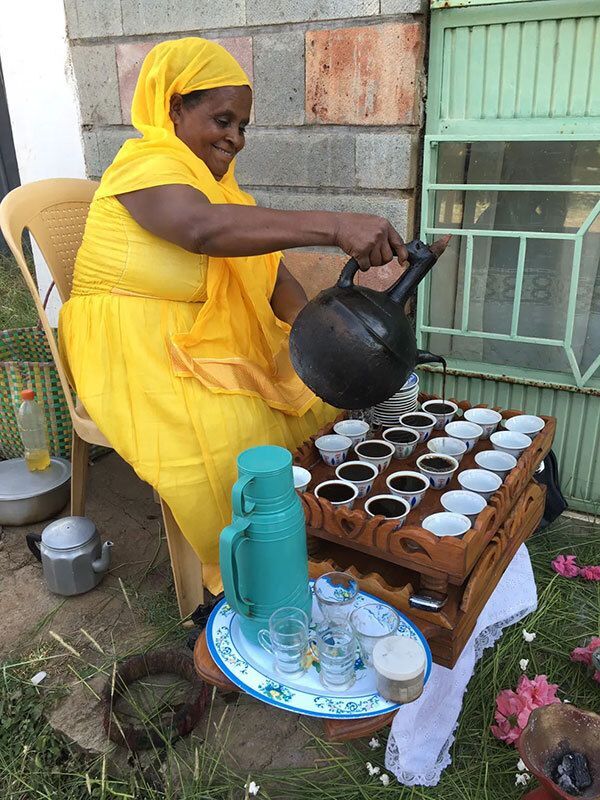
Before the first sip, the roasting pan makes a visit. In Roots Ethiopia’s account of the coffee ceremony, the host carries the freshly roasted beans around for guests to enjoy their aroma. Incense is already burning; the beans have darkened and become glossy. Coffee has begun to occupy the room while the cups are still empty.[1]
That is an inviting way to think about service. The guest receives something at each stage: a scent, a view of the work, a reason to turn toward the other people present. Waiting acquires a shape. The eventual pour belongs to a sequence that everyone has had a chance to enter.
At its center is the jebena, the clay coffee pot. Looking at the vessel alongside accounts of its use reveals a form of hospitality that gives preparation a place among the guests—and asks someone to sustain that attention.
A pot with a place in the room
One jebena in Cambridge’s Museum of Archaeology and Anthropology was bought in an Addis Ababa market in the late 1990s. Its catalogue records a rounded body, slender neck, angled spout and curved handle. Graphite burnishing darkens the surface; lines and circles decorate its shoulder. The museum describes the vessel as made without a wheel.[2]
Those details make the object easy to picture in use: the hand at the handle, the small opening directing the pour, the broad body below. Even in a collection record, it retains the scale of a person serving another person. Its ornament belongs to equipment that has a job to do.
Christian Partners in Africa describes ceremonies its directors have attended with friends in Ethiopia. In its account, beans are roasted, crushed with a pestle and mortar, then brewed with water in the pot. The coffee is strained before being poured from a height into small cups. Guests receive it before family and friends, with the eldest guest served first.[3]
Here, the order of service expresses welcome. The cup does not simply go to whoever is closest to the spout. A host notices who is present and makes that recognition visible through a small, deliberate act.
These accounts describe particular practices. They are useful windows into hospitality, rather than a script that every Ethiopian household must follow. Even the handling of the grounds differs across the descriptions: CPA records straining, while the contemporary art project discussed below builds its meaning around allowing them to settle.[3][4]
The person keeping the pause alive
CPA says a ceremony can occupy several hours and describes a woman conducting it. Its directors also remember drinking three cups late at night, a warm invitation with consequences for sleep.[3] The detail brings the occasion down to human size. Generosity has a duration, and the guests have bodies as well as good intentions.
For a dining room, the useful lesson concerns the work that makes lingering comfortable. Someone must prepare the equipment, tend the coffee, judge when to pour and notice the guests. Calling an experience leisurely describes the recipient’s side of it. The person providing it may be very busy.
That distinction matters when admiring a tableside ritual. The attractive gesture is only one part of the service. Its quality also depends on whether the host has the time and help to carry the sequence through. A beautiful vessel cannot supply that attention by itself.
Roots Ethiopia describes three successive servings, with the coffee growing lighter and weaker. It calls them abol, tona and bereka, associating the last with a blessing. Children may help carry cups to adults. Alongside the drinking, people exchange news and discuss community concerns.[1]
The changing strength gives the gathering a gentle progression. For a guest, the later cup can mark time spent together. For the host, it is another occasion to return to the company. The service renews contact without requiring a wholly new performance at each turn.
When the grounds settle
Artist Ainslee Alem Robson gave this pause a precise material focus in Yeskèn: Unsettled Grounds. Kala Art Institute’s listing for an October 3, 2026 coffee ceremony in Berkeley describes her work in dialogue with Mayumi Hamanaka. It explains yesken as the time taken for grounds to settle in the jebena, and connects the gathering to memory carried through food, immigrant restaurants and community elders.[4]
In that framing, sediment becomes a clock. Pouring has to wait for something small and physical to happen. Conversation can inhabit the interval. The pot supplies both a reason to pause and the promise that a cup will follow.
That relationship between an attended task and an unhurried guest is the service idea worth carrying back to dinner. A host gives the waiting substance, then follows through. By the time coffee reaches the cup, the welcome has already been under way.
Sources
- Roots Ethiopia, “Drinking Coffee The Ethiopian Way: Part 2” (September 2, 2022) — roasting aroma, successive servings, shared conversation and the article photograph.
- Museum of Archaeology and Anthropology, University of Cambridge, coffee pot 2006.759 A–B — collection history, construction and physical description.
- Christian Partners in Africa, “Ethiopian Coffee Ceremony” — visitors’ account of preparation, guest precedence, duration and late-evening hospitality.
- Kala Art Institute, “Yeskèn: Coffee Ceremony” (October 3, 2026) — Ainslee Alem Robson’s installation, settling grounds and intergenerational memory.