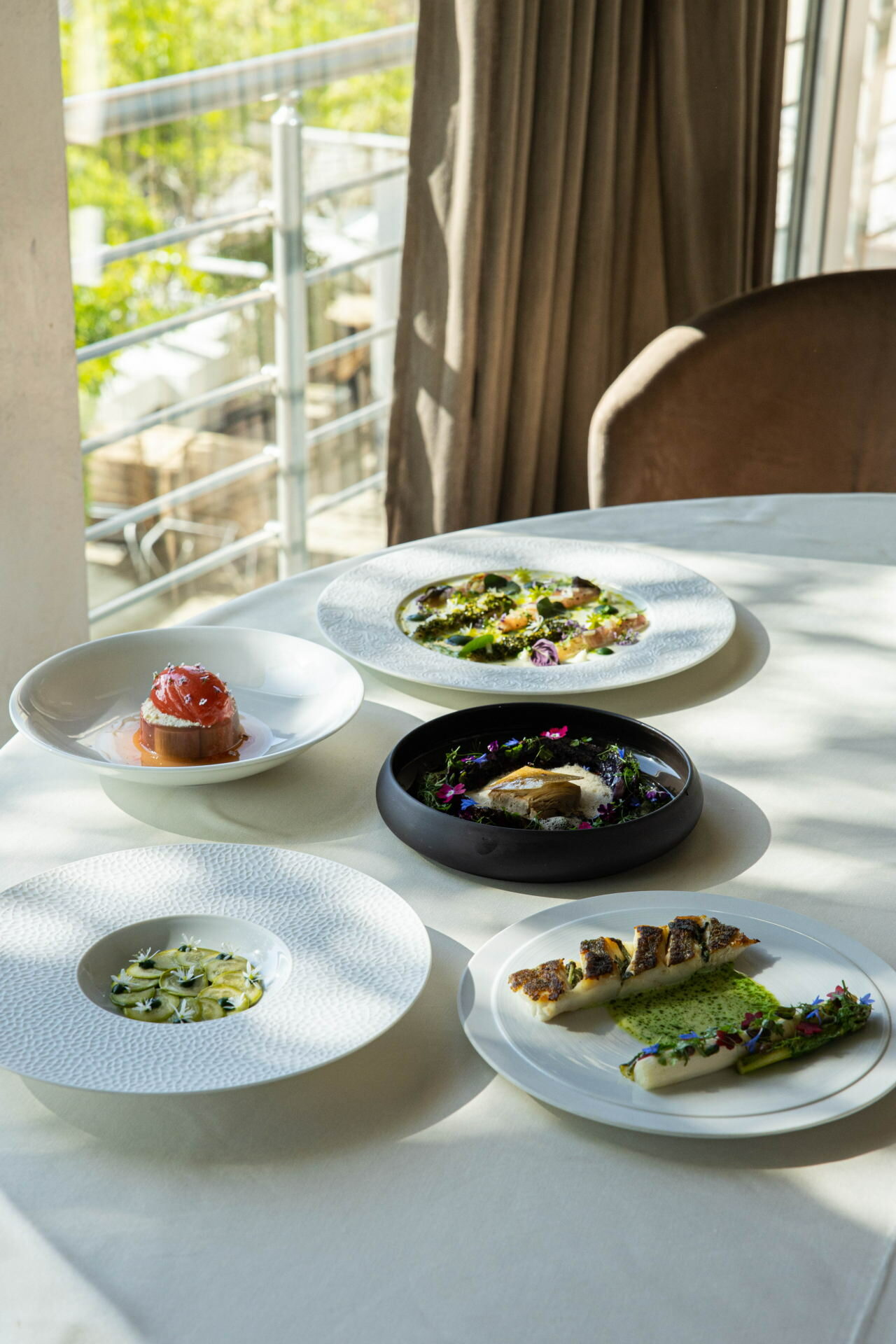
Langouste's broad windows give dinner an obvious direction: look toward the Sava, its opposite bank and Belgrade's modern skyline. The menu is more interesting when it refuses to stay inside that view. Adriatic scampi and grouper, Danube pike-perch, Pešter veal, Sjenica lamb, Fruška Gora truffle, garden fruit and fermented vegetables all appear in the restaurant's current public material.[1][2][3] Water may hold the room together, but the kitchen keeps turning inland.
That movement explains why the restaurant's eight-course Langouste Menu is the clearest first reading of Marko Đerić's cooking. The official menu also offers a five-course fish route and a five-course meat route, each at 12,500 RSD and including dessert. The mixed eight-course sequence costs 17,900 RSD and is the only option the restaurant explicitly describes as characteristic of the house and the best reflection of its culinary ideology.[1] Michelin gives the same architecture in plainer terms: five courses devoted to fish, five to meat, or a more elaborate eight that carries both.[3]
This is therefore a walkthrough of a structure, not a claim to have eaten the present menu. Langouste says all three tasting formats change with the season and does not publish their individual courses.[1] Gault&Millau's 2026 review records one detailed seasonal progression, while the current à la carte list reveals the pantry and techniques surrounding it.[1][5] Read together, they show what the full menu is designed to do—and where the evidence stops. A takoyaki or veal preparation observed by a critic is a useful clue to the restaurant's grammar, not a promise that it will arrive on every table in August.
Image context: the lead photograph is an official Langouste image of five actual plates gathered beside the window.[7] It supports this article's interest in sequence, but it is not presented as a photograph of the current eight-course menu.
The opening makes foreign technique speak locally
Gault&Millau begins its account with a deceptively small collision: tender takoyaki carrying kajmak aged in animal skin, Moravian bacon and fermented honey.[5] The round Japanese snack form supplies a compact shell; the filling pulls it toward dairy, cured pork and fermentation. It is an efficient introduction because it refuses the lazy choice between “Serbian” and “international.” The technique can travel while the flavor remains geographically opinionated.
Đerić's training makes that fluency legible. Michelin traces him from the ALMA culinary school near Parma through Bros' in Lecce, Tosca in Geneva, Piazza Duomo in Alba and Geranium in Copenhagen.[4] Those kitchens explain the precision and the European vocabulary, but not the decision to put kajmak, bacon and honey in the same bite. The latter comes from the chef's stated sequence for explaining Serbia to a visitor: begin with the direct warmth of a kafana, pass through contemporary versions of familiar flavors, and only then encounter those ingredients again at Langouste.[6] Fine dining is the final translation, not the original text.
The next observed plate tightens that idea. Venison tartare arrived with red cabbage, chokeberry and a creamy egg yolk.[5] The composition has the visual neatness expected of a tasting room, yet its flavor map is dark and autumnal: lean raw meat, brassica, tart fruit, fat. The current à la carte menu publishes a related deer tartare using sirloin aged for ten days, wild rose-hip cream, mushrooms, black chokeberry and red cabbage.[1] That continuity matters more than identical plating. It suggests a kitchen working through one family of woodland flavors over time rather than changing identities with every menu revision.
Corn slows the middle before the meats deepen it
A long menu needs a course that does more than escalate luxury. In the sequence Gault&Millau reviewed, quail arrived as a roll with several textures of corn and a corn risotto.[5] Corn is not merely a sweet garnish here. Repetition makes it the course's meter: soft grain, concentrated sauce or puree, perhaps a crisp edge, all gathering around a small bird. After fermented honey and tart forest fruit, that warmer register gives the meal somewhere to settle.
Then the geography becomes explicit. Gault&Millau records Sjenica lamb with salad and citrus hollandaise, followed by Pešter veal cooked sous vide, smoked over straw, briefly roasted, and served with demi-glace and black truffle.[5] The restaurant's current à la carte list keeps both places in view: a “lamb triptych” uses Sjenica lamb in three preparations, while a Pešter veal rack is slow-cooked, lightly smoked and paired with truffle and port sauce.[1]
The strongest part of this movement is not the prestige of lamb or truffle. It is the change in pressure. Citrus and fresh leaves keep the lamb from becoming the inevitable heavy midpoint; straw smoke, concentrated sauce and truffle then allow the veal to land lower and darker. One course opens the meat register, the next finishes the descent. The full tasting format has room for that contrast. A five-course meat menu may express it too, but the published documents do not disclose how that shorter edit is made.[1]
Fish is a route, not one luxury specimen
The fish-only menu has a clear appeal in a river-facing room, but Langouste's public à la carte list argues against treating “fish” as one lane. It moves from thinly sliced Adriatic fish with fermented pumpkin, almonds and chestnuts to scampi with yeast, porcini and “dashi coffee”; from dry-aged Adriatic grouper with asparagus, fermented mushrooms and smoked beurre blanc to line-caught Danube pike-perch, dry-aged for five days and poached with fig leaves.[1]
That list should not be mistaken for the five tasting courses. It is more valuable as evidence of how the kitchen differentiates water. Adriatic fish can be raw or dry-aged; a crustacean can meet mushroom and yeast; a river fish can take fig leaf, garden chard and beurre blanc. French sauce work and Japanese reference points appear, but fermentation, smoke, local leaves and inland produce keep interrupting any simple seafood-luxury script.[1][3]
This is where the eight-course menu earns its narrative advantage. Fish can establish delicacy, salinity and aging; meat can answer with corn, smoke, cultured dairy and mountain provenance. Neither has to carry the whole idea of Serbia by itself. Michelin's inspectors describe the kitchen as rooted in Serbian traditions and produce while drawing on French and Italian experience, and note that chefs present dishes at the table.[3] That last detail is not ornamental. When a menu crosses several regions and technique traditions, the handoff from kitchen to diner can keep provenance from disappearing beneath polish.
Dessert turns locality into memory
Gault&Millau's autumn meal moved through chestnuts before closing with a pancake filled with homemade biscuits and chocolate.[5] After tartare, quail, lamb and smoked veal, a pancake is a change of emotional scale. It does not attempt to finish with the rarest product in the building. It converts technical control into recognition.
The current dessert list preserves that instinct while changing the forms: fermented wild blackberries with dark-chocolate mousse and hazelnut; three kinds of honey with walnuts and burnt-milk ice cream; or mandarin parfait with candied peel, thyme and yogurt ice cream.[1] Each construction has enough pastry-room detail to justify its place, but the nouns remain readable. Blackberry, honey, walnut, milk and yogurt do not need a luxury glossary.
That is an important ending for this restaurant in particular. Langouste retained its Michelin star in the 2026 Belgrade selection, which now contains 25 recommended restaurants but only two starred addresses, one of them outside the city at Novi Slankamen.[4] Awards can push a menu toward defensive grandeur: more supplements, more imported signals, more visible difficulty. A finish built from honey, milk or pancake memory takes the opposite risk. It asks whether refinement can make a familiar flavor more exact without making it socially remote.
Which menu tells the whole story?
The arithmetic is unusually transparent. Moving from either five-course menu to the eight-course format adds 5,400 RSD, about 43 percent more, for three additional listed courses.[1] That does not mean every course has equal size or value, and the menu gives no basis for calculating an hourly return on dinner. The useful difference is editorial.
Choose the five-course fish menu if an all-aquatic line is the point of the visit; the published pantry suggests meaningful contrast between sea, river, raw, aged and poached preparations. Choose the meat menu if smoke, cultured dairy, corn and Serbian livestock are the stronger draw. But for a first visit centered on understanding the restaurant rather than narrowing it, the eight-course menu makes the better argument. It can stage the hinge between water and pasture that neither shorter title promises on its own.[1][3]
The room looks one way. The menu does not. Its most persuasive path begins near the water, borrows precise forms from kitchens abroad, then lets kajmak, chokeberry, corn, lamb, veal, honey and smoke pull the meal across the country. Langouste's full sequence works when those movements feel less like a display of references than one Belgrade chef deciding how many versions of home can fit between the river view and dessert.
Sources
- Langouste, current English menu — five-course fish and meat formats, the eight-course mixed menu, prices, seasonal boundary, current à la carte preparations and desserts.
- Langouste, official website — river-confluence setting, current chef, local-producer framing and restaurant positioning.
- MICHELIN Guide, “Langouste” — current one-star listing, room, menu architecture, cooking influences and tableside presentation by the chefs.
- MICHELIN Guide, “MICHELIN Guide Belgrade 2026 celebrates growth and culinary excellence” — current selection size, retained stars and Marko Đerić's local-product focus.
- Gault&Millau Serbia, “Langouste” — 2026 review documenting one seasonal course progression, the Marko Đerić–Ksenija Đokić team and the restaurant's local, classical and Japanese reference points.
- JRE, “Interview with JRE-member Marko Đerić, Langouste: Pushing Boundaries toward Authentic Gastronomy,” December 29, 2025 — the chef's account of moving from kafana tradition to contemporary reinterpretation.
- Langouste, official restaurant photograph used for the lead image — five plated dishes arranged beside the dining-room window.