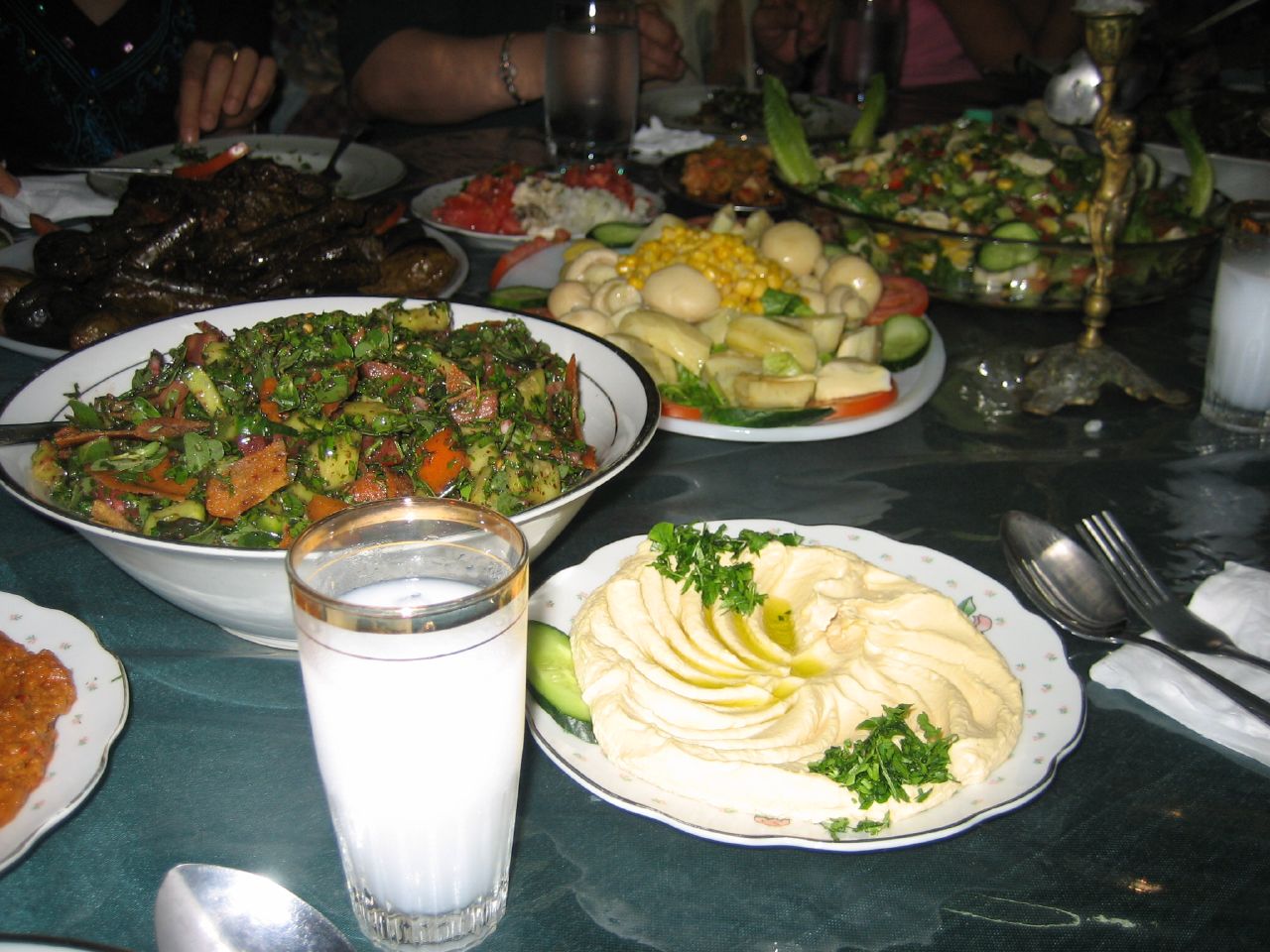
The first pairing decision happens before any food arrives. Clear arak goes into the glass; water follows; a white cloud moves through the spirit until the view of the table turns milky. Ice cools the mixture. Then the plates begin to accumulate—not in a straight line, but all at once: parsley bright with lemon, yogurt under olive oil, fried pastry, raw vegetables, grilled meat, pickles, bread.
This is why arak makes more sense as a whole-table pairing than as a one-course trick. A course-by-course pairing often changes drinks as the plates change. Mezze changes the plate while the drink remains. The same diluted glass has to meet acid, herbs, sesame, smoke, meat and salt without pretending that one flavor note solves all of them.
The claim here is not that arak objectively “beats” wine, or that every Levantine table follows one script. It is narrower: arak offers fine dining a different pairing grammar. Its anise supplies a continuous aromatic line; dilution makes a powerful spirit linger rather than strike; and the guest decides which bite comes next. The pleasure is not a perfect lock between one glass and one dish. It is the glass staying intelligible while the table keeps changing.
The cloud is part of the service
The Lebanese grape arak considered here begins with agricultural material, not a licorice-flavored shortcut. The International Academy of Gastronomy's Lebanon chapter identifies white grapes and anise as its two basic ingredients and places the drink closely beside the Bekaa Valley and mezze.[4] At Massaya's Tanaïl distillery, one producer's process makes that relationship unusually tangible: Obeïdi wine passes through three distillations in copper stills heated with vine wood; green aniseed is macerated during the third; the spirit then rests in porous clay amphoras made in Beit Chebab.[1] Those are Massaya's documented methods, not a universal specification for every bottle labeled arak.
At the table, dilution reveals what distillation held in solution. The cloudy change belongs to the same family of spontaneous emulsification often called the “ouzo effect.” Chemistry studies describe a mixture of ethanol, water and trans-anethole, the major aromatic compound associated with anise: once water changes the solvent balance, tiny oil-rich droplets form and scatter light.[5] The glass does not turn white because cream, sugar or coloring has been added. It turns white because water makes anise oil newly visible.
That phase change matters sensorially as well as theatrically. Neat spirit concentrates heat and anise into a narrow attack. Water lowers the alcoholic force and spreads the aroma across a longer sip. Massaya's public serving guide presents a common build of one part arak to two parts water with ice, while also describing its own more ice-led house preference; a Beirut account gives both one-to-one and one-to-two dilution as familiar Lebanese practice.[3][6] There is no need to turn either ratio into dogma. The useful service principle is to dilute deliberately, taste, and leave room for the food.
Green, sour and raw: let anise be the fixed point
A mezze table often opens in a high, green register. The Academy's Lebanese-food account describes tabbouleh through parsley, tomato, onion, mint, bulgur, lemon and olive oil, and places fattoush, labneh, olives and other cool dishes in the wider meal.[4] These ingredients are difficult for a notes-only pairing because they keep redirecting attention: lemon pulls one way, raw herbs another, tomato adds both sweetness and acid, and olive oil rounds the edges.
Arak does not mirror every component. That is its advantage. Diluted anise becomes the fixed point against which the plate can move. With tabbouleh, the drink's cool aromatic lift can extend mint without copying parsley. With fattoush, it can sit beside sumac and toasted bread while water prevents the spirit from bullying the salad. With raw tomato or radish, it supplies perfume rather than more acidity.
This is an interpretive pairing proposal, not a laboratory finding. It works only if the pour is soft enough. Served near neat, arak can make a bright salad feel thin and turn a first course into an endurance test. The measure should be modest, the water glass should be full, and the alcoholic pairing should be genuinely optional. “Traditional” is not a reason to make refusal awkward.
Tahini, yogurt and olive oil give the glass something to push against
The table then moves lower and rounder: hummus, moutabbal, labneh, perhaps a plate glossed generously with olive oil. Here arak's job changes. It is no longer extending the green edge; it is creating contrast against creamy texture and sesame depth.
Producer language often calls this palate cleansing. Massaya specifically places arak beside mezze containing parsley, tomato, lemon, mint and garlic.[2] The phrase is useful if kept culinary rather than medical. A chilled, diluted spirit can feel brisk after tahini or dairy, while anise gives the next bite a clear aromatic boundary. It does not erase fat from the mouth, “aid digestion” in any clinically established sense, or make the meal lighter. It simply changes the sensory sequence.
Bread is what makes the pairing feel social rather than technical. A scoop of hummus, a torn piece of flatbread and a sip of arak are not three isolated samples. Each adjusts the next: bread quiets the alcohol, sesame gives anise a darker background, water resets the intensity. The glass succeeds because the diner can move among them, not because a beverage director has identified one canonical hummus note.
Fried pastry and fire are where arak gains weight
Anise can sound delicate when described as fragrance. Put it beside a hot sambousek, grilled kafta or a lamb kebab and it becomes structural. The Academy's survey places kebbe, meat- and cheese-filled samboussek, kafta, kebabs and mutton chops inside the same Lebanese repertoire as the salads, dairy and spreads discussed earlier.[4] That documented breadth does not prove that every item shares one sitting; it is the basis for the pairing inference here. Arak does not have to abandon the opening dishes in order to meet the browned ones.
Against hot pastry, the chilled drink creates a temperature and texture break. With kafta or lamb, the aromatic line can meet char and warm spice without adding another layer of tannin or oak. None of these is a universal “best pairing.” The meat's seasoning, the pastry's filling and the bottle's anise intensity all matter. But the family resemblance is clear: browned food gives a diluted clear spirit enough bass.
The strongest match may be the transition bite rather than the grand centerpiece—a forkful that catches a little yogurt, charred meat, mint and pickle at once. Wine pairing often solves complexity by changing bottles. Arak solves it by accepting that the bite itself will not stay pure.
The pairing has a winter boundary
A whole-table drink should still be allowed to fail. Massaya's own food guidance draws a seasonal line: it favors arak with the parsley, tomato, lemon, mint and garlic of mezze, but suggests wine as a more compatible companion when winter cooking turns toward beans, potatoes and stews.[2] That is producer advice, not a law, yet it identifies a real boundary.
Arak is most persuasive when a meal keeps returning to freshness, smoke, oil and shared plates. A dense braise with deep stock, sweet onion and soft potato may ask for a drink with less aromatic insistence and more body. A heavily sweet dessert can make the spirit feel hotter. Once the food stops changing quickly, arak's great talent—holding a line through contrast—matters less.
That boundary also prevents the pairing from becoming cultural theater. The goal is not to place arak beside every Levantine dish because the bottle “belongs.” It is to understand what the drink actually does, then stop pouring when it no longer helps.
What a fine-dining room can borrow
The most useful modern service is not an arak flight. It is one carefully chosen bottle, one modest pour, water within reach, and permission to keep the glass through several dishes. Explain the transformation in a sentence, not a lecture: grape spirit and anise turn cloudy when water disperses the aromatic oil. Then let the table prove the rest.
Do not refill automatically. Do not insist on a toast that empties the glass. Do not describe the drink only as “licorice,” a word that can flatten grape, anise, clay, distillation and social use into one candy-store reference. And do not force the non-drinker into a lesser version of the meal; a cold infusion built around anise hyssop, mint, grape verjuice or another kitchen-appropriate line can follow the same whole-table logic without impersonating the spirit.
The photograph captures the idea better than a row of tasting glasses could. A tall cloudy drink sits beside hummus, chopped greens, pickles and stuffed vegetables, with hands entering the shared spread beyond it.[7] The arak is visually distinctive, but it is not the meal's soloist. Its role is closer to a drone note: steady enough to organize movement, quiet enough that herbs, yogurt, oil, bread and fire can keep taking turns.
That is the pairing lesson worth carrying beyond mezze. Sometimes precision does not mean finding a new bottle for every plate. Sometimes it means choosing one flavor line broad enough to survive the table—and serving it gently enough that the food remains in charge.
Sources
- Massaya, “Distillery” — producer documentation of Obeïdi grapes, copper stills, triple distillation, anise maceration and clay-amphora resting at Tanaïl.
- Massaya, “An exceptional spirit” — producer account of arak's place beside contrasting mezze flavors and its stated seasonal boundary with winter stews.
- Massaya, “Drink” — producer serving guidance covering a common one-part-arak to two-parts-water build and an alternative ice-led house method.
- International Academy of Gastronomy, “Lebanon” — culinary overview of arak, mezze and the ingredients and structure of Lebanese dishes discussed here.
- David Carteau, Dario Bassani and Isabelle Pianet, “The ‘Ouzo effect’: Following the spontaneous emulsification of trans-anethole in water by NMR,” Comptes Rendus Chimie 11 (2008) — mechanism and visual result of the water–ethanol–anethole emulsion.
- Sarah Delbos, “ARAK – ‘Le lait des braves,’” Le Petit Journal Beirut (updated January 31, 2019) — Lebanese production, dilution and shared-meal context.
- Abufares, “Everything You Wanted to Know about Arak and More” (October 29, 2006) — firsthand Syrian account of arak service and source page for the real arak-and-mezze table photograph used here.