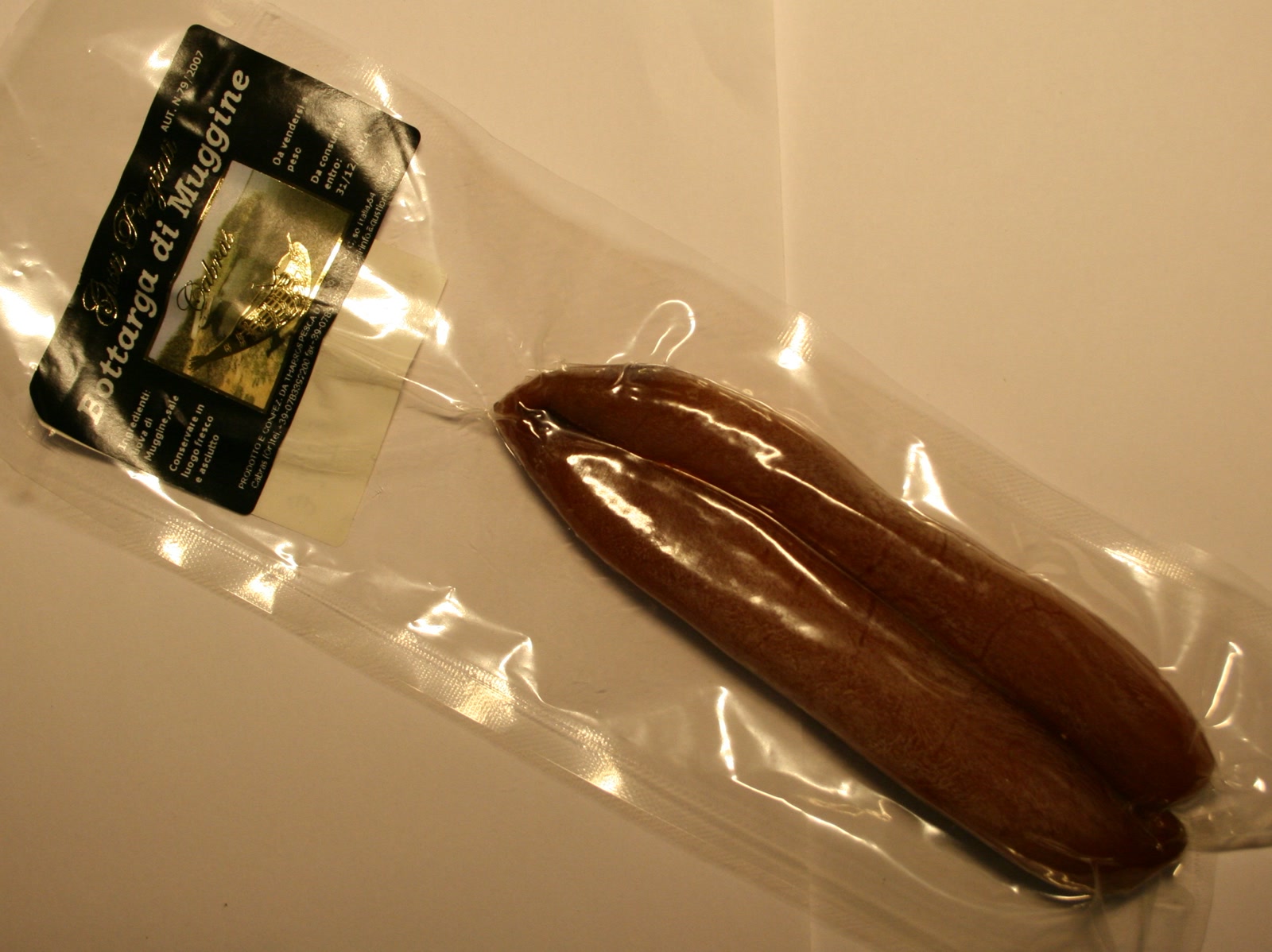
A whole lobe of mullet bottarga looks designed to attract metaphors. It is amber, dense and faintly translucent; call it Mediterranean gold and the sentence practically writes itself. In Cabras, on Sardinia's west coast, the more useful detail is silver: a small flap of skin left folded over one end of the cured roe sac. It is modest, almost untidy, and far more interesting than the shine.
That flap points backward. Before the roe met salt, the fish had to be caught without crushing it. Before it was caught, it had to fatten and mature in a particular lagoon. And before a restaurant grates the finished bottarga over pasta, someone should be able to say where that fish actually swam.
This is not a semantic luxury. The Slow Food Foundation's current Cabras Presidium page says that only 0.3 percent of Sardinian bottarga on the market comes from mullet caught in Cabras Lagoon, and that local fish supply only about 5 percent of the bottarga processed in the town of Cabras.[1] Sardinian curing skill can be applied to imported roe, often very well. But “processed in Cabras” and “caught in Cabras Lagoon” are two different claims. The best bottarga service makes the distinction visible rather than letting a famous place-name do all the work.
Image context: the cover is a real 2012 photograph of Sardinian grey-mullet bottarga, but its source does not verify Cabras-Lagoon provenance. That limit is deliberate. A photograph can establish the product's intact form; it cannot establish the catch.[7]
The lagoon is the first ingredient
Cabras Lagoon sits near the northern curve of the Gulf of Oristano. An official Ramsar information sheet describes it as a near-natural Mediterranean wetland: a shallow, brackish lagoon and temporary-pond system linked to the sea, important both for wildlife and for fishing.[5] It is not a blue, open-water postcard. Its character comes from exchange—freshwater, evaporation, rain, salt and a managed route to the sea.
The mullet use that route as part of their life cycle. Slow Food's account follows young fish into the lagoon in spring, where they grow, then describes their summer movement back toward the sea. At the fishery gates, fishermen guide mature fish with nets and take some by hand, gripping at the gills so the swollen roe sacs are not damaged. Fishing for the bottarga run falls between June and September.[1]
This is where the ingredient acquires its first constraint. Roe cannot simply be ordered to a standard size on a standard Tuesday. It belongs to a mature female, to a migration window and to a body that has to reach the processing room intact. The lagoon does not season the bottarga by magic. It sets the fish's food, movement, maturity and harvest calendar before the salter makes a single decision.
An unbroken sac, then a series of judgments
Traditional Cabras processing sounds short because the verbs are short: remove, wash, salt, dry. None of them is automatic. The ovarian sac is lifted without tearing, washed clean of blood, covered in salt for a period adjusted to its size and the ambient temperature, then air-dried for roughly four to fifteen days under the Presidium method.[1] The attached silver flap survives at one end as a recognizable house signature.
A 2020 study of ripe mullet caught in Cabras shows why one fixed recipe would be misleading. The researchers worked with two species and found a large difference in roe size: flathead grey mullet (Mugil cephalus) produced finished lobes of roughly 200–400 grams, while the thinlip grey mullet in the sample produced pieces around 30 grams. Their panel settled on about 30 percent moisture as the useful target for final consistency, so drying time was adjusted to the weight of each sac.[3]
Salt, in other words, is not the whole craft. The salter is trying to move water out without turning the roe into a brick, to firm the membrane without erasing the fine-grained, slightly yielding interior. A thick lobe and a thin one cannot arrive there on the same clock. Even color is a process record: gold can deepen toward orange amber as curing advances, while excessive oxidation or careless storage can flatten brilliance into dullness.[3][4]
Whole bottarga lets a buyer read some of that work. Shape, color gradient, surface, firmness and the silver flap remain available for inspection. A jar of grated roe can still be delicious and useful, but grinding removes many of those physical cues. It turns provenance into a question that only the label, lot record or supplier can answer.
Sardinian craft and Cabras catch are different assets
The imported-roe trade is not a secret shortcut discovered yesterday. A 2018 Italian food-safety case study explains that only a small share of the roe processed on Sardinia comes from the island's coastal waters and lagoons. Frozen ovarian sacs arrive from other fishing grounds, allowing year-round production; skilled Sardinian processors can turn carefully selected non-local material into excellent bottarga.[2]
That paper's useful intervention is not to call one product real and the other fake. It is to separate transformation from origin. Salting, pressing and drying add genuine value. Catch location and species add different information. When the first is used to imply the second, the diner loses the ability to choose knowingly.[2]
Cabras now has a more precise answer. The Slow Food Presidium, launched in 2025, covers bottarga made from lagoon-caught mullet and processed within the municipality. Its mark and narrative label are intended to carry the fishing and production chain together.[1] Sardinia's official traditional-food specification also documents the craft of mullet bottarga, but traditional-product recognition is not the same as the geographic guarantee of a PDO or PGI.[6] For a chef, buyer or serious diner, the practical questions remain wonderfully plain: Which species? Where was it caught? Was the roe fresh or previously frozen? Who salted it? Which lot links those answers?
The point is not to shame imported material. Global sourcing keeps workshops operating and bottarga available beyond a brief local harvest. The point is to pay a Cabras-Lagoon premium only when the lagoon is actually in the chain.
What can—and cannot—be tasted
The local sensory vocabulary is persuasive: amber color, a briny and almond-like aroma, then a rounded balance of sweetness, salinity and gentle bitterness.[1][3] A 2025 comparison gives that language a little experimental support. Researchers assessed 18 samples from one processor near Cabras on Sardinia's west coast and one at Tortolì on the east. The Cabras samples scored higher for overall flavor and sea flavor, among other attributes.[4]
The boundary matters as much as the result. Eighteen samples from two processors do not prove that every western lobe will beat every eastern one. The authors explicitly leave room for both environmental differences and each producer's handling choices; texture and overall consumer acceptance did not separate cleanly.[4] “Terroir” is tempting shorthand, but the evidence describes a chain: water and fish, then species and sac size, then salt, drying, storage and service. Break the chain anywhere and a famous lagoon cannot rescue the plate.
That makes restraint the right kitchen response. Sardinia's traditional-product specification recommends the two forms that keep bottarga most legible: thin raw slices for an antipasto, or a final grating over pasta and other dishes.[6] A good slice shows the dense, fine roe and gives sweetness time to emerge after the first saline hit. A good grating spreads aroma across warm food without asking bottarga to become the sauce itself.
For a verified Cabras piece, less intervention is not piety; it is information design. Slice it beside crisp celery, artichoke or plain bread and oil, where texture and aftertaste remain audible. Grate it over a simple pasta after the pan has done its work. Do not bury a scarce lagoon product inside so much cream, smoke or chilli that the only surviving message is “salty.” If the menu names Cabras, the diner should be able to discover why.
The silver matters more than the gold
Bottarga will keep being called gold because gold describes color, rarity and price in one easy word. The silver flap asks a harder question. It recalls the whole sac, the careful catch and the fact that luxury should have a route, not just a reputation.
Cabras bottarga is most compelling when every stage stays attached: lagoon to mullet, mullet to roe sac, sac to salt and air, producer to narrative label, label to plate. Sardinian bottarga made from imported roe can carry formidable craft. Genuine lagoon bottarga carries that craft plus a short, seasonal, fragile origin story. The fine-dining move is not to confuse the two. It is to serve each honestly—and to keep the receipt.
Sources
- Slow Food Foundation, “Mullet bottarga and traditional fishing from the Cabras pond” — current Presidium specification covering lagoon fishing, seasonality, traditional processing, sensory profile, local-production share and narrative-label provenance.
- Pierluigi Piras et al., “A case study on the labeling of bottarga produced in Sardinia from ovaries of grey mullets caught in Eastern Central Atlantic coasts,” Italian Journal of Food Safety 7 (2018) — imported frozen-roe supply, processing origin and traceability boundary.
- Francesco Corrias et al., “Influence of the Technological Process on the Biochemical Composition of Fresh Roe and Bottarga from Liza ramada and Mugil cephalus,” Foods 9 (2020) — Cabras samples, species and weight differences, moisture target, processing effects and sensory attributes.
- Manuela Sanna et al., “Microbiological Control and Nutritional and Sensorial Characterization of Bottarga by Mugil cephalus Produced in Sardinia,” Applied Sciences 15 (2025) — small Cabras–Tortolì comparison and limits on separating environmental from processing effects.
- Italian Ministry of the Environment, “Information Sheet on Ramsar Wetlands: Stagno di Cabras” — official description of the lagoon's protected wetland character, hydrology and fisheries role.
- Laore Sardegna, “Bottarga di Muggine” — regional traditional-food specification for whole and grated mullet bottarga, processing, storage and culinary use.
- Wikimedia Commons, “Bottarga di Muggine (Sardegna, Italia) P.A.T.” — Pava's 2012 photograph of Sardinian grey-mullet bottarga used as the article image.