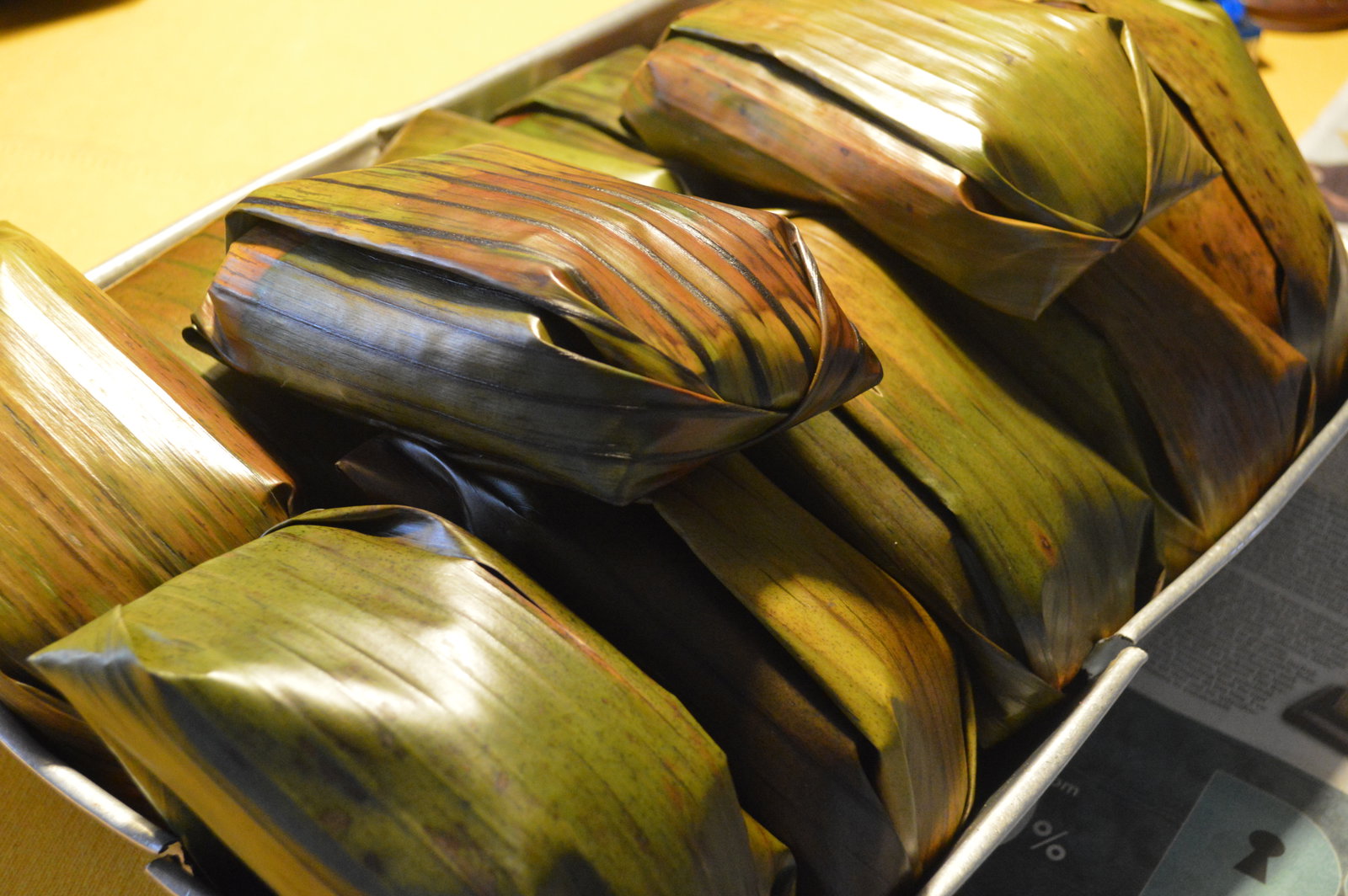
The first impression is restraint. Before the leaf opens, lamprais looks like a tray of glossy bronze-green packets, each one folded tightly enough to hide its abundance. In Vidya Balachander's documentary photograph, the seams and scorch-darkened leaves are the whole visual event.[1] Inside, rice, curry and relishes already touch before the fork does. The leaf holds a meal that has decided to mingle out of sight.
That closeness is the point. Lamprais is often described as Sri Lankan rice and curry baked in banana leaf, but the shorthand hides its achievement. This is not one recipe. It is a small production in which several recipes—savory rice, mixed-meat curry, frikkadels, eggplant, plantain, seeni sambol and blachang—must finish at the same moment, fit inside one parcel and remain distinct enough to create contrast. The final bake does not rescue undercooked food. It makes a group of finished foods agree.
For a fine-dining kitchen, lamprais offers an unusually stern lesson. Refinement does not always mean separating components so that each can be admired alone. Sometimes the craft lies in composing contact: deciding what should soak into the rice, what should stay sharp, and how a leaf can turn many pans into one aroma.
The rice remembers the meat
Lamprais begins before anything is wrapped. In accounts from Dutch Burgher cooks and families in Colombo, meat is simmered ahead of assembly; its stock then becomes the cooking liquid for rice scented with butter, curry leaf, pandan and whole spices.[1][4] The rice is therefore not a neutral bed waiting for curry. It carries the first record of the meat before the meat returns as a separate spoonful.
Small-grained rice matters here because the parcel is compact rather than sprawling. Lorraine Bartholomeusz, a keeper of a family lamprais recipe interviewed by The Sunday Times, described an ideal portion as roughly a breakfast-cupful of small-grain rice cooked in stock—not the huge, oily mound that commercial shorthand can place inside any banana leaf.[2] Richness comes from concentration, not acreage.
That distinction changes how the dish should be read. A luxury menu may instinctively upgrade the rice by making every grain pale, long and individually pristine. Lamprais asks a different question: has the grain absorbed enough of the kitchen's work to connect everything around it? The rice earns attention by being permeable.
Every accompaniment has a different job
The traditional parcel described across the sources varies at its edges, but its grammar is remarkably consistent. A finely cut curry combines several meats. Frikkadels add a fried, peppery register. Eggplant brings sweet-sour softness; seeni sambol brings dark onion sweetness and fishy savor; blachang concentrates fermented shrimp; some family versions include ash plantain.[1][2][4] A scholarly survey of Sri Lankan foods similarly identifies lamprais through flavored rice gathered with shellfish-based relish, curried plantain and meat.[3]
Listing the elements makes the dish sound encyclopedic. Eating them reveals a tighter design. The curry supplies moisture and depth. Fried meat creates an edge. Vinegar lifts the eggplant out of the meat's bass notes. Caramelized onion stretches sweetness across the rice. Fermented shrimp is used in a quantity small enough to behave like punctuation rather than a second sauce.
The parcel succeeds because these preparations do not seek equal volume. A little blachang can alter a large bite; a small patch of sharp eggplant can reset the palate after meat and butter. Lamprais is closer to orchestration than abundance. The cook controls force by changing proportion.
This is also why a chicken leg, boiled egg and heap of yellow rice do not become lamprais merely by acquiring a leaf. Those may make a generous and delicious lunch packet. The objection recorded by Burgher cooks is structural, not cosmetic: replace the network of contrasts with one large protein and one large starch, and the parcel loses the relationships that gave it a name.[1][2][4]
The leaf is a finishing chamber
Before folding, the banana leaf is cleaned and passed over heat so it becomes supple enough to close without splitting.[1][4] That small act belongs to the cooking. A brittle leaf is packaging; a warmed leaf can become a chamber.
Once the cooked elements are gathered, the sealed parcel goes into the oven. The heat rewarms the center, loosens fat and moisture, and draws the leaf's aroma around foods made in different pans. Sri Lankan food researchers describe the broader practice of wrapping warm rice and curries in heat-wilted banana leaf as a way of infusing the meal with a leafy aroma.[3] Family accounts of lamprais make the same sensory point: without the leaf and bake, the food does not smell or taste complete.[1][2]
The important boundary is that the oven is not performing a long braise. The rice has absorbed its stock. The curry is cooked. The relishes have been reduced, fried or pickled. Assembly comes late, when the kitchen has no desire to blur every texture into sameness. The bake supplies a common atmosphere while leaving vinegar sharp, meat rich and the frikkadel edged by frying.
Modern tasting menus often use a last-second tableside pour to unite separately plated elements. Lamprais achieves the inverse. It joins the elements before the guest sees them, then makes the guest break the seal. The reveal is aromatic rather than visual: warm leaf first, then meat, spice, vinegar and fermented shrimp.
A small parcel can contain a large kitchen
The compact size carries social history. Deloraine Brohier recalled lamprais as a Sunday specialty made collectively by women in an extended Burgher family, with meat cooked and leaves prepared the night before.[1] Stephanie Herft described the work in similar terms generations later: one person on onions, another on rice, others on condiments, all following a family recipe.[4]
That labor is easy to erase once the parcel is treated as convenient takeaway. Portability is real, but convenience for the eater was purchased with inconvenience in the kitchen. Several pots, long prep, careful cooling and portioning, leaf work, folding and a final bake disappear into something no bigger than a hand.
Commercial enlargement changes more than appetite. When extra rice pushes the relishes farther apart, the ratio changes; when one oversized parcel replaces several small ones, less leaf touches each mouthful. Whetstone's reporting records the VOC Café increasing portion size in response to customers who felt the older format was insufficient.[4] That adaptation is understandable. It also shows that authenticity arguments are often arguments about who the product must now serve.
No useful account should pretend the dish fell intact from a Dutch cookbook. Reported histories describe lamprais as a Dutch Burgher creation formed in Sri Lanka from Asian rice, tropical leaf, local spice habits, European-style meatballs and a fermented shrimp relish with Indonesian or Malaysian affinities.[1][4] It is creole food, born from colonial movement and made into community inheritance. Calling it simply “Dutch” mistakes the route for the destination.
Do not deconstruct the thing that construction made
A chef can translate lamprais without freezing every household variation. Meat choices can respond to dietary boundaries. A vegetable preparation can change with season. Portion size can suit the service. But a serious reinterpretation should preserve the dish's working verbs: cook the rice in flavor, build several contrasting accompaniments, warm the leaf, fold tightly, bake, open, mix.
The least convincing fine-dining version would place a cylinder of rice in the center, draw eggplant purée across one side, balance a meatball on top and present a tiny square of banana leaf as a heritage signal. Every component might be expertly cooked. The plate would still remove the final mechanism—the forced proximity through which lamprais becomes more than a tasting board of Burgher flavors.
The stronger service is simpler and more theatrical in the honest sense. Bring the parcel closed. Let its seams and scorch marks remain visible. Open it at the table only if the guest wants help, and explain the accompaniments by their own names. The first bite can isolate; the next should mix. What looks rustic from across the room will reveal itself as extremely controlled once sweetness, vinegar, stock, meat and fermented shrimp begin taking turns.
Lamprais does not conceal refinement inside a humble wrapper. The wrapper is refinement. It converts separate preparations, family labor and travelled ingredients into a meal with one temperature and one fragrant sky. A whole table enters the leaf. What comes out is not a collection but an agreement.
Sources
- Vidya Balachander, “History Baked in Banana Leaf,” Roads & Kingdoms (December 16, 2014) — reported history of Dutch Burgher identity, family preparation, the parcel's components, small format, leaf finishing and debates over commercial adaptation; source of the documentary article image.
- Megara Tegal, “That Burgher delicacy wrapped up in banana leaf,” The Sunday Times Sri Lanka (September 13, 2009) — interview with Lorraine Bartholomeusz on rice, mixed meats, accompaniments, portion size and the leaf's role.
- J.K. Mihiranie et al., “Indigenous and traditional foods of Sri Lanka,” Journal of Ethnic Foods 7, 42 (2020) — scholarly overview of Sri Lankan rice traditions, banana-leaf meal packing and lamprais composition.
- Zinara Rathnayake, “In Sri Lanka, Lamprais Keeps the Dutch Burgher Legacy Alive,” Whetstone Magazine — Colombo reporting on family labor, component preparation, portion changes, Dutch Burgher history and present-day inheritance.