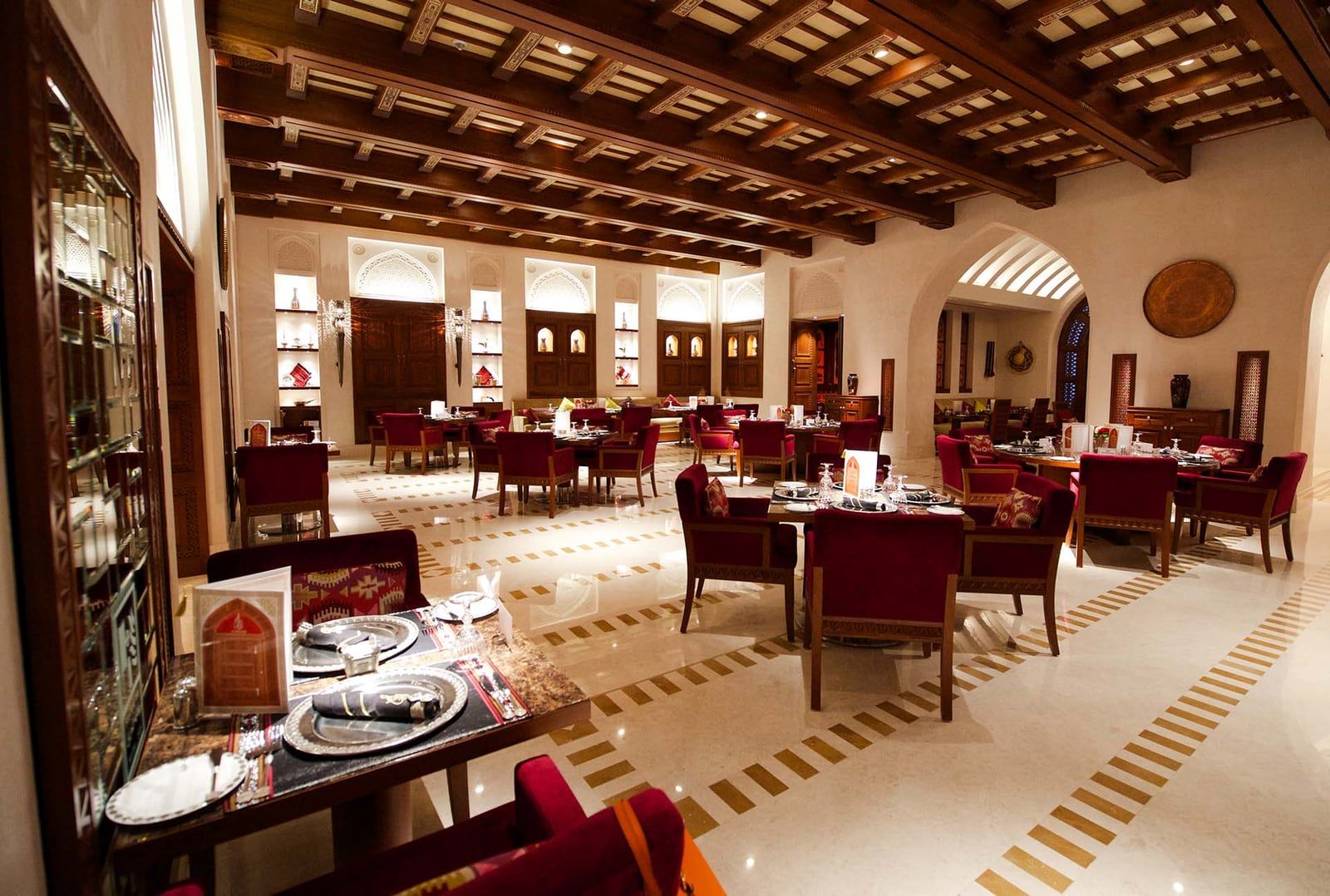
Al Angham's dining room has already made the maximalist decision for you. Deep-red chairs sit under a coffered dark-wood ceiling; silver-toned place settings catch the light; arches open one formal room into another. In the restaurant's official photograph, even an empty table looks as though it is waiting for a delegation.[1]
That grandeur can provoke the wrong kind of ordering. Faced with a menu full of unfamiliar names in a room beside Muscat's Royal Opera House, it is tempting to ask for every prestige signal at once: camel, lamb, rice, another rice, a stuffed pastry, a tasting of sweets. The result may be expensive abundance but a strangely narrow picture of Omani food—brown meat over fragrant grain, repeated until the distinctions disappear.
There is a better route. Order from the coast to the pit, then let coffee close the room. Begin with dry lime or a saline fish preparation, move through one soft grain dish, make shuwa the only monumental meat, and finish with halwa and kahwa. The sequence is not a claim to be the one authentic Omani meal. It is an ordering strategy for seeing how acid, sea, spice, preservation, slow heat and hospitality occupy different registers of the same cuisine.
One boundary matters before booking. Al Angham and the Royal Opera House still identify shuwa, harees, jareesh and other Omani preparations as part of the restaurant's repertoire, while a 2025 tourism guide issued with Oman's Ministry of Heritage and Tourism places the restaurant firmly in Muscat's refined local-dining landscape.[2][3] The detailed menu PDFs hosted by the restaurant were created years earlier. They are useful maps of dish families, not guarantees of today's prices, portions or availability.[1] Confirm the current menu, and ask the server to size the sequence for the table.
First move: find the dry lime
Omani food does not need a theatrical amuse-bouche to announce itself. A bowl or small plate organized around dried lime can do the work more clearly.
The restaurant's published repertoire includes tomato soup with dried Omani lime, fish and seafood preparations sharpened with lime, and qabooli rice carrying dried lime among its spices.[1] The ingredient does several jobs at once. It is sour without tasting freshly green; drying concentrates bitterness and perfume as well as acidity. Against tomato, it darkens sweetness. Against fish, it cuts through oil while leaving a warm, almost fermented-looking shadow of citrus. In rice, it belongs to the spice structure rather than sitting on top as garnish.
For two diners, ask which dry-lime-led soup or salad is available and begin with one shared portion. This is a better first move than assembling several fried or meat-filled starters simply because they look snack-sized. You are establishing the menu's contrast system: sour before smoky, light broth before soft grain, appetite before abundance.
Put one piece of the coast on the table
The second choice should be fish or shellfish—not because seafood must precede meat by fine-dining law, but because Oman is too often reduced to desert imagery once the menu reaches an international dining room. The Ministry-backed guide describes coastal Al Seeb, Salalah and Sur through hammour, kingfish and lobster with tamarind, lemon and aromatic rice. Al Angham's own published menu has mapped kingfish, prawns, lobster, coconut, tomato, tamarind and dried lime across its seafood section.[1][3]
Choose one coastal preparation with a sauce that differs from the opening. If the first course was tomato and dried lime, ask for fish with coconut or tamarind. If the opening was creamy, move toward a clear broth or a sharper tomato base. The point is not to collect species. It is to hear the Indian Ocean in the seasoning.
That ocean is historical, not metaphorical decoration. Reporting for AramcoWorld, Felicia Campbell traced Muscat's table through maritime routes joining the Arabian Peninsula to India, East Africa and beyond; she found biryani, coconut curry, Omani spice mixtures and local fish absorbed into a cuisine whose identity comes partly from making outside influences feel at home.[4] The British Omani Society likewise connects cloves and coconut to the Zanzibar relationship and warming spices to Indian trade.[5]
This is why “skip the fish and save room for the real Omani meat” is the wrong shortcut. The coast is not a preface to Omani cuisine. It is one of the routes by which the cuisine became itself.
Let harees change the speed
At this point the meal needs softness, not another showpiece. If available, make that bridge harees or another slow-cooked wheat preparation.
Harees brings grain and meat so close that their original borders blur. Wheat is cooked down with meat until the dish becomes cohesive; cardamom, cinnamon and ghee can supply aroma and richness without restoring the neat separation of a composed plate.[1][2] Visually, it may be the least spectacular thing in the room. Structurally, it is invaluable.
After bright citrus and a distinct piece of fish, harees lowers the volume. Its texture asks for slower attention and prepares the table for the deeper roast character of shuwa. Share it. A full individual portion before a lamb-and-rice main risks turning the middle of dinner into a wall of starch, but a few spoonfuls give the menu a texture no grilled luxury ingredient can replace.
If harees is not available, ask the server for the softest grain-based dish that is not another mound of rice. The exact substitute matters less than the role: a quiet, spoonable interval between the coast and the pit.
Make shuwa the only monument
Now order shuwa. Not shuwa plus camel rice plus lamb stew plus a second biryani. Just shuwa as the meal's central meat.
Traditional shuwa is built around duration and enclosure: meat is spiced, wrapped and cooked in a tannur or underground oven for a day or longer. Accounts differ by household and region, as they should. The stable idea is that vinegar or citrus, a spice paste, leaves or wrapping, retained heat and a closed chamber turn a large cut into food for an occasion.[3][5] Al Angham's published description specifies lamb marinated with spices and vinegar, covered with banana leaves and slow-roasted overnight in an underground pit.[1]
That method should determine the order. Shuwa is not merely “the lamb option.” It already contains a whole service narrative: anticipation, heat stored out of sight, a parcel opened, meat yielding into rice. Give it room to be read. Ask whether the current serving is designed for one person or for sharing, choose one rice treatment, and resist adding another prestige protein unless the table is large enough to make genuine comparisons.
The useful skip here is duplication, not a supposedly inferior dish. Camel can be fascinating; qabooli can be central; a meat stew may be excellent. But ordering all of them beside shuwa makes the table richer and the tasting poorer. For two, one shuwa and one coastal dish reveal more range than three meat-and-rice combinations. For four, a camel preparation can be the extra branch—but only after the server explains portion size and only if it brings a different sauce or grain logic.
Do not confuse refinement with purification
Al Angham presents Omani food inside an intentionally ceremonial frame. The Royal Opera House describes the restaurant's Omani motifs, silverware, staff welcome and traditional dishes as one continuous hospitality experience.[2] It would be easy to treat that frame as a museum seal: here is pure national cuisine, protected from mixture.
The food itself refuses that story. Rice from the east, cloves associated with Zanzibar, coconut on the coast, dried limes, wheat, coffee, rosewater and saffron do not assemble into a cuisine by remaining strangers. They become Omani through repetition, place and social use.[4][5] A fine-dining room can clarify those connections, but it should not polish away the evidence of travel.
So skip the mental ranking that calls a delicate presentation “modern” and a shared platter “traditional,” as though one must supersede the other. Campbell's reporting found Muscat restaurants already playing with shuwa in flatbread, camel biryani on fine china and frankincense in ice cream while retaining recognizable local flavor structures.[4] The better question is whether a reinterpretation preserves a dish's working idea: dry lime should still cut, harees should still soothe, shuwa should still taste of long enclosure, and hospitality should still outlast the last main course.
Let coffee, not another main, close the argument
The finish should be small and fragrant. Oman's official tourism material places halwa, dates and cardamom-scented kahwa inside the grammar of welcome, served in small cups and accepted as a social gesture rather than merely a caffeine order.[3] Al Angham's published dessert repertoire extends that register through rosewater, saffron, dates and frankincense.[1]
Order Omani halwa with coffee first. Halwa's soft, sticky density and perfume make more sense in small bites beside a bitter, aromatic drink than as a large plated finale. If appetite remains, add one cold detour—frankincense, date or Omani-coffee ice cream if offered—but do not turn the dessert order into a second tasting menu.
The most revealing Al Angham meal is not the one with the largest number of national dishes. It is the one that lets each system stay legible: a dark flash of citrus, the coastal pantry, wheat cooked past its edges, meat transformed by a closed pit, then a small cup that returns luxury to hospitality.
The room supplies the ceremony. The order should supply the movement.
Sources
- Al Angham's official restaurant materials — primary description, source of the real dining-room photograph, and menu documents consulted as repertoire records rather than current price or availability guarantees: official website, official à-la-carte menu, and official set-menu document
- Royal Opera House Muscat, “Al Angham” — current Opera Galleria listing on the restaurant's setting, Omani architectural motifs, silverware, hospitality and core traditional dishes.
- Oman Ministry of Heritage and Tourism with Wanderlust, Uncover the Hidden Tales and Untold Stories of Oman (2025), “On the Menu” — current official tourism context for Al Angham, shuwa, coastal seafood, Omani coffee and the wider dining landscape.
- Felicia Campbell, “The Spice Routes on a Plate,” AramcoWorld, January/February 2014 — reported feature on Muscat's Indian Ocean food history, household cooking and modern Omani restaurant interpretations.
- British Omani Society, “Insight: Gastronomy of Oman” (2020) — Omani-authored account of maritime influences, regional ingredients, shuwa, qabooli, dried lime, spice and bread.