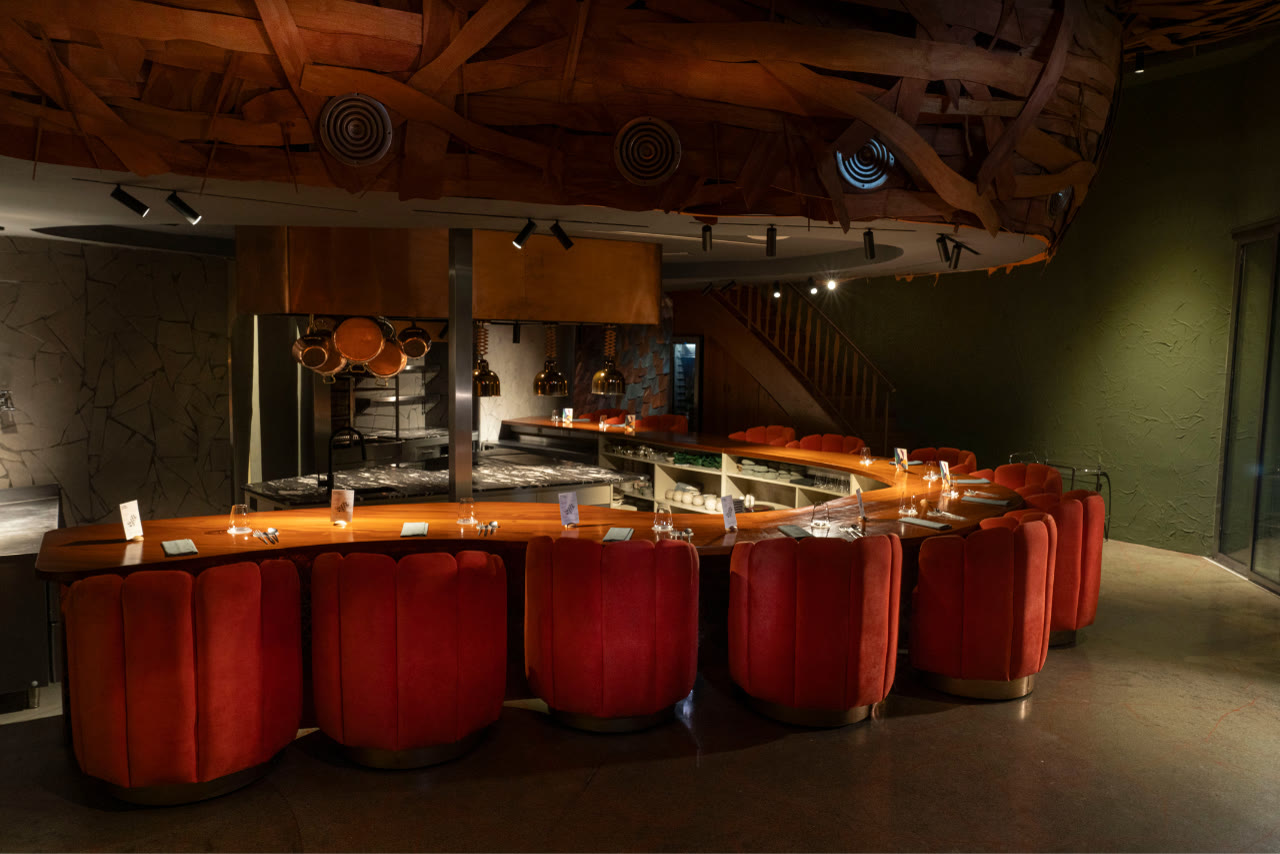
The easiest way to misread Trescha is to treat it as a wunderkind story with a reservation link attached. Tomás Treschanski is young, decorated, and easy to package that way. The stronger reading starts with the room. Michelin's current Argentina feature describes an almost anonymous exterior door, a small reception bar, an underground cellar, and a cedar counter for a tiny number of diners gathered around the kitchen.[3] Latin America's 50 Best 2025 lands on the same point from another angle: dinner begins at the bar, moves to the chef's counter, and finishes with dessert on the patio, making the whole evening feel less like a standard restaurant service than a routed sequence.[5]
That routing matters because it tells you what kind of fine dining this is. Trescha is not trying to overwhelm the guest with plushness, lineage theater, or an inflated sense of old-house formality. The official site talks instead about a contemporary Argentine cuisine built from local products, research, and an ongoing search for its own voice.[1] Put together with the tiny counter and synchronized service, the profile becomes clear. This is a restaurant that wants every diner to see the same argument arrive plate by plate.
Image context: the lead image uses the Buenos Aires Herald's dining-room photograph because the profile turns on the counter itself. Before a guest tastes anything, the room has already declared that proximity, heat, and sequence are part of the cuisine.[6]
The room removes the usual fine-dining blur
Current public details make Trescha sound almost severe in its edit. The restaurant serves dinner Wednesday through Saturday, with seatings at 6:30 pm and 9:45 pm.[2] The menu is currently listed at 300,000 ARS, with four beverage-pairing paths layered around the same meal.[2] Reservations open three months in advance, the experience starts simultaneously for all diners, and the house allows only a 15-minute delay window before lateness becomes a problem for the whole service rhythm.[1] These are not decorative policies. They are the operating conditions of a restaurant that wants the night to begin as a single line, not as a staggered accumulation of arrivals.
Michelin's current write-up and the 50 Best page make the spatial logic even more legible. Michelin describes the cedar counter as seating 11 diners, while 50 Best frames the experience as a 16-course dinner for 10 guests at a kitchen counter.[3][5] The exact public count shifts by source, but the meaning does not. Trescha is built around a deliberately tiny group facing the same kitchen at the same time.
That is why the room feels important. Many ambitious restaurants talk about intimacy when what they really mean is scarcity. Trescha seems to mean something stricter. A counter that small removes cover. The guest can see pace, hesitation, recovery, and confidence; the kitchen can feel attention as a live pressure rather than as an abstract review score. In a city where long tasting menus have often had to defend their existence against a more casual eating culture, that kind of spatial commitment reads less like trend-following than belief.[5][6]
Treschanski's cooking stays local without turning dutiful
The chef biography would be easy to flatten into résumé prestige, yet the sources point somewhere more interesting. Trescha's official page says Treschanski trained in Frantzén, Azurmendi, Boragó, and Barrafina before opening the restaurant in March 2023 in Villa Crespo.[1] Michelin's Argentina article emphasizes the same international background while describing a multi-course menu shaped by textures, temperatures, aromas, and contrasts.[3] The 50 Best profile then adds the key boundary: he opened the restaurant to follow the ideals of those major fine-dining rooms while working mainly with Argentine ingredients.[5]
That combination is what gives the house its charge. In the Buenos Aires Herald interview, Treschanski says the cooking revolves around Argentine produce, but he stops short of calling it straightforward Argentine gastronomy; he describes it instead as personal cooking with French influence in proteins, plenty of ferments, Nordic accents, and some Asian seasoning.[6] That statement is worth taking seriously. It keeps the restaurant out of two weak categories at once. The food does not reduce Argentina to patriotic museum work, and it does not use cosmopolitan technique as an excuse to float free of place.
The result is a profile built on translation. Argentine ingredients are not being staged as heritage relics that must be treated reverently and left untouched. They are being pushed through a chef's travel memory, technical appetite, and appetite for contrast until they can behave like contemporary fine-dining material without losing their local accent.[1][5][6] That is a harder achievement than simply announcing seasonality or origin.
The test kitchen keeps the restaurant from becoming a greatest-hits counter
The most persuasive detail on the official site is not the Michelin star. It is the Test Kitchen. Trescha describes it as a research-and-development space where techniques, fermentations, unexpected combinations, and new narratives for each dish are tested.[1] The Herald interview makes the same place sound even more central: ideas are proposed there, mistakes are allowed to happen there, and dishes can begin from a flavor memory, a visual concept, or a ferment started a year earlier.[6] Michelin's 2025 Sommelier Award release even treats the phrase "Test kitchen" as part of the restaurant's recognized philosophy, not as a side project.[4]
This matters because tiny tasting counters often drift toward self-imitation. Once the room is full and the awards arrive, the temptation is to lock the menu into recognizable signatures and let the booking difficulty do the rest. Trescha's public language points in the opposite direction. The menu is understood as changeable, the test kitchen sits upstream of the dining room, and the chef's own interview language keeps returning to trying things, making mistakes, and discovering combinations through process rather than brand maintenance.[1][4][6]
That restless structure helps explain why the restaurant feels more house-like than chef-heroic. The point is not merely that one talented young cook has good instincts. The point is that the restaurant has built a controlled loop between research upstairs and service downstairs. Michelin and 50 Best both notice the same thing from different ends: what reaches the cedar counter carries experimentation, but the room is tight enough to keep that experimentation readable.[3][5]
The liquid side is part of the profile, not an accessory
Trescha's menu page is unusually explicit about one principle: the liquid component is as important as the solid one.[2] The current public offer lists four pairing routes around the 16-course menu: non-alcoholic at 100,000 ARS, mixed at 160,000 ARS, Trescha at 230,000 ARS, and Cava at 330,000 ARS.[2] The page says the cellar carries more than 650 labels, while the bar builds cocktails with global spirits, ferments, homemade liqueurs, and macerations designed in dialogue with the kitchen.[2]
That claim could still have been marketing inflation if Michelin had not reinforced it independently. In the April 8, 2025 MICHELIN Guide Buenos Aires & Mendoza press release, the Sommelier Award goes to Elena Fernanda Cabrera and Leonel Ismael Castro Ortiz of Trescha, with Michelin praising their work for elevating the restaurant's experience and pairing the Test Kitchen philosophy with champagnes, organic Argentine wines, bottles from around the world, creative cocktails, lambic beers, and house kombuchas.[4] That description makes the beverage program sound less like a generic luxury add-on and more like part of the restaurant's intellectual scaffolding.
For diners, the practical implication is simple. Trescha is not only asking whether a plate is delicious. It is asking whether the whole sequence can stay exploratory without losing shape. The pairings are part of how the restaurant manages that risk.[2][4]
Why Trescha matters now
As of May 11, 2026, the public signals line up with unusual clarity. The official site still foregrounds the restaurant's Michelin star, renewed in 2025, and its inclusion in the Latin America's 50 Best selection.[1] Michelin's current Argentina feature still treats the room as one of the country's starred addresses and singles out the cedar counter as a defining fact.[3] Latin America's 50 Best 2025 places Trescha at No. 36 and describes it as a young chef's fine-dining argument made with mostly Argentine ingredients, a test kitchen, and a highly choreographed guest route.[5] The Michelin press release adds a dining-room distinction through the 2025 Sommelier Award.[4]
That is why Trescha feels worth profiling now. The restaurant's strongest claim is not youth, hype, or even difficulty of booking. It is that Buenos Aires fine dining can still make itself legible through structure. An almost anonymous door, a cedar counter, a cellar below, research above, and a liquid program woven tightly into the meal: the house has enough moving parts to become showy, yet its current public form suggests the opposite. Everything has been bent toward concentration.
In that sense, Trescha's real luxury is not excess. It is control.
Sources
- Trescha official info page, covering Tomás Treschanski's training, the March 2023 opening in Villa Crespo, the restaurant's contemporary Argentine thesis, the Test Kitchen, the Michelin-star renewal in 2025, and reservation rules.
- Trescha official menu and wine page, covering current dinner days and times, the 16-course menu price, four beverage-pairing options, and the cellar/bar program.
- The MICHELIN Guide, "All 10 MICHELIN-Star Restaurants in Argentina," covering Trescha's nearly anonymous entrance, underground cellar, cedar counter, and Michelin's current framing of the restaurant.
- MICHELIN Guide Buenos Aires & Mendoza 2025 press release, covering Trescha's renewed one-star status and the 2025 Sommelier Award for Elena Fernanda Cabrera and Leonel Ismael Castro Ortiz.
- Latin America's 50 Best Restaurants 2025, "Trescha," covering the No. 36 ranking, the 16-course counter format, the bar-to-counter-to-patio sequence, the Test Kitchen, and the mostly Argentine-ingredient concept.
- Buenos Aires Herald, "Meet Tomás Treschanski, Buenos Aires' new culinary wunderkind," covering the room layout, chef interview, staff and service scale, and the dining-room photograph used for this article's lead image.