The easiest way to misread La Degustation Bohême Bourgeoise is to treat it as a nationalist revival room with prettier plates. The stronger reading is narrower and more interesting. This restaurant matters because it takes an urban, bourgeois Czech archive and subjects it to modern tasting-menu discipline: shorter sentences, sharper edits, less starch, more structure.[1][2][3] Prague City Tourism calls it a Michelin-starred flagship of the Ambiente group, while the official site describes a multi-course tasting menu from Czech ingredients inspired by Central European cuisine.[1][3] Both framings point in the same direction. La Degustation is not trying to look rustic. It is trying to make an older Czech language sound exact again.
That is why this is a lineage story rather than a review summary. The current book about the restaurant, covered by Czech Bites in late 2025, says La Degustation decided nearly twenty years ago to return Czech cuisine to domestic and international recognition and proved it could do so, winning a Michelin star in 2012.[4] The deeper anchor sits even further back. Ambiente's own Marie B. Svobodová feature explains that the cookbook author matters because the Michelin restaurant cooks from her legacy; the archive is not decorative background but a live source of method.[5] In other words, La Degustation did not become important by inventing Czech fine dining out of thin air. It became important by deciding that bourgeois Czech cooking could survive only if it was cut down, tightened, and translated.
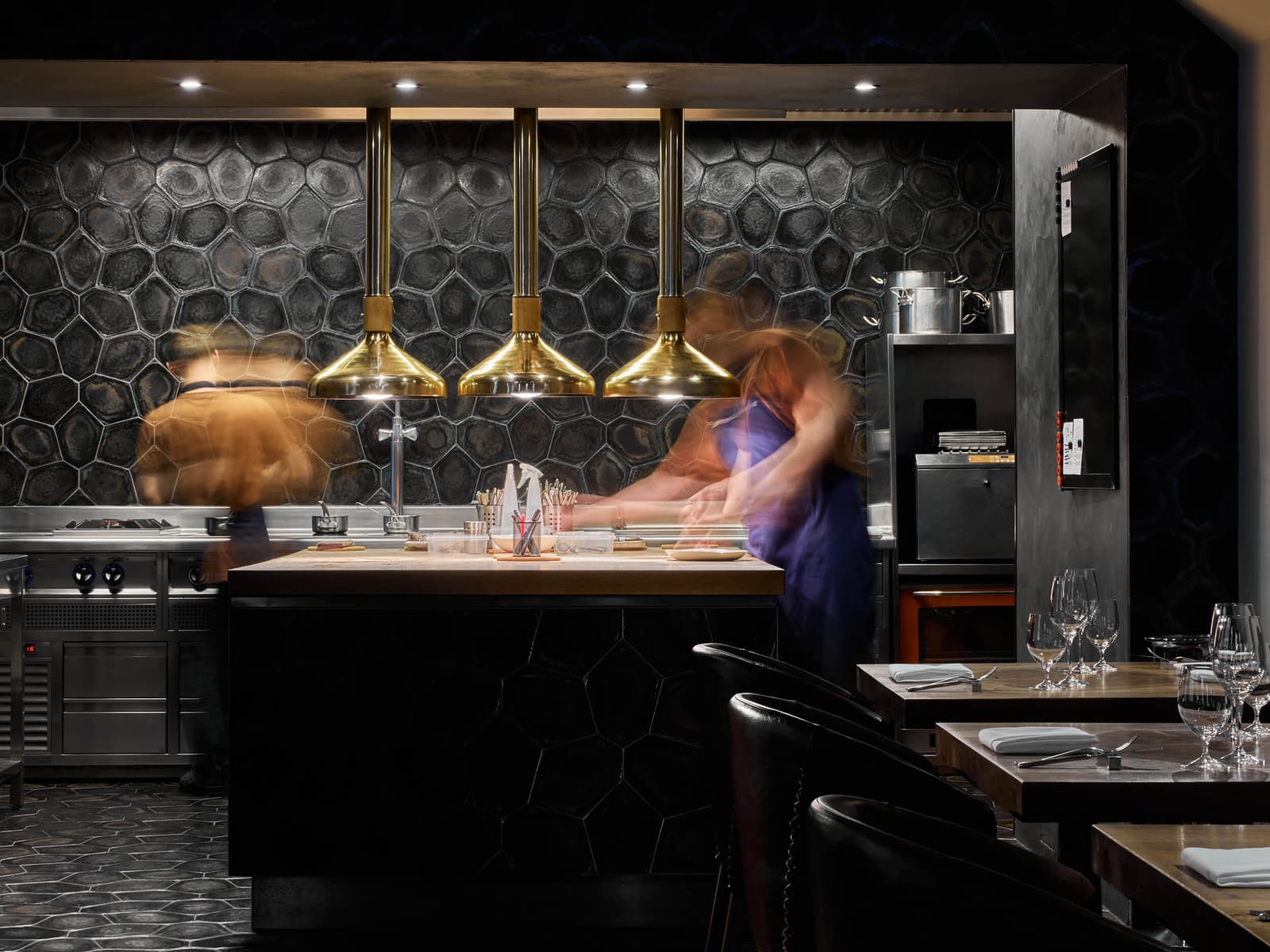
Image context: I chose the official kitchen photograph instead of a hero plate because the core argument is about processing old material through a modern apparatus. The room's black hexagonal tiles, brass lamps, and visible pass make the restaurant look like a workshop of reduction, which is exactly the historical point.[1][6]
1. The archive here is bourgeois, not pastoral
The word bourgeoise does a lot of work in the restaurant's name, and it helps explain why La Degustation feels different from the more common "grandmother's recipes, upgraded" script.[1][5] This is not a hay-and-fermentation fantasy about peasant authenticity. It is a city language: sauces, broths, dill, game, offal, root vegetables, pastry discipline, and the kind of domestic order that can be written down in a serious cookbook and then re-entered into restaurant life a century later.[4][5]
That is where Marie B. Svobodová becomes more than a historical mascot. The Ambiente feature on her life explicitly frames the question as: who was she, and why does a Michelin restaurant cook according to her? The point is not antiquarian curiosity. It is that her book offered a codified Czech household grammar substantial enough to be reworked at high resolution.[5] Czech Bites pushes the same idea into present tense when it says the restaurant proved even dishes such as koprovka and svíčková could stand inside an internationally legible fine-dining setting.[4]
This is a more demanding lineage move than simple homage. Homage lets the old dish remain emotionally powerful because everyone already knows it. La Degustation asks something harder: what if the old repertoire has to survive after being stripped of its family-size generosity and rewritten as sequence, concentration, and pace? That question is what makes the restaurant matter outside Prague.[2][4][5]
2. The current menu shows how the translation works
The current menu is persuasive because it does not shout its historical references.[2] Instead it reads like a series of clean reductions. The tasting sequence currently moves through combinations such as asparagus, potato, apple vinegar; trout, white beans, basil; lamb, ramsons, herbs; beef, beer, green peas; and rhubarb, yoghurt, sorrel.[2] The menu price is 3500 CZK, with Wine adventure at 2000 CZK, Renowned terroirs at 3700 CZK, Non-alcoholic pairing at 1300 CZK, and a Terroir finale at 700 CZK.[2]
Those details matter because they show the restaurant refusing two opposite temptations. On one side is pure museum behavior, where "historic" cuisine arrives too whole, too heavy, too committed to reenactment. On the other is generic international minimalism, where place is reduced to a sourcing slogan. La Degustation's menu sits in the middle. It keeps Czech landscape and Czech ingredient memory close enough to stay legible, but edits them so aggressively that the meal reads as modern Prague rather than culinary pageant.[2][4]
The most revealing line on the menu may be the short dedication beneath the courses: "A tribute to the Czech landscape and those who cultivate it."[2] That sentence narrows the ambition. The restaurant is not claiming to reproduce national cuisine in full. It is claiming to work with land, producers, and inherited flavor logic under the pressure of a small-format dinner. That pressure is what makes the lineage feel alive. The archive is being used, not admired from a distance.[2][5]
3. The room stays contemporary so the archive does not become costume
The official contact page makes the operational outline unusually clear: Haštalská 18 in Praha 1, lunch and dinner service Monday through Sunday, last lunch reservation at 1:30 PM, last dinner reservation at 9:30 PM, and a leadership line that still keeps Oldřich Sahajdák visible as chef patron while naming Marco Christov as chef de cuisine.[1] None of that sounds romantic. That is useful. It means the restaurant is not asking the guest to enter a staged historical village. It is asking the guest to enter a very current service system.
The official kitchen image reinforces that point.[6] There is no folksy warmth, no embroidered reassurance, no fake old-Bohemia atmosphere. What you see instead is a dark, precise pass with cooks moving quickly under brass lamps. Prague City Tourism likewise frames La Degustation as a Michelin-starred tasting restaurant and Ambiente's flagship, which again pushes it away from cosplay and toward institution.[3] The history matters here precisely because the room refuses to dress up as history.
That refusal is a strength. Once a restaurant begins leaning too heavily on inherited atmosphere, the archive does most of the work and the kitchen becomes timid. La Degustation works the other way around. The room is spare enough that the kitchen has to earn the historical claim course by course.[2][6] It cannot hide behind mood.
4. Why La Degustation still matters in 2026
The publication of a restaurant book nearly twenty years into the project is a useful signal.[4] It suggests La Degustation has moved beyond novelty and into something closer to durable civic memory. Czech Bites describes the restaurant as the place that helped return Czech cuisine to recognition at home and abroad.[4] That line would sound inflated if the current menu were a lazy prestige machine. It does not, because the menu still behaves like an argument.
What the restaurant has argued, steadily, is that Czech fine dining becomes convincing only when it stops trying to prove how much past it can carry at once. It has to choose, trim, and recombine. The Marie B. Svobodová connection matters because it gives the project a real archive.[5] The current tasting menu matters because it proves the archive can survive radical editing.[2] The service frame matters because it keeps everything in the register of present-tense work instead of heritage theater.[1][6]
That is why La Degustation remains worth writing about in 2026. It does not preserve Czech bourgeois cooking by keeping it intact. It preserves it by making it smaller, sharper, and more exact until it can move through a modern dining room without losing its accent.[2][4][5]
Sources
- La Degustation Bohême Bourgeoise official site and contact page, covering the restaurant's one-star status, team, address, hours, and Oldřich Sahajdák / Marco Christov leadership line.
- La Degustation Bohême Bourgeoise menu page, covering the current tasting-menu courses, the 3500 CZK menu price, pairing options, and the line "A tribute to the Czech landscape and those who cultivate it."
- Prague City Tourism, "La Degustation Bohême Bourgeoise" - city guide page describing the restaurant as a Michelin-starred tasting restaurant and the flagship of the Ambiente group.
- Czech Bites, "The book documenting Michelin restaurant La Degustation Bohême Bourgeoise" - article covering the restaurant's nearly twenty-year project, its 2012 Michelin star, and its effort to return Czech cuisine to domestic and international recognition.
- Jídlo a radost / Ambiente, "Co dům dal: Po stopách kuchařky a autorky Marie B. Svobodové" - feature on Marie B. Svobodová and why her cookbook became a working source for the Michelin restaurant.
- Official La Degustation image CDN URL for the open-kitchen photograph used in this article.