The easy way to describe Alois is to say that it is the Michelin-starred restaurant above the Dallmayr delicatessen in central Munich.[1][3] That is true, but it misses the real achievement. In a building associated with centuries of appetite, retail display, and ingredient plenty, Alois chooses a quieter register. The restaurant uses the staircase almost like an editorial cut. Downstairs is abundance, movement, and memory. Upstairs, Rosina Ostler and her team turn that abundance into a sequence of small, deliberate dishes that feel more distilled than grand.[1][3][4]
That is why Alois feels worth profiling in 2026. Michelin's current description is unusually precise about what happens once you climb to the first floor: a chic, elegant room; 15 to 17 dishes; classic French and Nordic styles filtered through Ostler's Bavarian roots; thoughtful structure; and a relaxed service model in which chefs help explain the food.[3] Dallmayr's own restaurant page describes the menu in similarly controlled terms, stressing natural simplicity with depth and an atmosphere where guests can relax rather than brace for ritual.[1] Put together, those sources suggest that Alois is not trying to magnify the house's fame. It is trying to edit it into finer detail.
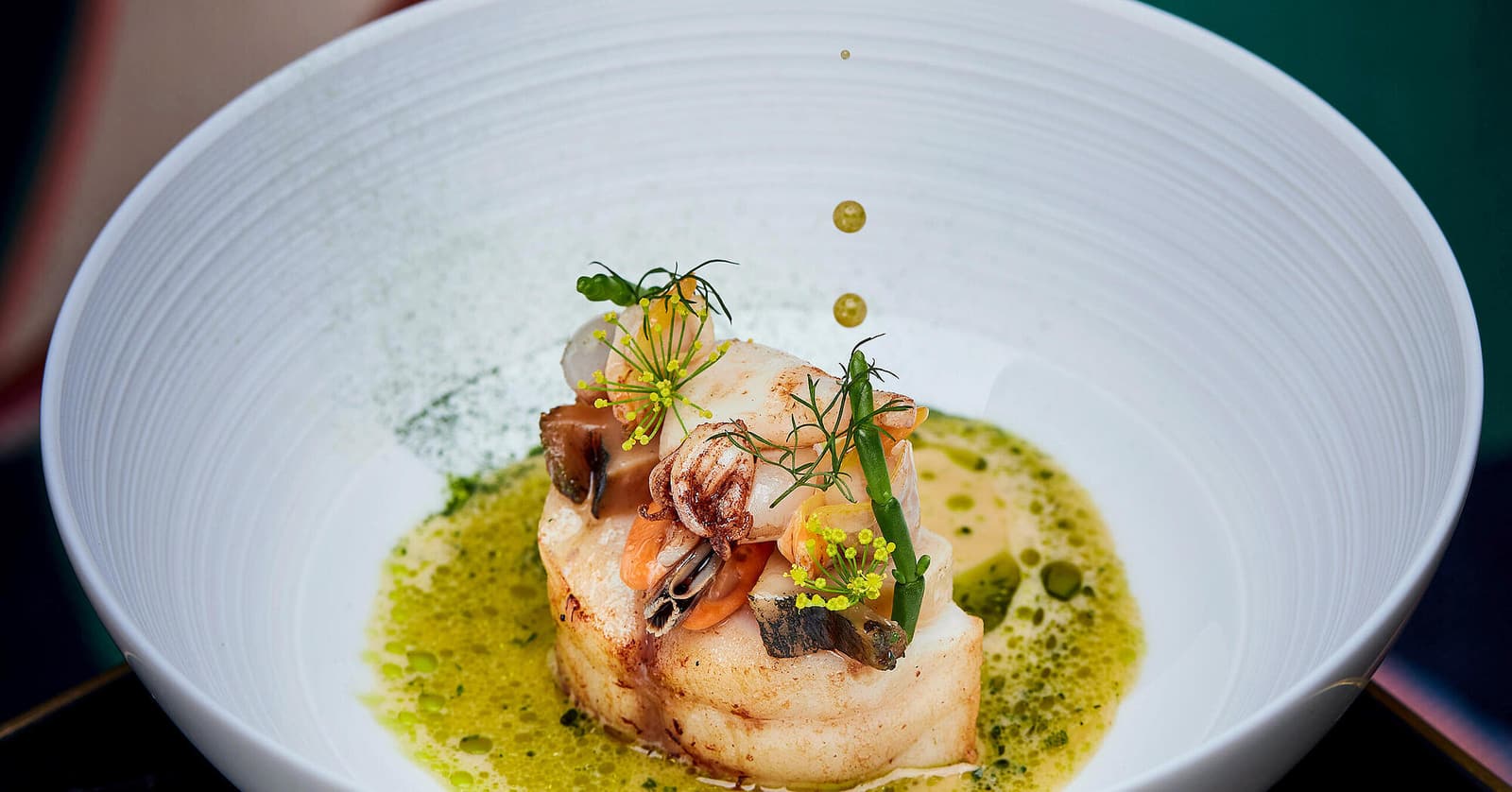
Image context: the cover uses Dallmayr's official dish photograph because this article is about reduction, not spectacle. The wide white bowl, the narrow central build, and the restrained green oil all say something essential about Alois: the house prefers precision and spacing over decorative overload, even when the ingredient set could easily support a louder style.[1][2]
1. The staircase is part of the concept
Dallmayr's official page gives the first important fact plainly: Alois sits on the first floor of the Dallmayr delicatessen, just behind Marienplatz, and is named after former owner Alois Dallmayr.[1] That location is not incidental background. It is the restaurant's central pressure point. Munich's tourism profile on Rosina Ostler captures the feeling well when it describes the room as a kind of living room inside a delicatessen and then places it inside a building first documented in 1700, later famous across Europe for luxury food and for supplying the Bavarian royal court.[4]
Most restaurants attached to a historic gourmet institution would be tempted to stage that inheritance in obvious ways. They would double the luxury signals, push the guest toward reverence, and let the room become a showroom for expensive sourcing. Alois appears to prefer another solution. On the official restaurant page, Dallmayr says the goal is a lively place where guests can have a wonderful time, enjoy themselves, and remember the evening with ease rather than stiffness.[1] Michelin's inspectors independently arrive at the same conclusion from the guest side: the waitstaff is charming, the chefs talk diners through their dishes, and the room stays refreshingly relaxed despite the level of cooking.[3]
This matters because Dallmayr is already doing the loud part elsewhere in the building. The delicatessen downstairs is the public theater of selection and possession. Alois works because it does not try to repeat that performance upstairs. It narrows the emotional field. You are still inside the Dallmayr world, but you are no longer asked to admire it at full volume.[1][4]
2. Rosina Ostler gives the room its exact temperature
The second reason Alois feels current is that Rosina Ostler's biography lines up closely with the restaurant's best qualities. Dallmayr's page traces her route through Schwarzwaldstube, einsunternull, and then Maaemo in Oslo, where she also opened Mon Oncle as head chef before returning to Munich in December 2023.[1] Munich's profile fills in the texture behind that CV: Ostler speaks warmly about Norway's minimal plates, its respect for ingredients, and the way producers deliver directly and personally; she also describes herself as detail-oriented, calm, and uninterested in kitchen screaming.[4]
You can see how those experiences would settle into Alois. Michelin describes the cooking as a blend of classic French and Nordic styles with Bavarian roots.[3] That formula could easily sound generic in lesser hands, but the article on Munich.travel makes it more legible. Ostler is drawn to many small dishes, to wild herbs, to vegetables, to the drama of accumulation without the heaviness of one giant centerpiece. She even shows the writer a small rooftop garden where the team grows herbs, spices, and edible flowers.[4]
This is where Alois stops being a generic luxury restaurant in a famous address. Ostler is not using French technique and Nordic clarity as prestige badges. She uses them to regulate scale. Dallmayr's own wording about depth without contrivance becomes believable once you look at her background.[1] The restaurant feels designed by someone who likes flavor intensity, but likes it even more when it arrives in measured increments.
3. The menu explains the house style better than the branding does
The current English menu PDF makes the point with more force than any slogan.[2] At 300 euros, the full evening menu moves through dishes such as lettuce, elderflower, whey; oyster, seaweed, bergamot; sturgeon, bush fennel, quince; veal sweetbread, onion, rhubarb; asparagus, buffalo milk, fig leaf; pheasant, grain, lovage; and finally dessert notes such as Chartreuse, young spruce, elderberry and sour cream, Szechuan, plum.[2] Even on paper, the sequence reads like compression rather than proclamation.
Michelin's inspectors describe the same menu as cleverly devised, thoughtfully structured, and delicate, with specific praise for combinations such as lobster tail, dark beer, chanterelles or roe deer, wild fig, Swiss chard.[3] The useful part of that description is not the luxury ingredient checklist. It is the sense of cadence. Alois seems to prefer dishes that arrive with two or three strong directional cues rather than a dozen competing gestures.
Munich.travel adds one more practical detail: Ostler currently works with 10 courses at lunchtime and 16 in the evening, and she likes the way numerous small plates can build toward a cumulative flavor line.[4] That helps explain why Alois feels less like a room chasing blockbuster signatures and more like one shaping the guest's attention course by course. The menu is not miniature because the house lacks ambition. It is miniature because ambition here is sequenced.
That sequencing also clarifies why the dish photo works for this article. Even the plate in the lead image holds back. The seafood, the sauce, the herb note, and the open white space all cooperate. Alois appears to believe that luxury gets sharper when the plate leaves something unsaid.[1][2]
4. Wine and service keep the room warm
Restaurants built on many small courses can become overly cerebral if the dining room does not supply warmth. Alois seems aware of that risk. Michelin tells diners to seek out Julien Morlat for recommendations from a wine list especially strong in Old World wines.[3] Dallmayr's own page similarly says Morlat curates a cellar of rare wines, new discoveries, and insider tips, and notes that the restaurant can also build non-alcoholic accompaniment into the experience.[1]
The service philosophy matters just as much as the bottles. Michelin notes that the chefs themselves support the waitstaff by talking diners through the dishes, while Munich.travel emphasizes the restaurant's relaxed energy, young team, and Ostler's preference for a room full of people laughing and chatting rather than measuring themselves against formal codes.[3][4] Read next to the historic Dallmayr setting, that is a sharp decision. Alois could easily have become a ceremonial shrine over a famous shop. Instead, it behaves more like a high-precision room that still wants circulation, conversation, and pleasure.
Even the timetable supports that reading. Dallmayr lists lunch on Fridays and Saturdays from 12:30 and dinner Wednesday through Saturday from 19:00, while Michelin notes the presence of an 8-course business lunch in addition to the full menu on weekend middays.[1][3] Those details make the restaurant feel lived-in rather than aloof. There is room for a long evening, but also a room for a more compressed midday version of the argument.
Alois therefore matters in 2026 for a reason more specific than star count. It shows how a famous gourmet house can translate abundance into quiet. The Dallmayr building supplies history, procurement reach, and sensory temptation. Ostler's menu and Morlat's cellar then reduce all of that into a finer scale: many small dishes, strong but edited flavor contrasts, and a dining room warm enough to keep precision from turning cold.[1][2][3][4]
Sources
- Dallmayr, "Alois Dallmayr Fine Dining" - official restaurant page covering the first-floor location behind Marienplatz, Rosina Ostler's career path and December 2023 return to Munich, Julien Morlat's role, menu philosophy, opening hours, and the official image used for this article.
- Dallmayr, "Menu Alois" - current English menu PDF listing the 300 euro evening menu and its present dish sequence, from lettuce, elderflower, whey through pheasant, grain, lovage and the final dessert courses.
- MICHELIN Guide, "Alois - Dallmayr Fine Dining - Munich" - current Michelin listing covering the two-star status, first-floor setting above the iconic delicatessen, 15 to 17 dish structure, French-Nordic-Bavarian blend, Old World wine strength, business lunch, and relaxed service model.
- simply Munich, "Lunch break with a star chef: Restaurant Alois" - profile of Rosina Ostler covering the room as a living room inside a delicatessen, the 1700-era Dallmayr setting, the rooftop herb garden, her Norway and Maaemo years, the 10-course lunch and 16-course evening format, and the restaurant's calm team culture.