The lazy way to sell AUYL is to call it an atmospheric destination restaurant in the hills above Almaty and stop there. You drive into the Medeu district, see felt, clay, copper, and low light, then leave believing you have consumed a little culture along with dinner. The stronger reading is harder and more interesting. AUYL's own site does not describe itself as a nostalgic national restaurant. It calls itself an experimental restaurant project created by architects, artists, artisans, designers, and creative producers, a place that sits at the intersection of gastronomy and performance.[1] The World's 50 Best Discovery profile says much the same from outside the house: this is a former yurt-shaped building inherited from Soviet modernism, relocated and reworked around an interactive open kitchen that functions like a stage.[2]
That difference matters. Plenty of restaurants borrow traditional imagery as mood. AUYL seems determined to make the room, the cooking methods, and the guest's movement through the evening say the same thing. The official site keeps repeating a small set of core ideas: neo-nomad restaurant, open fire, water, flour, and meat, handmade interiors, and a drinks list designed to stimulate not only taste but smell, sound, touch, and story.[1] Visit Almaty's current gastronomy guide then places AUYL in the city's fine-dining conversation as a unique restaurant of neo-nomadic cuisine of Central Asia.[3] Put those pieces together and the restaurant starts to look less like a themed night out and more like a serious attempt to give Central Asian memory a contemporary fine-dining language.
That is also why AUYL feels timely in 2026. Chef Ruslan Zakirov now describes his work as a philosophy in which the ingredient takes center stage, and his current profile notes that the restaurant entered 50 Best Discovery in 2025 and had already been recognized by Prix Versailles as one of the world's most beautiful restaurants.[4] Those accolades are not the reason the restaurant matters. They are evidence that a dining language built from horse, dough, smoke, rough texture, and mountain distance is no longer being read only as local color. It is being read as authorship.
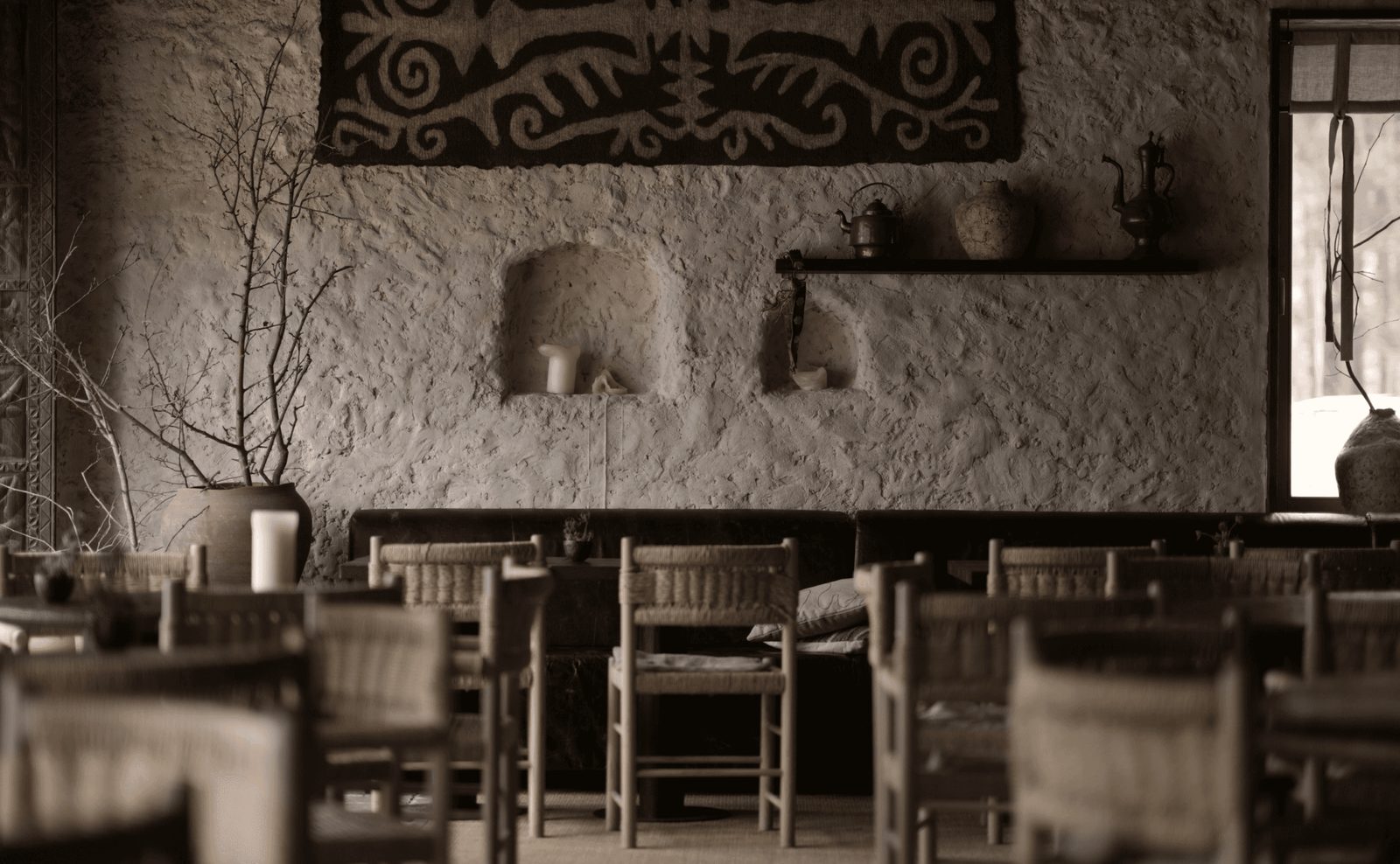
Image context: the cover uses AUYL's official interior photo because this article is about how the restaurant builds authority through material discipline. The clay-textured wall, felt hanging, shelves of vessels, and woven chairs make the point more cleanly than a plated glamour shot could: AUYL wants the guest to enter a world before the menu starts explaining itself.[1][5]
1. The room is not a container for the concept. It is the concept's first sentence
The official site is unusually blunt about how many hands shaped AUYL.[1] It frames the restaurant as a creative collaboration rather than as a chef-only signature. That matters because the place is clearly trying to avoid the most familiar luxury template: polished international neutrality with a few local references dropped in afterward. Instead, AUYL makes its design language inseparable from the meal. The house materials are described as handmade items, chairs, carpets, and decorations meant to age naturally and develop patina over time.[1] That phrase alone tells you the room is being asked to behave like an object with memory rather than a showroom for pristine newness.
The 50 Best Discovery write-up makes the same argument more efficiently.[2] It points to handmade chairs, carpets, and decor, then locates the restaurant in the mountainous Medeu zone and stresses that the open kitchen is part of the spectacle rather than hidden backstage.[2] Goya's 2026 photo essay fills in the textural details. It describes a historical Soviet-era building moved from Aktau to the slopes above Almaty, a facade with mosaic imagery, coarse clay and stone surfaces, oxidized copper, jute, rough wood, and floor seating derived from yurt traditions.[5] Whether a diner knows all of that history on arrival is almost secondary. The important thing is that the room refuses to read as generic contemporary luxury. It asks the guest to understand that craft, material, and ancestry belong inside the meal's argument.
This is where AUYL becomes more than a stylish national project. Too many "heritage" restaurants separate visual authenticity from culinary ambition: the room does the cultural work, while the plate follows a more familiar upscale global script. AUYL appears to be pushing the opposite way. The room narrows the restaurant's choices. Once the architecture says Central Asia this clearly, the kitchen has to answer in kind.
2. Fire, flour, and meat are treated as grammar, not as rustic theater
AUYL's food statement is one of the clearest in the current fine-dining landscape. On the official site, the kitchen is called the restaurant's flaming heart, and the menu is said to be based on the three most important ingredients in nomadic cuisine: water, flour, and meat.[1] Those dishes are cooked over open fire, in a qazan, on a mangal grill, and in a tandoor oven, while some produce comes from a small kitchen garden on the grounds.[1] 50 Best Discovery repeats the same formulation almost verbatim, which is useful because it confirms that the restaurant's public identity is coherent from inside and outside the house.[2]
That coherence matters because AUYL could easily have settled for open-fire theatrics. Instead, the sources suggest a more disciplined ambition. Zakirov's chef profile says his current focus is neo-nomadic cuisine, a philosophy where the ingredient takes center stage and quality is non-negotiable.[4] Goya's account then shows what that looks like in practice: bone marrow spread over bread with lazjan, Dungan noodles with horse meat, beshbarmak served with broth, breads baked in ways tied to the steppe, and an apple dessert that folds local fruit memory into a modern ending.[5]
What makes those dishes interesting is not shock value. Horse meat in particular can be flattened into easy outsider fascination. The better way to read AUYL is structural. The restaurant keeps returning to foods that would make very little sense if they were stripped of dough work, broth logic, hand-feel, and fire management. Even when the presentation is contemporary, the meal appears committed to techniques that preserve the pressure of older eating systems: boiling, baking, grilling, pulling noodles, warming bread, and building flavor from grain, fat, and smoke rather than from imported luxury cliché alone.[1][5]
That is why AUYL feels more persuasive than a lot of globally ambitious "new national" restaurants. It does not try to make Central Asia look elegant by removing the very foods and textures that made the region legible in the first place. It modernizes by editing method and proportion, not by erasing origin.
3. The performance claim is real because the whole house participates
If the room and the menu already carry a strong point of view, the drinks and service system finish the argument. AUYL's official page says the cocktail list is designed to immerse guests in the culture of Kazakhstan through smell, sound, tactile feel, appearance, and story, with bartenders prepared to recount the logic behind each drink.[1] The wine section is built around a similar idea: each bottle should connect the vine, the winemaker's philosophy, and the moment the glass is poured.[1] That is a distinctly authored stance. Drinks are not being treated as a parallel revenue stream. They are part of how the restaurant teaches guests to read the meal.
Goya's reporting sharpens the performance element further. It describes the open kitchen as a visible working core where guests can watch chefs knead dough, churn kumys, bake flatbread, and grill meat, while smoke rises from the tandoors and qazans below warm-tinted lamps.[5] 50 Best Discovery had already called the kitchen a stage.[2] Seen together, the claim stops sounding like promotional poetry. AUYL appears to have built a restaurant where process is deliberately exposed, but exposed in a way that still belongs to a composed environment rather than to casual transparency theater.
This is a harder trick than it looks. A lot of restaurants now offer open kitchens, but the result is often one of two extremes: either an anonymous production line, or a self-conscious chef performance that overwhelms the meal. AUYL seems interested in a narrower lane. The choreography matters because it keeps the guest inside the restaurant's central thesis: tradition is not a static exhibit behind glass. It is an active set of methods still capable of producing heat, rhythm, and modern pleasure.
4. Why AUYL feels worth publishing now
The strongest reason to care about AUYL in 2026 is not that it has become internationally visible, although that visibility helps. It is that the restaurant offers a way to talk about Central Asian fine dining without flattening the region into either folklore or geopolitics. Visit Almaty currently presents the city as a gastronomic destination with thousands of restaurants and a serious fine-dining lane, and within that frame AUYL is singled out as a unique neo-nomadic project rather than a generic national stop.[3] Zakirov's profile adds the external proof of momentum: 50 Best Discovery recognition in 2025 and prior Prix Versailles attention.[4]
Those signals matter because they show that AUYL is not operating only as an attractive local exception. It is entering a wider conversation about what contemporary regional authorship can look like. The restaurant seems to understand that international readability does not require sanding down its own grammar. It can keep horse, flatbread, broth, qazan, mangal, tandoor, felt, patina, and mountain distance in the frame while still asking to be judged as a modern restaurant rather than as an ethnographic curiosity.[1][2][4][5]
That is AUYL's real achievement. It takes traditions that are easy to romanticize from a distance and makes them work under the pressures of a full dining room, a visible kitchen, a beverage program, and a globally legible fine-dining standard. The result, at least from the current public record, is not a museum and not a theme park. It is a restaurant that has found a way to make Central Asian memory behave like present-tense craft.[1][2][3][4][5]
Sources
- AUYL official homepage, covering the restaurant's experimental-project framing, the intersection of gastronomy and performance, the cocktail and wine concepts, the open-fire cooking methods, the water-flour-meat core, the kitchen garden note, and the official interior image used here.
- The World's 50 Best Discovery, "Auyl - Almaty - Restaurant" - profile covering the Medeu mountain setting, the former yurt inherited from Soviet modernism, the interactive open-kitchen stage, Ruslan Zakirov, Yulia Lomteva, and the interior's handmade chairs, carpets, and decor.
- Visit Almaty gastronomy guide, current English page listing AUYL under fine dining as a "Unique restaurant of neo-nomadic cuisine of Central Asia" and positioning Almaty as a growing gastronomic destination.
- Borjomi Gastro Guide, "Ruslan Zakirov" - chef profile covering Zakirov's neo-nomadic philosophy, the ingredient-centered approach, AUYL's inclusion in 50 Best Discovery in 2025, and the restaurant's Prix Versailles recognition.
- Goya, "Auyl is Redefining Central Asian Food in Kazakhstan" (January 29, 2026) - photo essay covering the relocated Soviet-era building, interior materials, open-kitchen choreography, yurt-inspired seating, and dish examples including marrow with bread, Dungan noodles with horse meat, beshbarmak, and apple dessert.