The easiest way to flatten Indian Accent is to keep talking about it as if the whole story were already finished sometime in the Manish Mehrotra years. That version of the restaurant is real, and its historical importance is not in doubt. But it is no longer the only interesting question. In 2026, the better reason to look at Indian Accent is that it has become a test of whether a modern Indian flagship can survive the handoff from founding-chef aura to durable house style without losing sharpness, warmth, or appetite.[1][4][5]
That test matters because Indian Accent is not a small cult counter built on one person's improvisation. The official New Delhi page still presents it as a restaurant that "showcases inventive Indian cuisine" by pairing the flavors and traditions of India with global ingredients and techniques, now from its base inside The Lodhi.[1] The 50 Best Discovery profile, updated for the current awards cycle, frames the room as a polished modern dining space with garden views, a vegetable-aware menu, and a six-course wine-paired tasting sequence as the clearest way to read chef Shantanu Mehrotra's range.[4] Put beside the current menus, that gives you the real picture. Indian Accent now works less like a monument and more like a system.
The chef transition is therefore not side gossip. It is the central reason the restaurant is still worth profiling. India Today wrote in April 2025 that after roughly two decades under Manish Mehrotra, Indian Accent was being led by executive chef Shantanu Mehrotra.[5] A second April 2025 feature in The Week described the new tasting menu as regional, surprise-minded, and modern in technique while also stressing the chef's own simplified explanation: traditional Indian flavors, presented with modern methods.[6] That is exactly where the house now stands. Indian Accent is persuasive because it has kept the original argument alive while changing who carries it.
1. The restaurant still wins by making "modern Indian" legible
Many restaurants in this category become vague once they start talking about memory, region, and innovation in the same paragraph. Indian Accent is still unusually readable. The official site describes the cuisine plainly: Indian flavors and traditions, global ingredients and techniques.[1] That sentence is broad, but the current menus make it concrete.
On the à la carte menu, the restaurant is not simply plating familiar dishes more neatly. It keeps staging recognizable Indian forms against small technical or cultural displacements: atta and semolina puchkas with Calcutta jhal potato and five waters; burrata chaat with lotus-root papdi and mustard tomato jam; 100 layer paneer with tamatar chaman and kohlrabi; rice-crusted john dory moilee; and warm doda burfi treacle tart to close.[2] None of those dishes hide their reference points. The pleasure comes from the fact that the references remain visible while the treatment shifts.
The tasting menu makes the same case with more discipline. The current non-vegetarian six-course sequence opens with potato chaat, black truffle, then moves through sea scallop, XO balchao, sanna, kolhapuri chicken with avocado and Gujarati thalipeeth, a sorbet pause, a choice between chicken keema roulade and pork belly tikka, and finally smoked duck biryani with koshihikari rice before dessert.[3] The vegetarian version follows the same grammar, substituting dishes such as green jackfruit, XO balchao, sanna and malai kofta, five spice squash curry, quinoa.[3] This is the real Indian Accent trick: it does not pretend modernity requires distance from Indian forms. It keeps returning to them and then reroutes texture, sequence, or plating pressure around them.
2. The menu architecture is strong enough to survive a chef handoff
Restaurants built too tightly around one founding personality often become unstable the moment succession becomes visible. Either the new chef is forced into imitation, or the room lunges toward reinvention to prove that history no longer matters. Indian Accent looks more durable than that because the menu architecture already knows what the house is supposed to do.
The current pricing structure helps make that visible. As of April 19, 2026, the four-course lite tasting menu is INR4,000 vegetarian and INR4,200 non-vegetarian, while the full chef's tasting menu is INR5,800 vegetarian and INR5,950 non-vegetarian, with wine-pairing supplements layered above that.[3][7] Those numbers matter less as luxury-signaling than as editorial choices. The restaurant is offering readers two ways into the same worldview: a shorter, clearer entry path and a longer statement piece.
The lite menu shows how controlled that entry path is. A vegetarian guest moves from Thai pomelo salad to pulled jackfruit, then to mashed greens, summer corn, kadhi or baked paneer, tamatar chaman, kale, with dal sultani, raita, millet roti, and a Kinnaur apple dessert finishing the structure.[7] The non-vegetarian version keeps the same pacing but swaps in smoked duck and Thai pomelo salad, kolhapuri chicken, and a choice of seared john dory, Kerala moilee, asparagus or slow-cooked lamb shank, brown onion korma, hajikame.[7] That is not a loose sampler. It is a compressed statement of the house: acidity first, memory second, one comfort-heavy main, then a soft landing.
This is why the Shantanu Mehrotra transition feels less risky than it might have on paper. The Week described a 2025 tasting menu that moved through different Indian states and flavor memories while remaining technically restrained rather than theatrical.[6] India Today called the restaurant an "interesting inflection point" and highlighted the way the new chef's tasting menu handled contrast, surprise, and texture.[5] In both accounts, the operative point is not rupture. It is continuity with a tighter editorial hand. Indian Accent no longer needs to prove the category exists. It now needs to prove the category can age without stiffening.
3. The Lodhi room matters because it keeps the flagship from turning doctrinal
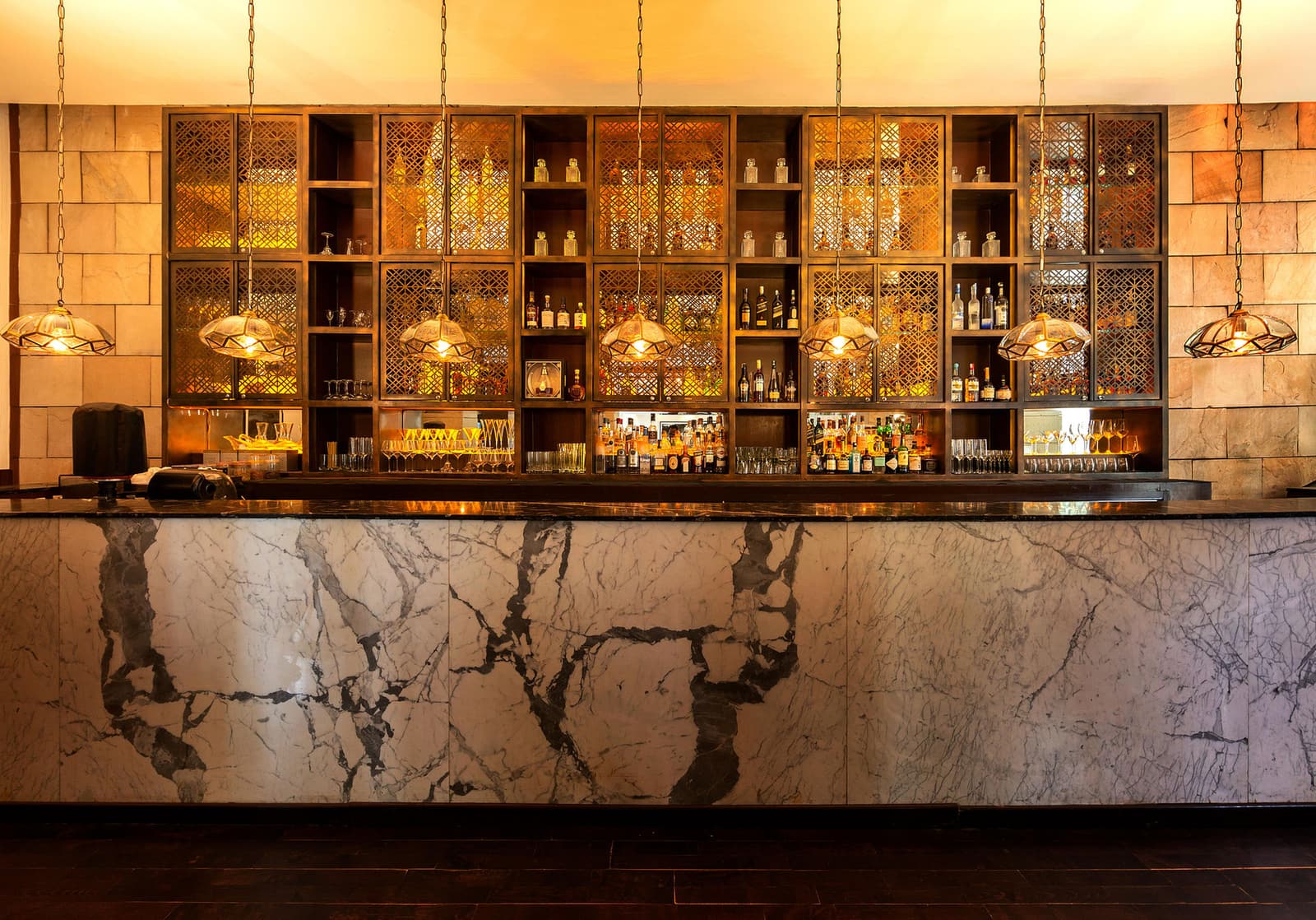
Fine-dining restaurants that describe themselves as cultural projects often forget to remain pleasurable as rooms. Indian Accent's continued value lies partly in the fact that it still behaves like a place to enjoy dinner, not a seminar on the future of Indian cuisine. The 50 Best Discovery entry emphasizes the dining room's marble, white tablecloths, and garden-facing windows.[4] The official site keeps the description simple and rooted in place: Indian Accent, New Delhi, at The Lodhi.[1]
That setting does more than flatter the food. It prevents the restaurant's intellectual ambitions from becoming dry. The current menus are full of dishes that could sound overdetermined if served in a colder room: black dairy dal, dal moradabadi with crispy lentils and buknu masala, kashmiri morel pulao, meetha aachar pork ribs, kanyakumari crab with Tellicherry pepper.[2] In a sterile environment, that kind of list can feel like a lecture in regional reference. At Indian Accent, the room softens the rhetoric. The restaurant still understands that a flagship needs atmosphere as much as ideology.
That atmosphere also explains why the restaurant has held onto relevance even as newer Indian fine-dining projects have emerged with sharper single-region claims or louder technique. Indian Accent's ambition is broader. It wants to turn the dining room into a controlled argument for plural Indian luxury: not one region, not one memory register, not one imported fine-dining syntax. The result is occasionally less radical than the most daring younger kitchens, but it is also more legible to a wider table.
4. Why Indian Accent still feels alive now
By 2026, Indian Accent is no longer interesting because it invented a recognizable global language for modern Indian food. That achievement is historical. What matters now is that the restaurant still knows how to stage appetite inside that language instead of merely preserving it.
The current menus keep giving the game away. Potato chaat meets black truffle, but remains chaat.[3] Green jackfruit arrives with XO balchao and sanna, but the dish still reads as coastal Indian and fermented rather than vaguely cosmopolitan.[3] 100 layer paneer is an unmistakably modern piece of kitchen engineering, yet it still leans on tamatar chaman rather than fleeing into abstraction.[2] Even the bread section is trying to hold pleasure and authorship together: butter chicken kulcha, chilli hoisin duck kulcha, wild mushroom kulcha, black garlic naan.[2]
That is why the restaurant profile still holds. Book Indian Accent if you want to see what happens when a category-defining restaurant refuses both museum status and nervous reinvention. Book it if you want a flagship that still believes in the tasting menu as narrative, not just as price format. Think twice only if you want something narrower, rougher, or more confrontationally regional. Indian Accent's gift is different. It makes a broad idea of Indian modernity feel edited, comfortable, and alive enough to survive the departure of the person who first made the idea famous.[1][2][3][4][5][6][7]
Sources
- Indian Accent New Delhi official website, covering the Lodhi location, the restaurant's inventive-Indian positioning, and Chef Shantanu Mehrotra's role.
- Indian Accent New Delhi, current à la carte menu PDF, covering present dish names, categories, and menu pricing.
- Indian Accent New Delhi, current chef's tasting menu with house wine pairings PDF, covering the vegetarian and non-vegetarian six-course sequences, wine pairings, and tasting-menu pricing.
- The World's 50 Best Discovery, "Indian Accent - New Delhi," covering the 2025 Asia's 50 Best placement, the dining-room description, and the tasting-menu framing.
- India Today, "Indian-fusion food | Getting the accent right" (April 25, 2025), covering Indian Accent's chef transition, the new tasting-menu inflection point, and updated pricing context.
- The Week, "Chaats, chillies and chocolate: Indian Accent's new tasting menu is all about traditional flavours with a modern twist" (April 15, 2025), covering Shantanu Mehrotra's stated menu logic and the regional structure of the new tasting menu.
- Indian Accent New Delhi, current 4 course lite tasting menu PDF, covering the shorter vegetarian and non-vegetarian tasting paths and pricing.