Chez Panisse is now so famous as a shorthand that the shorthand can get in the way. "Farm to table" makes the Berkeley restaurant sound as if it mainly contributed a moral slogan. "California cuisine" makes it sound as if the whole matter can be reduced to sun, lettuces, and rustic charm. The more durable achievement is quieter and more technical: Chez Panisse made the market menu feel like an operating system.
That distinction matters because the restaurant did not begin as a polished institution. It opened in 1971, in a Berkeley food culture shaped by counterculture, French memory, local artisans, and a still-forming network of growers and foragers.[1][2][3] The first version was not a mature template. It was a fragile room trying to make taste, politics, and hospitality point in the same direction before the supply chain had fully learned how to support it.
The result, after years of improvisation, was not simply a better tomato on a plate. It was a new hierarchy. Instead of asking ingredients to serve an inherited fine-dining script, Chez Panisse asked the menu to serve the ingredients. That is why its influence still travels through restaurants that look nothing like it.
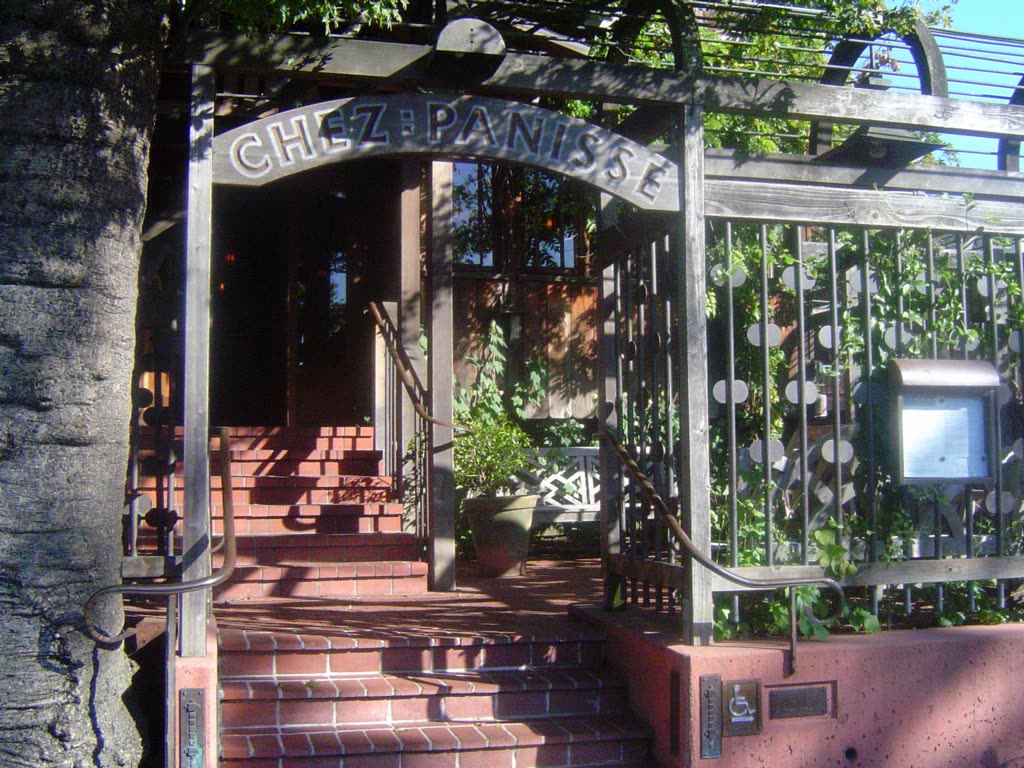
Image context: the lead image uses a real Wikimedia Commons photograph of Chez Panisse taken in 2003. The exterior is modest, but that modesty is the point: the restaurant's lineage is less about spectacle than about how a small doorway in Berkeley became a durable model for market-driven fine dining.[7]
The French beginning was real, but it did not stay frozen
Chez Panisse was not born from pure Californian spontaneity. Alice Waters had studied in France, and Britannica's biography ties her early imagination to farm-to-plate habits she absorbed there before returning to Berkeley.[4] Smithsonian Magazine similarly frames the restaurant's first years against French models, noting that the opening dinner in August 1971 still looked backward toward a fixed-price, French-inflected menu rather than toward the later cliches of Californian lightness.[1]
That makes the later shift more interesting. Between 1977 and 1983, the restaurant gradually moved away from French imitation and toward what would become "California" or "New American" cooking.[1] The transformation was not a rejection of France so much as a relocation of French seriousness. The lesson Waters and her circle carried forward was not that every dish should remain French. It was that a restaurant should care fiercely about season, locality, ripeness, and the social life of food.
This is where Chez Panisse's lineage becomes useful. Many restaurants inherit recipes. Chez Panisse inherited a way of paying attention, then translated it into Berkeley conditions. The Bay Area supplied urban gardeners, foragers, bakers, winemakers, coffee people, olive oil advocates, cheese makers, and farmers who were willing to treat a restaurant as a market partner rather than a passive buyer.[2][3] The cuisine changed because the ecosystem around the back door changed.
The daily menu made seasonality accountable
Seasonality is easy to admire in principle and hard to execute in public. A restaurant can write "local and seasonal" on a website and still run a menu that barely changes. Chez Panisse made the promise legible by tying the dining room to daily menu behavior.
The current restaurant still expresses that old logic in operational form. Its downstairs dining room offers a four-course set menu built around sustainably sourced seasonal ingredients; menus for the coming week are published the prior Saturday; the restaurant runs two dinner seatings Monday through Saturday; and vegetarian substitutions are treated as the main planned exception rather than as a custom-build model.[5][6] The weekly menu page shows the same discipline in miniature: one May 2026 week moves through Full Belly Farm asparagus, local fish and shellfish, wild king salmon, Riverdog Farm lamb, Becker Lane Farm pork, morels, fava beans, spring onions, stone fruit, strawberries, and a wood-fire vocabulary that keeps the meal grounded in product rather than decoration.[5]
The important part is not that every listed dish is revolutionary. Many are intentionally plain in outline. The point is that the menu teaches the guest how to read luxury. A spring dinner does not need to announce itself through caviar, truffle, and imported prestige alone. It can announce itself through asparagus at the right moment, salmon handled with restraint, or a tart that lets fruit behave like fruit.
That is a radical move only because it sounds so obvious now. Smithsonian Magazine notes that in the early 1970s American shopping and dining culture often valued low price, variety, and year-round availability more than origin or flavor.[1] Chez Panisse helped make the opposite expectation feel normal: a serious restaurant should know where food comes from, and the answer should shape tonight's menu.
The producer network was the real luxury
One reason the Chez Panisse story can become sentimental is that "local farmers" now reads as a soft phrase. In practice, it was infrastructure. The Smithsonian's National Museum of American History describes Berkeley's "gourmet ghetto" as an extended community committed to fresh, local, seasonal, artisanal food, with Waters and Chez Panisse embedded among people baking bread, making cheese, raising animals, farming vegetables, and foraging wild foods.[2] UC Berkeley's account of the Chez Panisse archives also emphasizes how much early energy went into sourcing ingredients, building clientele, and learning the basic work of a restaurant while the institution was still chaotic.[3]
That chaos is not incidental. It is part of the lineage. Chez Panisse did not simply discover a perfect regional pantry and place it on white tablecloths. It helped create demand for that pantry. Smithsonian Magazine puts the causal chain plainly: as farmers and foragers saw a market for seasonal local products, they began producing for it, laying groundwork for the farm-to-table movement.[1]
This is why Chez Panisse belongs in fine-dining history rather than only in food-politics history. Luxury shifted from finished technique to upstream relationship. The prestigious act was not only saucing, carving, or plating. It was knowing which grower had the right asparagus, which orchard had fruit worth waiting for, which fish made sense tonight, and which menu should be abandoned because the market had answered differently than expected.
The restaurant also exported people, habits, and expectations
A lineage piece has to ask what moved outward. Chez Panisse did not influence American dining only through Alice Waters as an individual public figure, though Waters became the face of the project and later extended its ideals through school and food-education activism.[4] The restaurant also sent out habits: short seasonal menus, direct farmer relationships, open affection for humble products, and an idea that American fine dining could be regionally articulate without apologizing to Europe.
The Smithsonian museum page makes that broader ecosystem visible by placing Chez Panisse alongside American wine, olive oil, Acme Bread, posters, menus, and market culture.[2] That context helps explain why the restaurant's influence was unusually portable. It was not a single signature dish that could be copied badly. It was a grammar. A young cook could leave Berkeley and carry the belief that the menu should start at the market. A baker could build bread into the identity of a region. A wine buyer could treat California bottles as part of the same argument as the vegetables.
There are also tensions inside that inheritance. A market-driven restaurant can become expensive. A local-sourcing ideal can become branding. A fixed menu can feel generous to one guest and restrictive to another. Chez Panisse's own current information page shows the modern operating boundaries clearly: limited space, tight booking windows, a 48-hour cancellation policy, a 17 percent supplementary charge tied to wages and benefits, and restrictions that reflect the kitchen's daily-changing structure.[8] The dream has always needed administration.
That is not a flaw in the story. It is the story. Chez Panisse's romance worked only when it became repeatable enough to feed guests, pay people, and keep a supply network alive.
Why it still reads as fine dining
Chez Panisse no longer needs to be treated as the most technically dazzling restaurant in America to remain important. The Michelin Guide's current description still frames it as a Bay Area icon of Californian cuisine, with a downstairs fixed menu and an upstairs cafe, but the more revealing detail is continuity: the restaurant still makes peak-season produce and the open kitchen central to its identity.[9] More than five decades in, the premise has not disappeared under nostalgia.
The better question is not whether Chez Panisse invented every idea now associated with it. It did not. French market cooking came before it. Local farming came before it. American regional foodways came before it. The achievement was synthesis under restaurant pressure. Chez Panisse joined French-Mediterranean appetite, Berkeley counterculture, small-producer economics, daily menu discipline, and a new American confidence into one working room.
That is why the restaurant's most important dish may be the menu itself. The menu changes, but the operating claim remains stable: dinner should be answerable to season, place, and producer before it is answerable to luxury convention. Once that idea became pleasurable instead of merely virtuous, American fine dining had a new route.
Sources
- Paul Freedman, "Fifty Years Ago, Berkeley Restaurant Chez Panisse Launched the Farm-to-Table Movement." Smithsonian Magazine, August 10, 2021.
- National Museum of American History, "Counterculture Meets Gourmet" - exhibition page on Berkeley's gourmet ghetto, Chez Panisse, local foods, wine, bread, and related artifacts.
- UC Berkeley Research, "A taste of Chez Panisse history" - account of the Chez Panisse archives, early restaurant culture, sourcing work, and Berkeley connections.
- Encyclopaedia Britannica, "Alice Waters" - biography covering Waters's French formation, Chez Panisse's 1971 opening, daily fixed-price menu, supplier relationships, and later food activism.
- Chez Panisse, "Restaurant menus" - official current page for weekly downstairs menus, prices, wine-pairing note, service charge, and substitution policy.
- Chez Panisse, "Restaurant Reservations" - official current page for set-menu structure, reservation window, dinner seatings, and cancellation timing.
- Wikimedia Commons, "File:ChezPanisse.jpg" - 2003 real photograph of Chez Panisse's Berkeley entrance used as the article image.
- Chez Panisse, "Information" - official current page for hours, booking window, cancellation policy, service charge, dietary boundaries, and guest logistics.
- MICHELIN Guide, "Chez Panisse" - current guide profile of the Berkeley restaurant, downstairs fixed menu, upstairs cafe, open kitchen, and Californian cuisine framing.