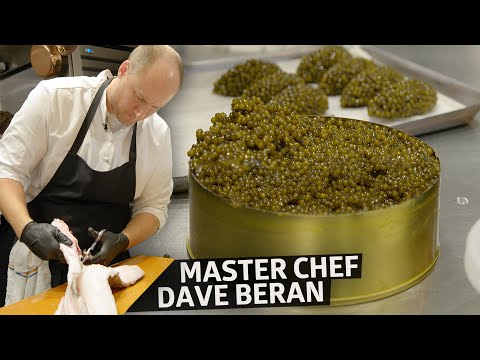
A spoonful of yuzu and black sesame appears early enough to resemble a premature dessert. Hamachi arrives without the knife an average diner would expect. Later, a beet-and-squab consommé is poured into a wine glass and looks, for a moment, like a red. In Eater's 2020 film about Dialogue, each small disruption is more than a flourish. It is punctuation: a way to make a diner notice where one course ends and the next begins.[1]
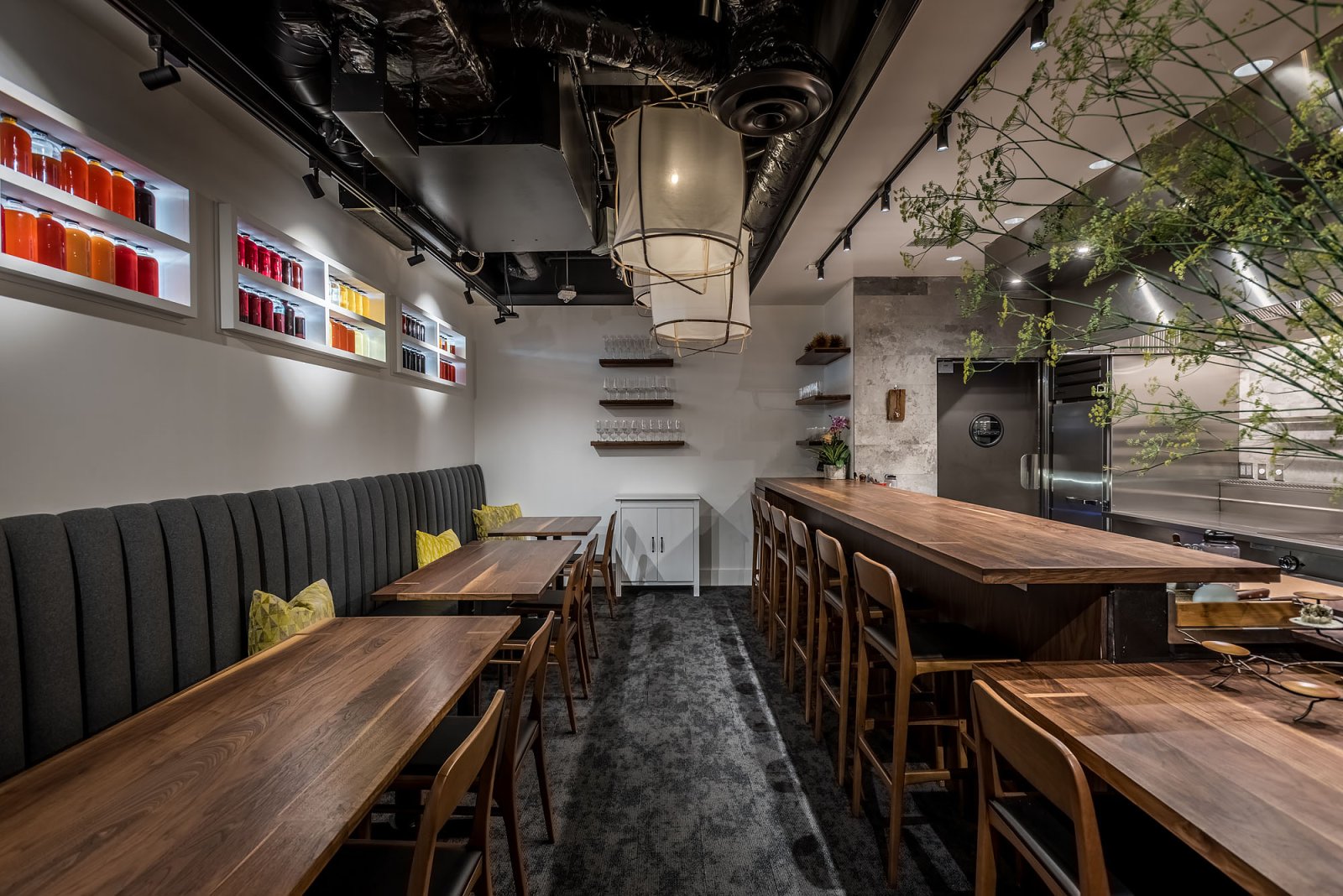
Dialogue opened in 2017 behind an unassuming door inside a Santa Monica food hall. The room covered roughly 800 square feet and seated only 18; the opening menu ran to 21 courses.[2][3] The Michelin Guide awarded it one star in its 2019 California selection.[7] Yet this is an archival viewing, not a current reservation tip. The restaurant closed on November 7, 2020, after the pandemic made its tiny, intimate format untenable.[6]
What survives in the film is unusually useful because chef Dave Beran explains a tasting menu as a problem of composition rather than abundance. Watch for ingredients that cross the seam between courses, changes in utensils and plate color, and moments when guests must negotiate with one another. The kitchen footage shows that the menu's story was not pasted onto finished dishes: four cooks had to build it into purchasing, prep, and service.[1]
Adjacency, not accumulation
At about 1:45, Beran distinguishes one long story from a pile of short ones. The film then makes that distinction edible. A dark opening course of pumpkin seed and burnt parsley evokes the debris of late fall; fillings remain concealed under later surfaces. Near 2:40, he describes a structural rule: each course carries something from the one before it and something that will appear in the next. Passion fruit passes from wagyu into broccolini, and seaweed then leads toward hamachi.[1]
This principle predates the filmed menu. Before Dialogue opened, Beran described his ambition through books and albums: individual chapters or songs could be pleasurable, but their order would produce another level of meaning.[2] That is a stricter standard than a sequence of signature plates. A great standalone course can be moved, repeated, or photographed in isolation. A narrative course has a position. Changing it alters what the diner remembers from the previous bite and anticipates in the next.
The distinction is easiest to hear in music. Track five does not need to be the loudest or catchiest track if it changes the force of tracks four and six. Dialogue applied the same logic to flavor. Passion fruit is not merely an ingredient used twice; its first appearance creates recognition, while its second redirects that recognition toward char and vegetation. Repetition becomes development.
This also gives length a test. A long menu is justified neither by the number of techniques on display nor by the price of its ingredients. It earns its duration when removing a course damages the arc. Without that dependency, “progression” can become a flattering word for accumulation.
Friction can reset attention
Around 3:55, the film reaches a piece of hamachi seared on one side and tender enough to separate with a fork. Dialogue withholds a knife anyway. The small struggle is deliberate: several courses into dinner, ease can turn into inattention, so the awkward utensil choice wakes the hands and eyes.[1] The yuzu-and-black-sesame bite that follows performs a similar reset through category. It is sweet enough to suggest dessert, but arrives while the savory sequence is still unfolding.
These gestures matter because tasting menus have an attention problem. Comfort is hospitality, yet perfect smoothness over many courses can flatten perception. Dialogue varied not only flavor but the diner's task: cut now, lift now, question whether the meal has crossed into sweets. At 8:45, the squab-and-beet consommé borrows the appearance and vessel of red wine, making recognition hesitate once more.[1]
Misdirection has limits. If the missing knife merely made eating difficult, or the wine-glass illusion existed only for a reveal, both would be gimmicks. Here, each intervention returns the diner to the menu's changing grammar. The test is what happens after surprise: does the device sharpen a relationship between courses, or just advertise the chef's cleverness? Dialogue's best disruptions do the former because they alter pace and expectation, then get out of the way.
The diner becomes part of the arrangement
At roughly 4:50, the yuzu-and-sesame bites arrive on spoons set on the first shared plate of the meal. Two diners have to decide who takes which one. Later, a slow-cooked white carrot comes with a shared bowl of soft cheese and a separate bowl of fritters, but without a prescribed assembly. The invitation to explore forces a practical conversation: dip or spoon, combine or alternate, yours or mine.[1]
The restaurant's name becomes a service instruction. Dialogue's opening design—counter seats plus a few tables, with guests in continual proximity to cooks and one another—was meant to encourage exchange.[3] Resy's 2020 account likewise describes paired or communal elements that made diners compare choices rather than receive every plate as a sealed personal object.[5]
That is more consequential than making dinner “interactive.” The conventional tasting menu gives almost total authorship to the kitchen: portion, order, utensil, and pace are decided before the plate arrives. Dialogue briefly gives some authorship back. A shared component creates multiple valid paths through the same course, and the diners' negotiation becomes part of its timing.
There is risk in that design. Forced participation can feel stage-managed, especially when a guest would rather eat quietly or needs clear guidance. Dialogue's filmed approach works when the prompt is small and legible, not when the diner must solve a puzzle to unlock dinner. The exchange should create attention between people, not anxiety about performing correctly.
Winter is a verb
The film's seasonal idea is not a mood board of brown plates. It moves. Early winter is decay and concealment: seeds, twigs, burnt parsley, flavors tucked beneath apparently austere surfaces. In the middle, warmth and shelter take over. A three-course squab progression distributes the bird across consommé, leg, mousse, heart, breast, and sauce without presenting the customary whole roasted bird as spectacle.[1]
Then the menu begins to thaw. The transition out of squab uses baby versions of greens that appeared mature in the savory course. Pea, sorrel, olive oil, and pale green tones carry dessert toward spring.[1] Los Angeles Times critic Bill Addison observed the same larger method across another season: Dialogue's menu evolved over successive visits, using California produce to give the meal a dramatic arc rather than treating seasonality as a static list of peak ingredients.[4]
This is the film's clearest compositional lesson. “Winter” names a change over time: burial, cold, interior warmth, then new growth. The menu can therefore advance even when the guest does not know every ingredient or hear every explanation. Color brightens, hidden elements emerge, and mature leaves return as shoots. Story is carried by sensory evidence.
The tiny room makes the idea expensive
The opening minute supplies a necessary corrective to the romance. Dialogue has no receiving department and nowhere to leave boxes. Deliveries turn into an all-hands task. Market and butchery work must be assigned across a four-person kitchen, and on the filmed day Beran spends much of his time processing fish.[1] The concept album depends on a highly practical track list.
Linked courses create operational coupling. If the quality of one fish changes, a substitution may affect not only a single plate but the ingredient echoes on either side of it. If a shared course is redesigned, its service conversation and the pace of the following course may change too. The narrative gains coherence by giving up some modularity. In 800 square feet, that tradeoff is visible: every ambitious relationship has to survive storage, labor, heat, and a clock.
At about 10:50, prep surfaces are cleared, music starts, and the room converts into a restaurant. The doors open; only then can the carefully ordered components become a story for guests.[1] The scene is a useful final annotation because it prevents “concept” from sounding weightless. Sequence is an act of service repeated table by table.
Dialogue's closure gives the film a second function. It preserves an experience whose intimacy could not be separated from its physical constraints when COVID-19 arrived.[6] The recipes remain interesting, but the deeper artifact is the edit between them: the handoff of an ingredient, the purposeful interruption, the shared bowl, the shift from buried seed to green shoot.
The concept-album analogy is valuable because it is also unforgiving. It asks whether course five truly needs courses four and six. If it does, the diner receives a composition. If it does not, even exquisite plates may be only a playlist with an expensive running time.
Sources
- Eater, “How a Master Chef Created a Michelin-Starred Restaurant in a Mall Food Court — Mise En Place,” May 2, 2020 — the embedded YouTube film documenting Dialogue's winter-menu development, kitchen prep, and service.
- Hillary Dixler Canavan, “Why Is Dave Beran Opening His Ambitious Debut Restaurant in a Food Hall?” Eater, June 8, 2017 — pre-opening interview on the 800-square-foot room, 18-seat plan, and album-and-book approach to menu structure.
- Matthew Kang, “A First Look Inside Dialogue, Dave Beran's Intimate Tasting Menu Restaurant.” Eater LA, September 14, 2017 — opening report on the room, seating, initial 21-course menu, and the Wonho Frank Lee photograph used above.
- Bill Addison, “Newsletter: Summer is the best time to visit Santa Monica's modernist Dialogue.” Los Angeles Times, August 23, 2019 — critical account of the restaurant's evolving seasonal menu and dramatic pacing.
- Esther Tseng, “At Dialogue, Dave Beran keeps pushing the conversation in new ways.” Resy, March 4, 2020 — reported profile of the menu's pacing, shared courses, and diner interaction.
- Matthew Kang, “Dave Beran's Tiny, Michelin-Starred Dialogue Closes on November 7.” Eater LA, October 25, 2020 — report on the permanent closure and the incompatibility of the restaurant's intimate room with pandemic distancing.
- MICHELIN Guide, “MICHELIN Guide California 2019 Selection,” June 3, 2019 — official results listing Dialogue among the state's one-star restaurants.