Plenty of restaurants with world-famous views make one bad bargain with the guest: the landscape supplies the awe, so the kitchen starts chasing spectacle of its own. That is the lazy version of destination dining. Khufu's looks more interesting because its public materials keep describing the opposite ambition. As of May 8, 2026, the restaurant's official homepage presents the house through a language of clarity and restraint: heritage is refined rather than repeated, and the menu draws from memory without being trapped inside it.[1] The official Experience page then makes the operating logic even plainer. Entry is calm and intentional, reservations are spaced, and the menu is curated for a focused experience in which each dish should complement the setting rather than compete with it.[2]
That is the useful way to read why Khufu's matters now. The restaurant has all the raw material for vulgarity: one of the most overloaded views on earth, a tourism-heavy perimeter, and a national cuisine that can easily be flattened into either museum nostalgia or hotel-friendly shorthand. Yet MENA's 50 Best Restaurants 2026 now ranks Khufu's No. 1 in the region and names it The Best Restaurant in Egypt 2026, while describing it as contemporary Egyptian gastronomy with a view for the ages.[4] The stronger claim is not that Khufu's has a stunning backdrop. The stronger claim is that it has learned how to lower its voice enough for the backdrop to stop being a gimmick.
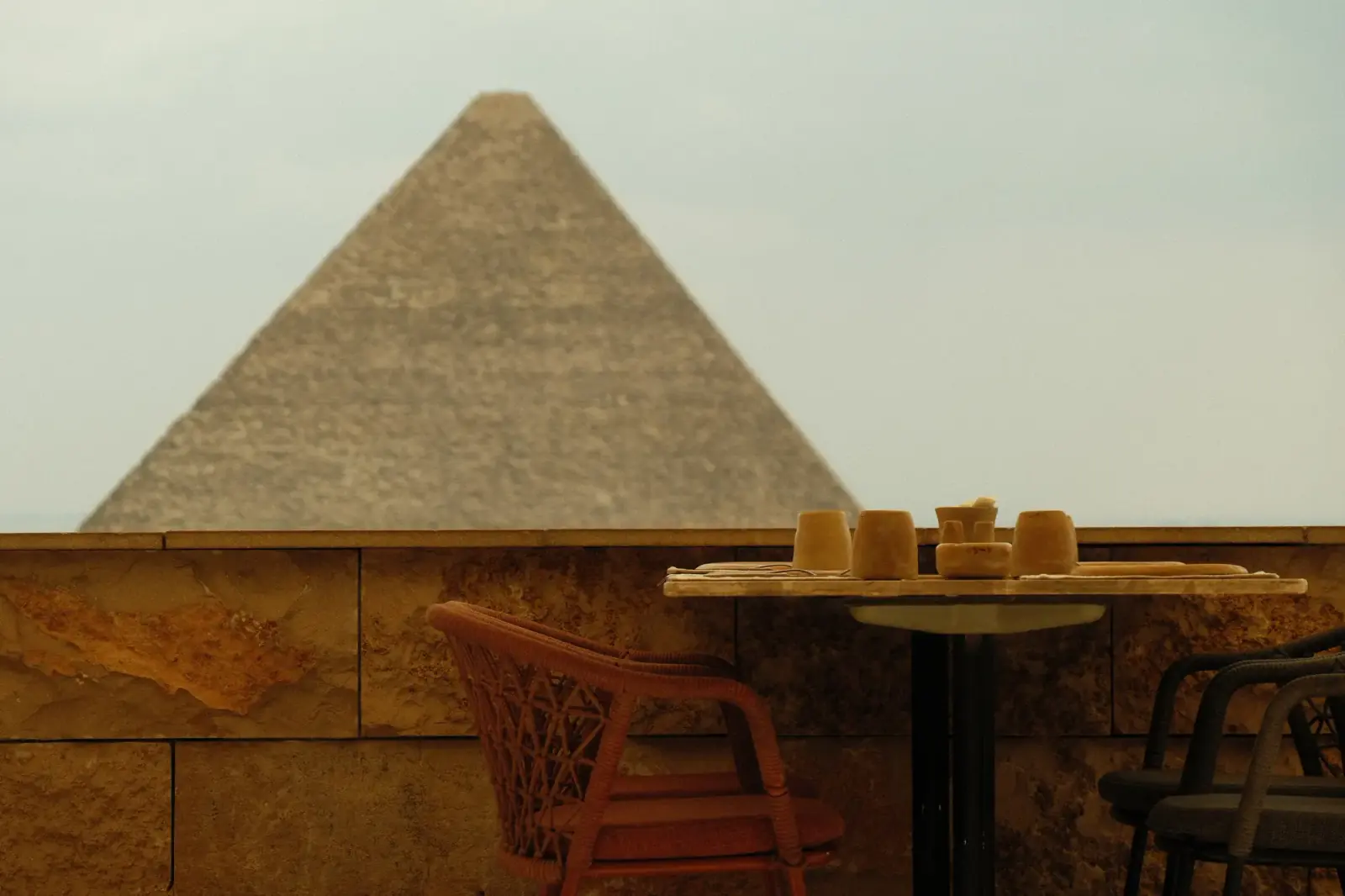
Image context: the cover uses Khufu's official terrace photograph because this article is about composure more than about plated glamour. The tableware, stone, and framed pyramid line show the restaurant's core challenge in one frame: the room is already monumental, so the meal has to win through measure rather than excess.[1][2]
1. The room is famous, so the restaurant has to get quieter
The most revealing sentence on Khufu's Experience page is not about a signature dish. It is about arrival. The site says each reservation is spaced to ensure a quiet, uninterrupted transition into the restaurant.[2] That sounds like hospitality copy until you put it back inside the actual setting. A restaurant placed within the Giza Pyramid Complex cannot afford bustle for its own sake. Any sense of hurry, traffic, or over-selling would cheapen the whole proposition immediately. Khufu's appears to understand that the first course is pace itself.
The homepage keeps extending that discipline. It describes the experience as being framed by ancient stone and open horizon, with evenings unfolding through precision, while the menu pursues clarity rather than excess.[1] Even the reservations page sells the restaurant in unusually direct terms: refined dining with views of the Pyramids of Giza, at the Giza Plateau address, under a current site schema that lists daily opening hours of 09:00 to 16:00.[3] That daylight framing matters. Khufu's is not trying to bury its identity in nightclub darkness or generic luxury glow. It is asking the food and service to survive under one of the harshest possible conditions for restaurant self-confidence: full visibility.
This is why the official phrase about the menu complementing the setting matters so much.[2] Most restaurants in a famous location say the view is part of the experience. Khufu's wording is sharper. It implies an active compositional problem. The pyramid line is already the loudest thing in the room, so the job of the restaurant is not to out-shout it. The job is to make the guest feel that table, plate, and horizon belong to the same sentence.
2. Mostafa Seif gives the room a culinary voice strong enough to stay calm
A room this exposed still needs a chef who can keep it from collapsing into scenic dining. Khufu's current homepage positions Mostafa Seif as one of the leading voices in new Egyptian cuisine, citing his Top Chef Middle East 2018 win and Two Knives recognition from The Best Chef Awards 2025.[1] The 50 Best story from May 7, 2025 fills in the more useful human line behind the accolades: Seif came out of his family's street-food cart in rural Egypt, moved through elite Cairo kitchens, and arrived at Khufu's with a desire to put the flavors of his homeland onto a larger stage without letting them stay heavy or static.[5]
That background suits the restaurant's best public idea. Khufu's is not selling Egyptian food as untouched authenticity, and it is not performing cosmopolitan distance from Egyptian food either. The 50 Best story describes restaurateur Giovanni Bolandrini and Seif building a place meant to help locals and tourists rediscover the cuisine through flavors based in tradition but refined for the modern palate.[5] The homepage uses more polished language, but the direction is the same: memory remains central, yet disciplined technique edits memory into a cleaner line.[1]
That is where Khufu's starts to feel more serious than a high-concept viewpoint restaurant. Seif does not need to invent a new Egypt on the plate. He needs to make familiar Egypt legible again under luxury conditions that often erase legibility. The public record suggests he is doing that by subtraction. The restaurant's own phrasing keeps returning to restraint, clarity, and refinement, which is exactly the vocabulary you would want if the broader goal were to rescue national dishes from heaviness without draining them of identity.[1][2][5]
3. The menu updates classics by changing their weight, not their passport
The MENA 50 Best 2026 profile is especially useful here because it shows the restaurant in service rather than in manifesto mode. It says weekends are especially popular for thoughtful versions of a classic rural Egyptian breakfast, and that later menus revisit iconic dishes such as mu'ammar rice with smoked beef, koshari salad, and pharaonic duck with dukkah-crusted meat, freekeh, orange-and-apricot puree, and duck jus.[4] That is a revealing list. Khufu's is not hiding national-reference dishes in favor of anonymous luxury-product theater. It is taking highly recognizable forms and changing their weight distribution.
The 50 Best feature on Seif's koshari makes the point even better.[5] There, he describes taking Egypt's national dish of rice, pasta, and lentils, then reworking it with quail eggs, crispy chickpeas, fried onions, and a cold-salad format that lets the spices read differently. That is a precise kind of modernization. The dish is still koshari in memory and structure, but the eating experience has been re-tuned. It lands lighter, sharper, and more edited.
Khufu's current regional profile also notes a dedicated vegetarian menu, explicitly tying that offer to the cultural importance of vegetarianism in Egyptian Coptic life, and says the house runs alongside three other rotating menus.[4] That matters because it shows the restaurant is not treating contemporary Egyptian cuisine as one singular luxury script. There is room for variation inside the concept, yet the variation remains attached to recognizable social and culinary histories. Put differently, Khufu's seems interested in modernizing Egyptian food from inside its own grammar, not in translating it into a neutral international accent.
4. Why Khufu's feels timely in 2026
The current moment gives the restaurant a sharper edge than the view alone could. In 2025, Khufu's was already moving fast: the 50 Best story noted its No. 4 ranking in MENA's 50 Best Restaurants 2025, its Best Restaurant in Egypt title that year, and its Resy One To Watch award at The World's 50 Best Restaurants 2025.[5] By 2026, that climb has turned into outright regional leadership.[4] Rankings never settle the argument, but they do tell you when a restaurant has moved from beautiful curiosity into a house that other cooks, operators, and diners now have to take seriously.
What makes Khufu's worth profiling is that its public argument remains coherent under that new pressure. The official pages still describe calm entry, focused pacing, memory-driven cooking, and restraint.[1][2] The regional ranking page still emphasizes Seif's roots in rural cuisine and the restaurant's updated treatment of classics rather than generic luxury excess.[4] The story that began with an Italian restaurateur asking what he could responsibly do inside the Giza Pyramid Complex in 2022 has now hardened into something more persuasive: a restaurant where the view stays famous, but the meal keeps its authority.[5]
That is why Khufu's feels important in 2026. It is easy to build a restaurant near a wonder of the world. It is much harder to keep wonder from becoming the only course. Khufu's looks strongest exactly where many destination restaurants get weak. It treats scenery as a condition to solve, then answers with control, memory, and a quieter kind of ambition.[1][2][4][5]
Sources
- Khufu's official homepage - current positioning on clarity, restraint, heritage refined rather than repeated, chef Mostafa Seif's profile, and the menu's relationship to memory and refinement.
- Khufu's, "Experience" - official page covering spaced reservations, calm entry, and the statement that each dish should complement the setting rather than compete with it.
- Khufu's, "Reservations" - official booking page describing refined dining with views of the Pyramids of Giza and current site schema details including the Giza Plateau address and listed opening hours.
- MENA's 50 Best Restaurants 2026, "Khufu's" - current regional profile covering the No. 1 ranking, Best Restaurant in Egypt 2026 award, chef Mostafa Seif's rural-Egypt framing, weekend breakfast popularity, updated signature dishes, vegetarian menu, and rotating menus.
- Sarah Gamboni, "The chef and the visionary: 6 ways Khufu's is redefining Egyptian cuisine." 50 Best Stories, May 7, 2025 - background on Giovanni Bolandrini's 2022 opening opportunity, Mostafa Seif's path from rural Egypt and Top Chef Middle East 2018, and the restaurant's revised koshari logic.