The easiest way to misunderstand Arkestra is to book it as a single dinner table with a Michelin star attached. The stronger reading is operational. Arkestra works because one 1960s villa has been divided into three different tempos: the main restaurant for the full authored meal, Ritmo for a looser front-room bistro rhythm, and the upstairs Listening Room for aperitif or after-hours drift.[1][6][7] In a city where ambitious dinners often end too abruptly or stretch too vaguely into nightlife, that division matters. It lets the restaurant control not just what you eat, but how the evening changes pace.
The official site says this plainly if you read across the sections rather than only the headline. Arkestra describes itself as a restaurant and bar where food, music, and ambience come together inside a former residential villa, then names its three distinct spaces one by one.[1] Michelin's inspector note reinforces the same point from the outside: the vintage feel of the villa matches Cenk Debensason's personality, the cuisine keeps shifting register through the meal, and guests are specifically told to visit the Listening Room before or after dinner, or explore Ritmo in the same building.[6] 50 Best Discovery pushes the idea even further by calling Arkestra an all-night destination built around pre-dinner cocktails, seasonal courses, the front-room Ritmo, and the upstairs record-lined bar.[7]
That is why Arkestra feels worth a service-and-operations reading in 2026. The restaurant's accomplishment is not just that Debensason can cook. It is that the house has been structured so a guest can move from anticipation to dinner to decompression without leaving the property or dropping into a different aesthetic language.[1][6][7]
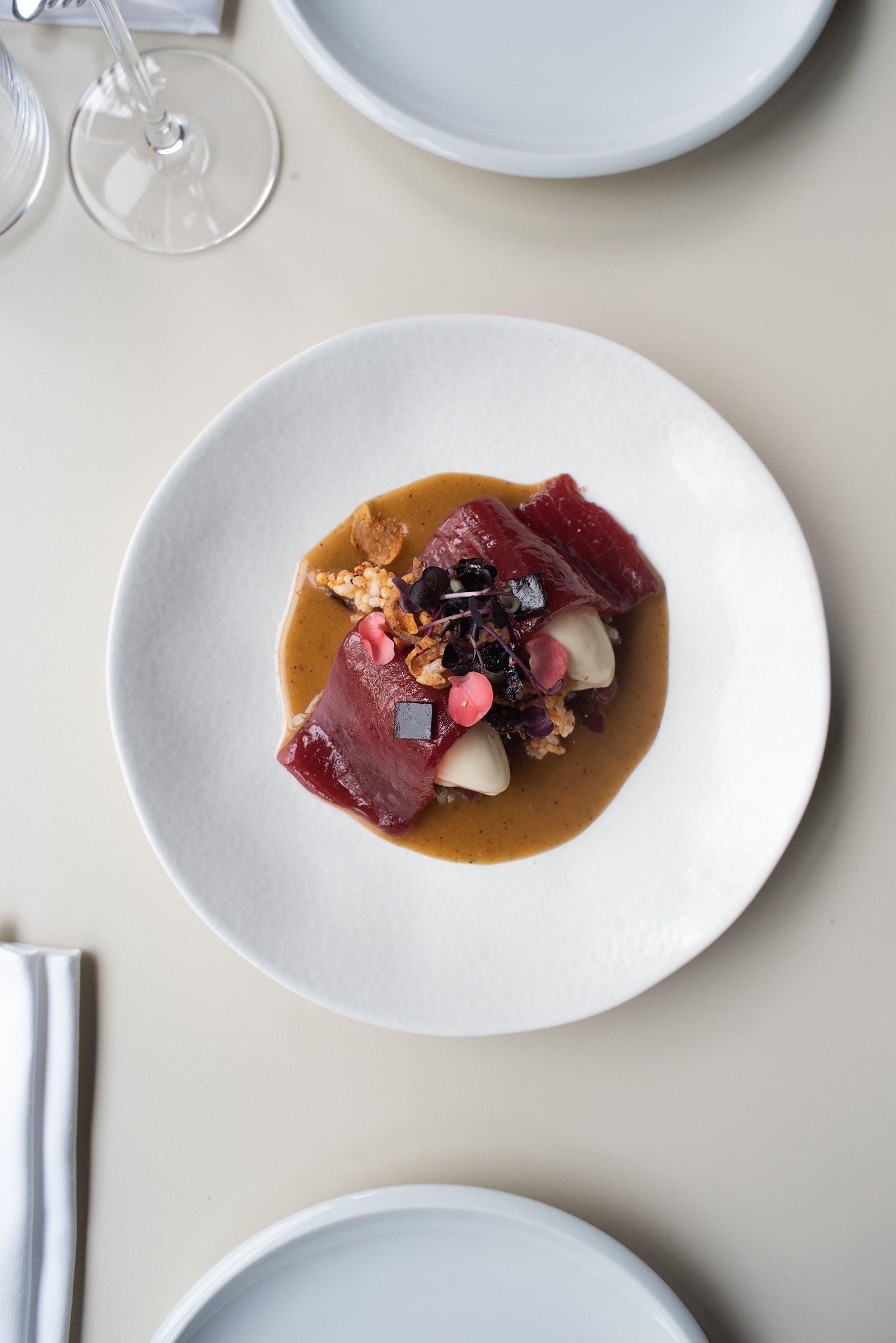
Image context: the cover uses Arkestra's official main-dining-room photograph rather than a plated course because this article is about room sequence. The wood paneling, chandeliers, and white-clothed tables show the most formal tempo in the building, which matters precisely because the same villa also contains the softer entry and exit lanes discussed below.[1][6]
1. One villa, three tempos
The official space descriptions are unusually useful because each room has a different job.[1] The main Restaurant is the formal center: a grand dining room with a lively atmosphere, an air of relaxed opulence, an open kitchen, and a courtyard connection for al fresco service when the weather allows.[1] This is where Debensason's main authored statement lands, and the site explicitly ties that room to his seasonality-driven, modern-European cooking with global influence.[1]
Ritmo works on a separate frequency.[1] It has its own private entrance and a defined 32-cover dining room, with mirrored ceilings, custom carpets, low lighting, small plates, local and international wines, and curated cocktails.[1] That is not just branding spillover from the main restaurant. It is a deliberate pressure valve. Ritmo gives the property a lower-commitment mode that can still feel house-authored, while letting the main dining room stay tighter and more ceremonious.[1][7]
Then there is the Listening Room upstairs.[1] Officially it is an intimate bar for pre-dinner aperitifs or late-night cocktails, with lounge seating, low tables, vinyl records, and a rotation of weekly selectors; the site adds one important operational restriction: it is currently welcoming restaurant guests only.[1] That detail matters. The Listening Room is not being run as a fully separate public nightlife business. It functions as a controlled extension of the dining experience, a way to stretch the evening without diluting the guest mix or mood.[1][6]
Put together, the building stops behaving like one restaurant with a bar attached. It behaves like a small evening system. The formal meal, the side-door casual lane, and the guest-only upstairs release valve all sit close enough to share staff judgment and house atmosphere, but far enough apart to give diners real choice.[1][6][7]
2. Booking Arkestra means choosing a tempo, not just a table
The reservation flow makes that structure visible. Arkestra's official booking page requires reservations and asks guests to choose a location in the form itself: Ritmo, Listening Room, or Arkestra.[3] The site also routes requests through a single phone and WhatsApp line, available between 11:00 and 22:00.[3] Operationally, that is a clear signal. The property wants one booking funnel, but not one undifferentiated product.
This matters because the three bookings imply different purchases. A reservation in the main restaurant buys the full sequence and the highest supervision density. A Ritmo booking buys mood, drinks, and smaller-format food with more casual entry conditions because the room has its own entrance and its own social energy.[1] A Listening Room request, by contrast, reads less like a standalone night out and more like a managed extension of dinner, especially because the room is officially restricted to restaurant guests.[1]
There is one important timing caveat in the public record. Arkestra's own site currently lists the restaurant hours as Tuesday to Saturday, 18:00-01:00.[1] By contrast, 50 Best Discovery still shows dinner daily 6pm-12am, closed Sundays.[7] That mismatch is exactly the sort of small operational detail diners miss when they rely on prestige directories alone. In practical terms, the official site should carry more weight for current hours and reservation behavior, while Michelin and 50 Best remain more useful for editorial framing and external description.[1][6][7]
This is where the villa format becomes more than a design story. It reduces the all-or-nothing problem. You do not have to buy the same kind of night every time you interact with the property. Arkestra has built formal dinner, soft-entry drinking, and semi-afterparty decompression into one address, then made those lanes legible in the booking flow itself.[1][3]
3. The menu architecture keeps the spend legible
The current menus strengthen the operational logic because they show Arkestra refusing to blur every visit into one expensive fog. The current Chef's Table PDF lists a Tasting Menu at 4800 TL and a Wine Pairing at 2700 TL.[4] The dishes on that menu include potato bread & butter, sea bream crudo, cabbage sprout tonnato, gnocchi & shrimp, beef short ribs Apicius, and chocolate ganache torte.[4] That is the high-control purchase: one sequence, one pairing ladder, one authored arc.
The current English a la carte menu, updated January 1, 2026, shows a different kind of flexibility.[5] The pricing range is wide enough to matter. Potato bread & butter starts at 410 TL, sea bream crudo sits at 1380 TL, Arkestra katsu sando at 2080 TL, steak au poivre at 3200 TL, and sole meuniere reaches 5520 TL.[5] That spread makes the room easier to read. You can use Arkestra as a signature-dish and bottle night, a full tasting-menu purchase, or something in between.[4][5]
50 Best Discovery's editorial description supports that middle lane. It highlights the bite-sized katsu sando, tuna sashimi, steak tartare, and pesto agnolotti with lemon mascarpone, then frames the whole venue as a place where bar classics are made sharper rather than heavier.[7] In other words, Arkestra does not lock its identity inside one chef's-counter solemnity. It leaves enough room for repeat use and different spending levels while keeping the voice recognizable.[5][7]
Ritmo makes the spectrum even clearer. The official site does not publish a full Ritmo menu on the homepage, but it does define the room through small plates, local and international wines, and curated cocktails.[1] That is an operational statement as much as a culinary one. Ritmo exists so the property can sell a shorter, faster, or more social evening without forcing every guest into the main room's intensity.
4. Why the house style survives the room changes
This system would feel gimmicky if the chef's voice were weak or scattered. Arkestra works because Debensason's background gives the house a coherent center. The official chef page traces him from culinary training at the Institute Paul Bocuse in Lyon, through Paris, San Francisco, and Los Angeles, to his 2016 return to Istanbul, five years of food-and-beverage consulting, the Ritmo Zeytino pop-up in 2021, and finally Arkestra's opening in 2022.[2] Michelin compresses that biography neatly: he grew up in Istanbul, trained in France, and matured as a chef in the United States.[6]
That mixed route matters on the plate. Michelin points to a spicy take on vol-au-vent, a deeply flavored sea bass sharpened by Thai sauce, and a cuisine whose versatility keeps the diner alert throughout the meal.[6] 50 Best Discovery notices the same instinct from a different angle when it describes bar-classic forms such as katsu sando and tuna sashimi being reworked with precision inside the villa setting.[7] The official site's own wording, modern European cooking with global influences, turns out to be accurate rather than evasive.[1]
Once that chef grammar is clear, the building's three-room system stops looking like hospitality theater. It becomes a way of distributing one sensibility across several levels of commitment. The main restaurant carries the highest concentration. Ritmo loosens the frame without abandoning it. The Listening Room lets the night breathe before or after dinner without dumping guests into a generic external bar scene.[1][2][6][7]
That is why Arkestra is worth publishing as a fine-dining operations piece now. In 2026, plenty of ambitious restaurants can stage a good meal, and plenty of bars can sell atmosphere. Arkestra's sharper accomplishment is that it has arranged room design, booking logic, price architecture, and chef identity into one continuous night. The star matters.[6] The food matters.[4][5][7] But the more durable strength is that the villa knows how to change pace without losing its voice.[1][2][3][6][7]
Sources
- Arkestra official homepage, covering the 1960s villa setting, the three-space structure, the main restaurant, Ritmo's 32-cover room and private entrance, the Listening Room guest policy, and current restaurant hours.
- Arkestra, "The Chef" - official chef page covering Cenk Debensason's Paul Bocuse training, Paris/San Francisco/Los Angeles route, 2016 return to Istanbul, Ritmo Zeytino pop-up, and Arkestra's 2022 opening.
- Arkestra reservations page, covering the required booking flow, 11:00-22:00 call/WhatsApp window, and the location selector for Ritmo, Listening Room, or Arkestra.
- Arkestra, "Chef's Table" tasting-menu PDF, covering the current 4800 TL tasting menu, 2700 TL wine pairing, and the current course sequence.
- Arkestra English menu PDF, covering current a la carte dishes, price points, and the January 1, 2026 price-update note.
- MICHELIN Guide, "Arkestra - Istanbul" - current one-star listing covering Debensason's Istanbul/France/United States route, the 1960s villa, the Listening Room, Ritmo, and current Michelin-listed hours.
- 50 Best Discovery, "Arkestra" - profile covering the former villa, all-night-destination framing, signature dishes, Ritmo, Listening Room, and broader positioning.