Two glossy black spheres rest on charcoal. In Arthur Jeanne's January 2025 report for Society, this is how dinner begins at Flor de Lis in Guatemala City. Chef Diego Telles explains that the dish connects maize with the creation of human beings in the Popol Vuh. The small tamal uses Saq'Por corn, with an ash-and-black-bean glaze. Behind it, traditional music acquires an electronic pulse.[1] Before the diner has taken a bite, maize has become both food and a subject of conversation.
That double role gives this restaurant its particular appeal. A tasting menu can introduce ingredients through a procession of unfamiliar names. Telles gives them characters, actions and a setting. The useful question is how much of that story survives in the food itself.
Flor de Lis still centers its published offer on a menu inspired by the Maya world and Guatemalan culture.[2] Its accumulated repertoire makes it worth revisiting now: the opening dishes described in older reporting, the room explained in a recent interview and the current reservation format show an idea being developed over years. This profile draws on those sources; the historical dishes are examples of the kitchen's work, rather than a promise of tonight's sequence.
A chef comes home with a question
Telles trained in Guatemala before taking internships at Mugaritz in Spain in 2009 and Noma in Denmark in 2012. He opened Flor de Lis in 2013. In a 2023 Prensa Libre interview, he recalled wanting to make Guatemalan cooking of his own authorship. His experience abroad had also sharpened his awareness of how little some people knew about his country.[3]
The ambition gives the restaurant a demanding brief. A visitor may arrive without recognizing an ingredient or knowing the story that accompanies it. A dish has to offer an immediate invitation—shape, aroma, texture—while leaving room for an explanation to deepen the pleasure. The cook is choosing what someone encounters first.
The explanation need not come first in the kitchen. Telles told Prensa Libre that he might begin with a passage he wanted to interpret, or with an ingredient and a search for what it could express. He also said that developing his fava-bean tamal took four years.[3] That time scale makes a useful correction to the apparent ease of a tiny finished plate. Conceiving a connection and finding something worth eating are separate pieces of work.
Smoke gives an old story a new entrance
A 2019 Radio TGW account records Telles and collaborator Edgar Meza describing an early welcome dish: sweetcorn croquettes presented in a small clay head, with smoke from myrrh incense passing beneath them. Reading the Popol Vuh, Telles recognized a connection between the dish and the grandmother of the twins, Ixmukane. The pair then developed further combinations of stories and food.[4]
The order matters. Here, a preparation helped the cooks notice a literary association. It suggests a more flexible process than assigning each passage a course and filling in the ingredients afterward. Material and story can change one another.
The clay head also gives the explanation somewhere to land. Corn, a vessel and a visible trail of smoke create distinct things to notice. A diner can carry those impressions into the story instead of having to remember an introductory lecture. This is an interpretation of the documented presentation, not a claim that the restaurant reproduces an ancient meal.
The room joins the menu
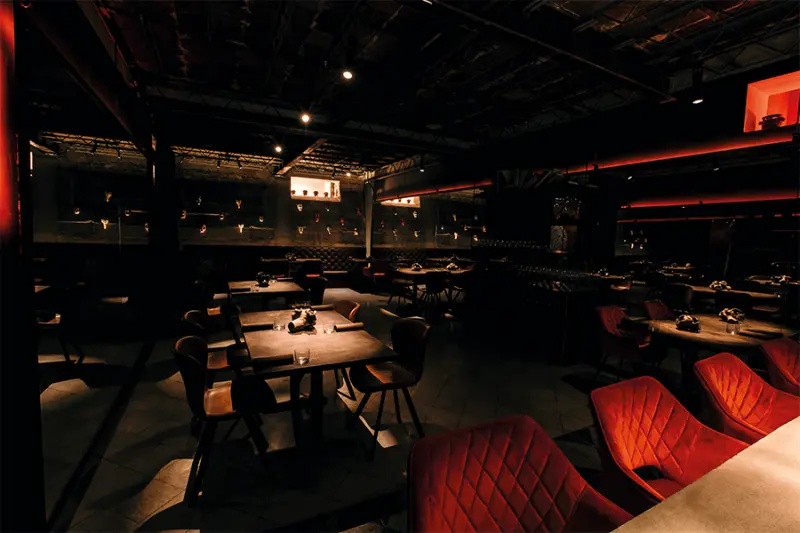
In Saber y Sabor's December 2025 interview, Telles described wanting a dark dining room and a brightly lit kitchen, invoking Xibalbá, the underworld. Light should reveal the food while leaving the diners' faces comparatively obscure.[5] The effect he seeks makes the kitchen a destination visible across the room. Attention is directed toward the work and what it produces.
The dishes can be visually spare even when their references are elaborate. The 50 Best Discovery entry describes chilli-ash and amaranth toast filled with frog legs and giant ants, and a dessert combining flower petals, orange-and-rosemary cream, a rose cookie and rose gel.[6] These descriptions suggest different routes into dinner: an unfamiliar savory filling on a recognizable crisp base; then flowers carrying color and fragrance across several components. They are documented examples, not a menu verified course by course.
Telles's account of his priorities is equally revealing. In the 2025 interview, he defended giving inexpensive ingredients serious culinary attention and keeping established dishes instead of changing them simply for novelty.[5] Taken together, those choices place value in sustained work on a preparation. The returning question becomes whether the dish still earns its place.
What the reservation buys
The official booking page, checked on September 25, 2026, lists a 12-course regular menu at Q695 per person, with 16 seats per service. Its four-seat chef's table costs Q850 and adds three dishes selected by the kitchen. The restaurant is in Casa del Águila in Guatemala City's Zona 4.[2]
Those two formats let diners choose their degree of proximity to the cooking. The restaurant asks for a deposit equivalent to one menu and says it cannot accommodate a vegan diet; anyone with dietary restrictions should resolve them before booking. Prices and conditions are the restaurant's published offer on the check date.[2]
A seat close to the kitchen makes particular sense for a restaurant built around interpretation. It brings the diner nearer to the moment when an idea becomes a physical object. But the lasting test belongs to the plate wherever it is served. After the story, there is still corn to taste, a crisp surface to break, a mouthful that must justify the attention it has been given. That is where Flor de Lis's ambitious conversation becomes dinner.
Sources
- Arthur Jeanne, “Maya Vida,” Society, January 16, 2025 — the publicly accessible opening describes the maize tamal, glaze, music and Telles's explanation; the remainder is subscriber-only.
- Flor de Lis, official reservations page — menu formats, seats, prices, location, deposit and dietary conditions; checked September 25, 2026.
- Andrea Jumique Castillo, “La cocina muestra la riqueza de un país,” Prensa Libre, January 10, 2023 — interview on Telles's training, 2013 opening, creative process and fava-bean tamal.
- Radio TGW, “Del paraíso al Inframundo en un platillo gastronómico,” July 9, 2019 — Telles and Edgar Meza on the corn-croquette presentation and its connection to Ixmukane.
- Jordi Seguí, “5 aspectos que convierten a Flor de Lis en el restaurante más arriesgado y singular de Guatemala,” Saber y Sabor / HelloChefs, December 18, 2025 — room design, repertoire and ingredient philosophy; photographs by Fernanda C. Caminade.
- 50 Best Discovery, “Flor de Lis” — descriptions of the savory toast and floral dessert; its undated pricing is not used here.