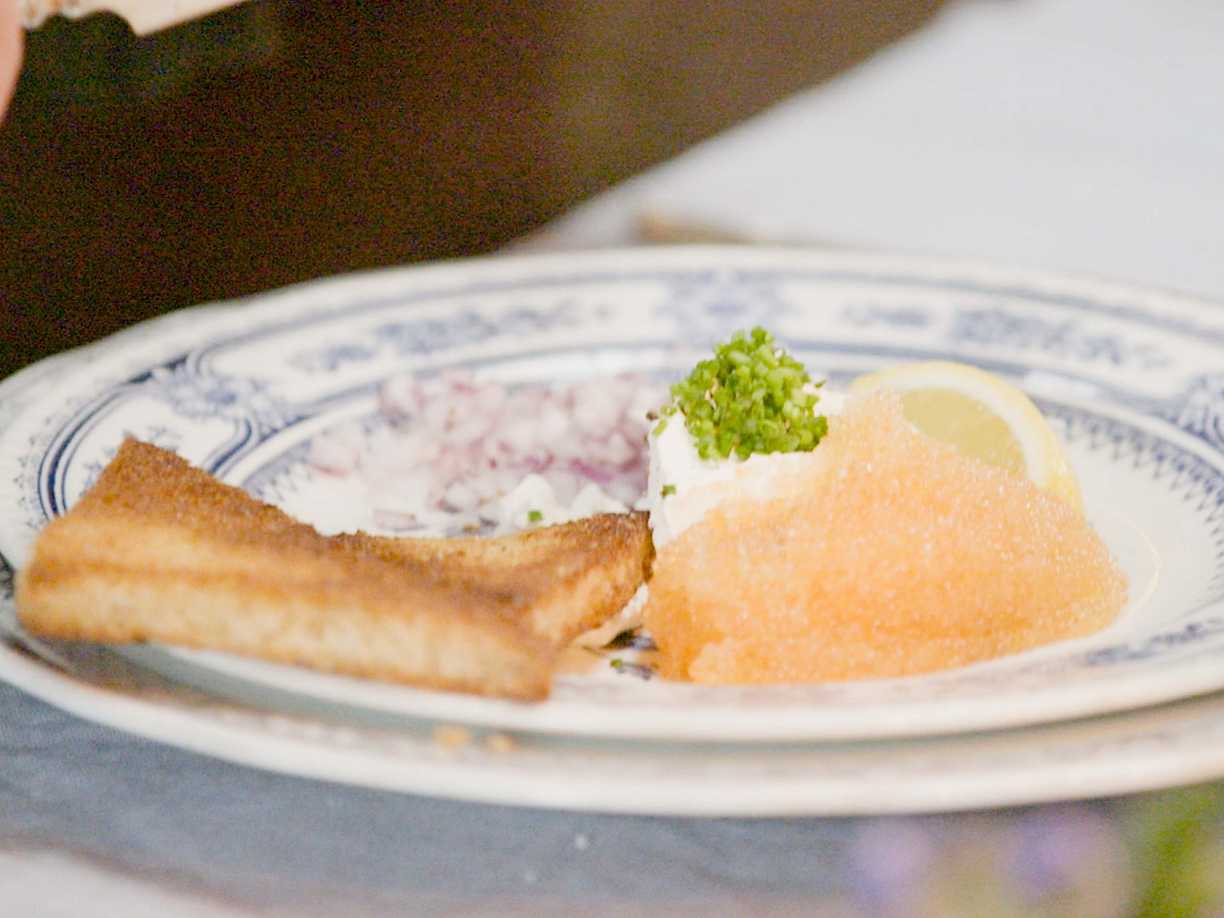
The orange roe gets an oval of its own. So does the white smetana. In Lotta Lundgren’s published recipe for löjromstoast, red onion and a lemon wedge sit beside them, with butter-fried bread ready for assembly.[1] This is a starter that leaves the diner a little work: choosing how much cream, how much onion, how much of the small orange mound belongs on the next bite.
That freedom is part of the dish’s appeal. Read as a composition, it offers crispness, richness and sharpness in separate, adjustable amounts. The roe remains visible throughout. There is nowhere for it to disappear beneath a sauce.
The orange has an address
Kalix löjrom is roe from vendace, Coregonus albula, a small salmonid. Its protected designation of origin, awarded in 2010, ties it to a defined stretch of Sweden’s northern Gulf of Bothnia: between the Torneå and Åby river estuaries, no farther than 40 kilometers offshore. Preparation belongs in the designated area too.[2]
The European Commission describes a rounded, mild flavor of fish oil and salt. The orange grains change size over the five-week fishing period, from approximately 0.8 to 1.3 millimeters.[2] They are fine enough for a spoonful to read as a single soft mound before the eye resolves the individual eggs.
On a menu, “Kalix” therefore does useful work. It identifies a particular origin and preparation system. It also gives the kitchen a reason to make the roe legible on the plate: the named ingredient deserves more than a decorative scattering.
A little mound, a considerable amount of handling
The Swedish Board of Agriculture’s Smaka Sverige account follows the roe through hand extraction, rinsing, cleaning, drying on racks, salting and packing before freezing. It describes a requirement for preparation within 24 hours of landing, and a production season lasting only five weeks.[3] The clean shape on the plate begins with careful work at the shore.
Junköfiskarna, a producer, supplies a useful sense of scale. It describes a female vendace weighing about 25 grams, with a roe yield rarely exceeding five grams. The females are handled individually; the roe is gently cleaned, then dried, salted and packed by hand.[4] Even a modest serving gathers the work of several fish and several operations.
The producer also notes that the males can be packed whole for food.[4] That detail briefly widens the view beyond the prized orange product. There are fish behind this garnish, and a working food business behind the immaculate spoonful.
Freezing belongs to that business. The Commission says Kalix löjrom is mainly sold frozen or defrosted, with smaller quantities available fresh during the catch period.[2] A winter serving can carry an autumn harvest. “Fresh” is consequently an incomplete description of quality; origin, preparation and subsequent handling all matter.
Firmness makes the plate possible
Lundgren begins by draining the roe through a coffee filter. She finely chops the onion, fries the bread golden on both sides and shapes the roe and smetana separately with a spoon.[1] These are small interventions, but they explain the dish’s tidy appearance.
Draining lets the roe hold its shape. Keeping the accompaniments separate leaves room to vary each mouthful. A diner can begin with bread and roe, then bring in the cream and onion, noticing what each addition changes. The arrangement makes that comparison easy.
There is also a pleasing difference between the bread’s broken edge and the smooth curve of the spooned roe. The plate needs both textures. Imagine the bread losing its crispness and the composition immediately becomes softer, less distinct. Much of the cooking lies in preserving that difference until the first bite.
A chef’s variation keeps the same center
A recipe by Björn Frantzén, published in King in November 2015, develops the toast into a more elaborate restaurant dish. It retains Kalix löjrom and butter-fried bread, while adding lightly smoked cauliflower cream, thinly shaved green apple, dill and browned-butter powder.[5]
The cauliflower is blended with cream and crème fraîche, using only enough liquid to produce a smooth, firm result. Lemon seasons it; a smoking gun supplies the smoke. The roe is drained separately.[5] Even with more technique involved, both components receive attention to their consistency.
Read alongside Lundgren’s version, the interesting change is how the accompaniments redistribute the work. Apple brings a crisp element of its own; the cauliflower cream gives smoke a place beside the roe; browned butter becomes a finishing accent. The orange mound still anchors the toast. This is an interpretation of the published recipe, rather than a report of tasting it.
The two plates suggest a useful way to appreciate the dish. Follow a bite from the brittle bread into the cream, then notice whether the roe remains distinct. The pleasure is in the proportions: enough richness to linger, enough sharpness to invite another mouthful, and enough space for those tiny autumn eggs.
Sources
- Lotta Lundgren, “Kalix-studentens löjromstoast,” Köket / TV4, from En smak på livet — recipe, separate plating of roe and smetana, and the article’s photograph, credited to TV4.
- European Commission, “Kalix Löjrom PDO” — protected origin, vendace species, geographical boundaries, flavor, grain size and sale frozen or defrosted.
- Swedish Board of Agriculture, Smaka Sverige, “Kalix Löjrom,” updated 17 December 2024 — seasonal production, hand extraction, processing sequence and the 24-hour preparation requirement.
- Junköfiskarna, “About Kalix Löjrom” — the producer’s account of fish size, roe yield, manual handling and use of male vendace as food.
- Rasmus Blom, “Så gör du mästerkocken Björn Frantzéns löjromstoast,” King, 16 November 2015 — Frantzén’s published recipe with smoked cauliflower cream, green apple and browned-butter powder.