
On one short New York lane, Paul Carmichael's Caribbean cooking has two front doors. Kabawa, at 8 Extra Place, currently asks diners to settle in for a three-course, $150 prix fixe. Bar Kabawa, at number 12, stays open two hours later, keeps space for walk-ins, and concentrates on daiquiris, wine, raw-bar bites, and patties.[2][3] The easy interpretation is hierarchy: the serious restaurant on one side, its casual waiting room on the other.
Eater's Mise En Place film makes that reading impossible. It opens with the large-format work of Kabawa—the pork chop, goat shoulder, duck sausage, and pepper shrimp—but devotes nearly four minutes to dough, filling, forming, and cooking patties for the bar.[1] The edit gives a hand-held snack the same visual patience it gives a prix-fixe main. That choice reveals why the two-room idea works: Bar Kabawa is not Kabawa with ceremony removed. Each room has a complete promise, and each asks the kitchen to express Caribbean range at a different scale.
This is a useful film to watch as an essay about commitment. One door asks for an evening; the other can hold a drink and a patty. The bridge between them is not price or branding. It is the refusal to make the shorter experience feel abbreviated.
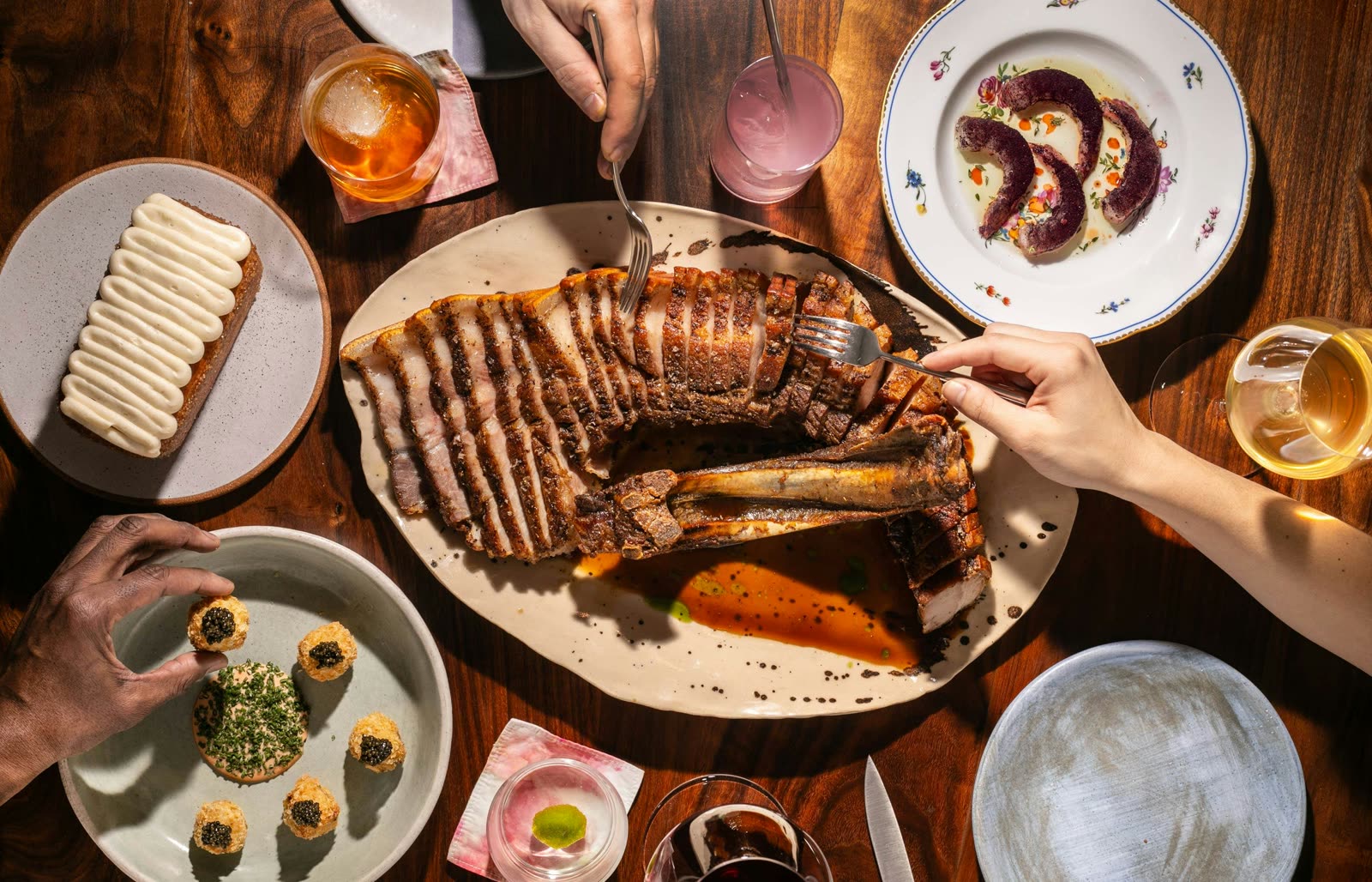
Image context: Kabawa and Momofuku's own photograph shows the dining-room end of that promise. The sliced chuletas can can occupies the middle of a crowded table, but reaching hands, cocktails, wine, and smaller dishes prevent the scene from becoming a trophy-shot portrait of meat.[2]
0:45 — the dining room begins with a whole commitment
The film's first named process is butchering pork, followed at about 1:37 by cooking chuletas can can.[1] The sequence begins with scale on purpose. This Puerto Rican cut joins loin, rib, belly, and scored skin in one spectacular piece; Helen Rosner described the finished dish as large enough for two, its skin flaring away from the meat.[5] It is food that resists being mistaken for a quick individual plate.
At roughly 2:39, the camera starts the goat dish, then returns later to picking and pressing the shoulder.[1] These preparations establish the dining room's temporal contract before a guest appears. A three-course format may sound compact, but its choices carry long work and arrive with sides, bread, and occasional extras. Kabawa's official description is careful on this point: the set menu offers options within each course and then rounds out the meal with something made that day.[2] Prix fixe here means a shaped evening, not one immutable tasting script.
The large pork and pressed goat also explain why simply shrinking the main-room menu would make a weak bar. Their pleasure depends on time, sequence, and appetite shared across a table. A neighboring room needs a different form, not smaller portions of the same promise.
3:36 — the patty refuses to be a shortcut
At 3:36, the film changes scale and starts the patty dough. Around 5:26, cooks portion, form, and stuff short-rib and conch fillings.[1] The camera lingers on repetition: circles of dough, measured centers, sealed edges, and rows ready for heat. The finished object can be held in one hand, but nothing about its preparation reads as an afterthought.
That matters because Bar Kabawa opened first, in February 2025, with its own vocabulary rather than as overflow for a dining room that was not yet serving. Eater's opening report described both baked and fried patties, drawing on laminated Haitian forms and Jamaican ones, with fillings that moved across Creole chicken, crab, conch, bone marrow, lobster, and red herring.[4] The current official page still defines the bar through a compact menu of patties and raw-bar bites beside daiquiris and wines by the glass.[3]
The film does not prove that every filling is trim from a dining-room dish, and it would be careless to invent a zero-waste ledger that the reporting does not show. Its stronger evidence is visible: the bar's signature has independent labor. Dough must be mixed and rolled; wet and fatty fillings must be portioned so the seam survives; frying and baking produce different crusts. Convenience belongs to the diner's posture, not to the cook's effort.
This is why the patty functions as a door. It compresses technique and flavor into a format that supports a spontaneous visit, but it does not summarize Kabawa's entire menu. A diner can stop at the bar and receive a finished idea rather than a preview packet.
7:40 — one repertoire, two time signatures
After the patty run, Eater's film returns to the goat shoulder at 7:40, breaks down duck for the “jerk” sausage near 9:07, prepares its stuffing around 12:03, and reaches pepper shrimp at 13:37.[1] The rhythm widens again. Grinding, stuffing, pressing, saucing, and careful raw preparation belong to plates that need explanation and a paced meal.
The quotation marks around “jerk” are not coy decoration. Carmichael told The New Yorker that he had not sourced the pimento wood essential to the smoke he associates with jerk, and that he did not want the cuisine's best-known style to crowd every other island off the menu.[5] The pepper shrimp follows the same method of translation without pretending to be a replica: a precise raw-shrimp plate refers to the bright, hot roadside shrimp Carmichael remembers from Jamaica.[5] These dishes use the dining room's time to open distinctions inside the broad label “Caribbean.”
Bar Kabawa works in another register. Its patties can move among island forms and fillings without requiring a lecture before every bite; rum drinks and raw-bar snacks make comparison loose and social. The restaurant can slow down around a set menu. The bar can let one object and one drink carry the encounter. Neither mode is inherently more authentic. They are different time signatures for the same insistence that Caribbean cuisine is plural.
The distinction also protects the bar from becoming a discount version of fine dining. Kabawa currently closes at 10 p.m.; Bar Kabawa continues until midnight and explicitly welcomes both reserved guests and walk-ins.[2][3] Those hours make the second room useful after the main restaurant has finished receiving its last long meal. It owns a later part of the night.
14:17 — service completes the architecture
The film reaches pre-shift around 14:17 and service about twenty seconds later.[1] Only then do all the morning's forms become hospitality. A pressed goat portion must arrive with enough context to be understood but not so much that dinner becomes a seminar. A patty must reach the bar hot while the drink beside it stays cold. The handoff is different in each room because the guest has made a different commitment.
Reported visits suggest that the distinction is emotional as well as operational. Eater's Stephanie Wu found the main room energetic rather than reverent, with staff who spoke about the food with visible joy, music in the room, and counter seats facing the open kitchen.[6] Rosner observed an even looser ritual next door: Carmichael ringing a brass bell when regulars arrived or the mood lifted.[5] Kabawa does not reserve warmth for the casual room and precision for the expensive one. Both receive both qualities in different proportions.
There is a limit to what this polished film can establish. It shows a selected day, not table-turn data, food cost, staffing strain, or whether maintaining adjacent identities remains easy over years. The footage also captures a 2025 menu, while both official pages warn—directly or through their current presentation—that offerings evolve.[2][3] What it does show clearly is editorial priority: patties are not rushed past on the way to the glamorous plates.
That is the most transferable lesson in Kabawa's two-door design. A casual sibling succeeds when it is not merely the place that takes the guest who could not book the flagship. A formal sibling succeeds when it offers more than the bar plated more slowly. The patty sits between those mistakes. It is portable but painstaking, inviting but specific, complete in the bar and unnecessary as an audition for dinner next door.
Kabawa gives one cuisine two kinds of night because it gives each room its own reason to exist. The dining room expands; the bar concentrates. The door between them stays open, but neither side has to apologize for where the guest chose to sit.
Sources
- Eater, “NYC's Best New Restaurant Is a Caribbean Smash Hit — Mise En Place,” July 14, 2025 — the embedded YouTube kitchen film, with chapters covering pork, goat, patties, duck sausage, pepper shrimp, pre-shift, and service.
- Momofuku, “Kabawa” — official restaurant page for the current three-course format, address, hours, menu framing, ingredient sourcing, and the communal-table photograph used as this article's image.
- Momofuku, “Bar Kabawa” — official page for the adjacent bar's current hours, walk-in policy, and compact menu of patties, raw-bar bites, daiquiris, and wine.
- Melissa McCart, “Momofuku's First New Restaurant in Years Spotlights Its Star Chef and Caribbean Cuisines.” Eater NY, February 4, 2025 — opening report on Bar Kabawa's earlier launch, patty styles and fillings, drinks, seating, and Carmichael's Momofuku history.
- Helen Rosner, “The Caribbean Restaurant Reinventing the Momofuku Empire.” The New Yorker, May 4, 2025 — reported review of both rooms, Carmichael's background, the main dishes, ingredient context, jerk boundary, atmosphere, and service.
- Stephanie Wu, “Kabawa Is New York's Most Fun Fine Dining Experience.” Eater NY, October 21, 2025 — firsthand dining report on the two-room arrangement, prix-fixe experience, open-kitchen counter, staff, music, and table format.