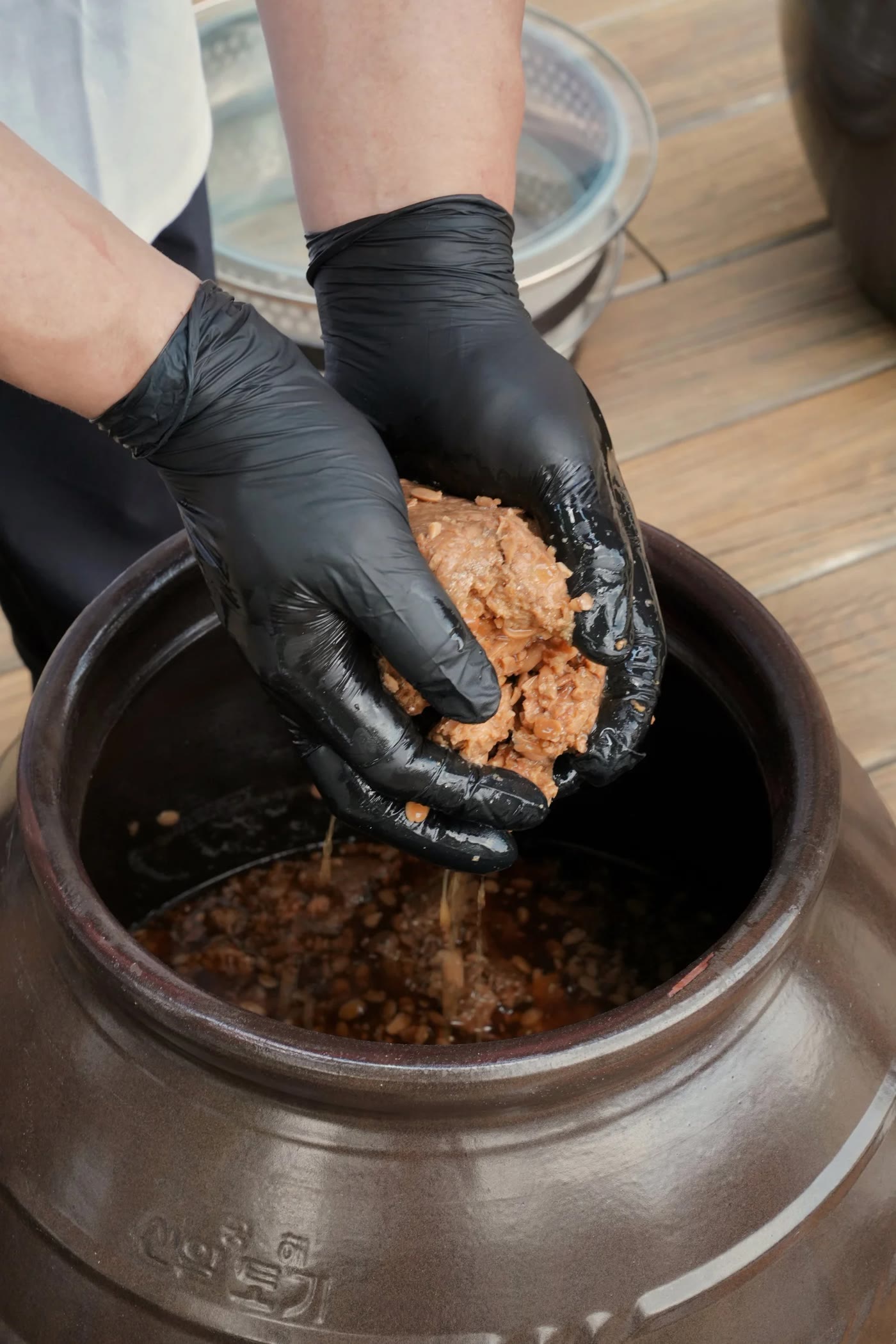
The easiest way to misread Joo Ok is to see the restaurant as one more Korean luxury transplant whose main trick is to move Seoul prestige into a Manhattan room. The official site keeps pointing somewhere else. It says the beauty of Korean cuisine lies in the art of fermenting jang, Korea's mother sauces, and adds that all of Joo Ok's jang is made in house by hand using traditional techniques learned over generations.[1] That statement matters because it names the restaurant's real center of gravity. Joo Ok is not building flavor from a final flourish. It is building flavor from condiments, oils, and preserved bases that begin working long before service.
As of April 18, 2026, the current official page is selling a 12-course tasting menu at $270, rising to $280 from May 1.[1] The April 2026 menu image makes the same logic unusually plain. Instead of hiding the sauce system inside the fine print, Joo Ok opens with a dedicated JANG section and names the bites after the condiments themselves: Gochujang, Ganjang, and Doenjang. The menu then keeps running that grammar through the rest of the meal, from a Jeon built around deul gi reum shrimp tartare, to Makgulli with eel and ganjang jelly, to Crustacean with lobster butter gochujang.[2] This is not decorative Korean vocabulary. It is the restaurant telling you how to read the food.
The secondary source trail reinforces that reading. Michelin's December 10, 2024 New York press release singled out Joo Ok's signature deul gi reum dish, describing diced geoduck and spotted shrimp in house-pressed perilla seed oil, and praised a menu rooted in tradition while presented through a modern lens.[4] Eater's September 3, 2024 opening report went even deeper into the production side, describing chef Chang-ho Shin bringing house-made doenjang, soy sauce, and preserves from Korea while building a new upstate farm plan for Korean herbs, soybeans, peppers, and perilla seeds.[5] Put together, those sources describe a restaurant where the expensive ingredients arrive late in the story. The structure is already in place.
Image context: the lead image uses Joo Ok's official photograph of jang being handled over an onggi jar rather than a dining-room glamour shot. That choice fits the article because the core claim is technical. Before the lobster, caviar, wagyu, or skyline enters, the house is already making an argument with fermentation vessels, time, and hand labor.[1]
1. At Joo Ok, jang is course architecture, not just seasoning
The current menu's strongest move is simple: it refuses to treat jang as a hidden background note.[2] In many restaurants, fermented sauces appear only as a quiet line in the description, something the diner tastes without being asked to think about it. Joo Ok does the opposite. By naming the opening bites Gochujang, Ganjang, and Doenjang, the kitchen frames fermentation as the first thing you should notice.[2] The sauces are not support staff. They are lead actors.
That naming choice matters because each sauce solves a different problem. Gochujang carries heat, sweetness, and slow depth. Ganjang sharpens salinity and umami while keeping edges clean. Doenjang gives the food weight, grain, and a slightly earthy bass note. The April menu suggests that Joo Ok wants diners to feel those differences as a progression rather than as one blended notion of "Korean flavor."[2] The house is teaching the palate how to separate its own vocabulary.
The official homepage makes the same point in more general terms. It says all jang is made in house and continues to develop over time, lending signature nuance and complexity to the dishes.[1] That "develop over time" line is the important one. Joo Ok is not seasoning at the finish line. It is staging flavor through fermentation clocks that begin weeks or months before the plate is composed. Once you read the menu this way, the restaurant stops looking like a luxury tasting counter with Korean references on top. It starts looking like a sauce-driven system that happens to use luxury ingredients.
2. Perilla oil is where farming and plating collapse into one gesture
If jang is the restaurant's grammar, deul gi reum, or perilla oil, may be its most revealing sentence. Michelin's 2025 New York guide release highlighted Joo Ok's signature dish of geoduck, spotted shrimp, and quail egg in house-pressed perilla seed oil.[4] The current official homepage explains where that oil comes from: Joo Ok's First Hand Farm in Bloomingburg grows the seeds for the restaurant's signature perilla oil, which the team cold-presses in the kitchen each week.[1]
That is more than a sourcing anecdote. It explains why the flavor lands differently. Perilla oil has a green, nutty, almost lifted aroma that can make raw or lightly cooked seafood feel broader without turning heavy. When the oil is pressed from the restaurant's own seed line, the distance between field and final seasoning collapses. The farm is no longer just upstream procurement. It becomes part of the last sensory event on the tongue.
Eater's opening report clarifies how seriously Shin takes that loop. He told the publication that he wanted to learn how Korean staples would grow in a new terroir and that he was reengineering recipes around the changed taste and texture of ingredients grown upstate.[5] That is the opposite of treating the move from Seoul to New York as a copy-and-paste relocation. It means the restaurant is using Korean technique to read American soil. Perilla oil therefore matters not just because it tastes good, but because it proves the restaurant is willing to rebuild flavor from seed outward.
3. Fermentation at Joo Ok is a whole-house system, not a kitchen silo
The official homepage makes another unusually direct claim: peels, scraps, stems, and rinds are transformed into more than 30 seasonally changing vinegars, teas, and syrups that form the basis of both the food and beverage program.[1] That sentence is easy to skim past, but it changes the scale of the project. Fermentation here is not reserved for a few prestige condiments. It is being used to connect savory courses, non-alcoholic pairings, cocktails, and the wider sustainability story.
The current beverage PDF confirms that the drinks list is built to speak the same language. Joo Ok offers a 7-beverage pairing, a 7 non-alcoholic pairing, Korean traditional drinks, and signature cocktails; among the house signatures is a drink simply called Perilla, built with perilla, pine soju, and yuja.[3] Even the non-alcoholic pairing leans into crafted, fermented, or botanically complex textures rather than generic juice service, ending with homemade Sikhye.[3] The result is a room where the glass is not there to interrupt the food's logic. It extends it.
That helps explain why Joo Ok feels sharper than restaurants that talk about sustainability only through sourcing. Sourcing matters here, but the more interesting move is conversion. A stem becomes syrup. A peel becomes vinegar. A seed becomes oil. A sauce becomes the title of a course.[1][2][3] The restaurant keeps finding ways to turn what would often be background process into the visible structure of dinner.
4. The room matters because it reduces noise around delicate work
Joo Ok's Manhattan setting could easily have become a distraction. Instead, the room appears designed to make the sauce system more legible. The official site promises a Hanok-setting experience, while Michelin's 2025 New York release describes an unusual freight-elevator entrance leading into an elegant room that echoes a traditional Korean home while looking out over the Manhattan skyline.[1][4] Eater's opening feature adds that the gritty 1913 building and operator-run elevator were kept as part of the sequence, before the guest enters a calmer interior shaped with hanok references, wood geometry, and skyline cut-outs.[5]
That contrast is not nostalgia theater for its own sake. It is a staging device. The rough shell of Koreatown outside, then the quieter room above, prepares the diner for food built on detail rather than brute force. Joo Ok does not need a maximalist room because the sauces, oils, and preserved elements are already doing so much hidden work. The space can stay restrained and let the palate do the reading.
This is why the restaurant feels compelling in 2026. Plenty of fine-dining rooms can buy luxury ingredients. Far fewer can make condiments feel like the real high craft. Joo Ok's strongest proposition is not just that it serves a polished Korean tasting menu in Manhattan. It is that the meal is organized by fermentation timing, seed pressing, and a clear understanding that flavor often lives in the medium rather than in the headline ingredient. The luxury is real, but the deeper pleasure is structural.[1][2][3][4][5]
Sources
- Joo Ok official homepage, covering the 12-course tasting-menu format, April 2026 pricing, the in-house jang program, First Hand Farm, weekly cold-pressed perilla oil, the 30-plus vinegars/teas/syrups note, the Hanok-setting room framing, and the official fermentation photograph used here.
- Joo Ok official April 2026 menu image, covering the current JANG opening section, dish names such as Gochujang, Ganjang, Doenjang, Jeon, Makgulli, Sujebi, Crustacean, and the current $270 tasting-menu price.
- Joo Ok official beverage menu PDF dated March 12, 2026, covering the 7-beverage and 7 non-alcoholic pairings, Korean traditional drinks, the Perilla signature cocktail, and homemade Sikhye.
- MICHELIN Guide press release PDF, "Star-studded MICHELIN Guide Ceremony" (December 10, 2024), covering Joo Ok's two-star recognition in New York, the freight-elevator arrival, room description, and the signature deul gi reum dish with house-pressed perilla seed oil.
- Caroline Shin, "A Michelin-Starred Restaurant From Seoul Uproots to Manhattan's Koreatown." Eater NY, September 3, 2024, covering Chang-ho Shin's move from Seoul, the transfer of house-made ferments, the upstate farm strategy, and the hanok-inspired interior sequence in Koreatown.