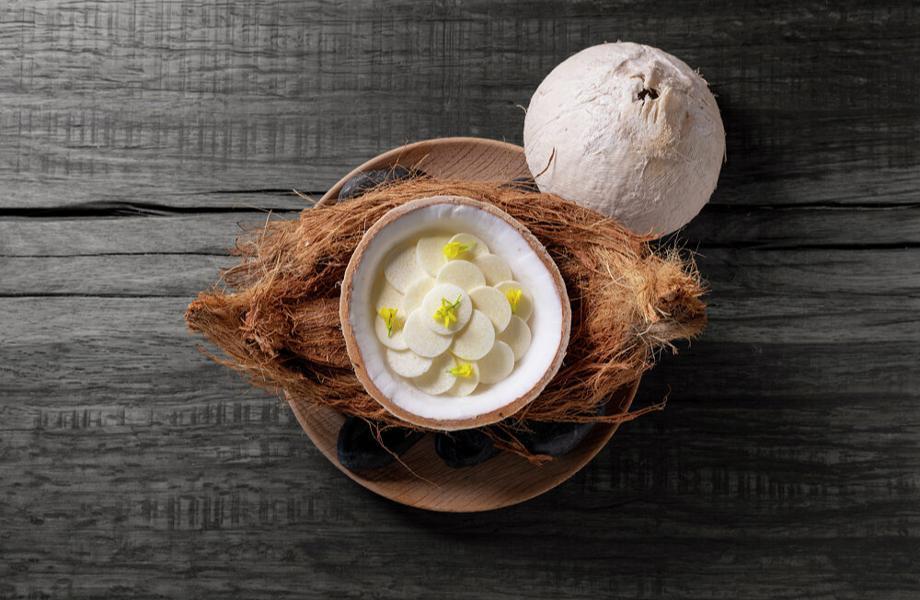
The coconut shell is open on dark wood, its rough husk left around a tight white bloom. Pale discs overlap like petals; a few yellow-green flecks interrupt the monochrome.[2] It is an earlier JL Studio course, not a promise about the 2026 menu. The image shows the restaurant's method before a bite: keep a real object recognizable, then rearrange what it carries.
The fish arrives carrying the memory of chicken. In one documented version of Hainanese chicken rice at JL Studio, Taiwanese garoupa was poached in aromatic broth while rice cooked with chicken stock became a smooth sauce; Taiwanese peppers took the place normally occupied by chilli sauce.[3] The protein changed. The relationship among fragrant stock, rice, gentle flesh and bright heat did not.
That plate contains the most useful way into Jimmy Lim's restaurant in Taichung. JL Studio is routinely described as Singaporean street food raised to fine-dining altitude. The description catches the change in setting but misses the intelligence of the work. Lim is not simply making familiar food smaller, smoother and more expensive. At his best, he identifies the flavor grammar that makes a dish recognizable, then changes the nouns.
The distinction matters in 2026. JL Studio retained its three Michelin stars in Taiwan's July selection and sits at No. 50 on the current Asia's 50 Best list.[1][2] Those awards confirm that the restaurant remains visible after nearly a decade; they do not explain why it deserves attention. The more interesting achievement is that a Singaporean chef in Taiwan has made adaptation feel like a form of precision rather than a softening of identity.
The restaurant also has a literal new frame. In June, JL Studio reopened at 59 Cunzhong Street, the former home of Le Moût—the kitchen where Lim once worked before building a restaurant of his own.[6][7] The move turns his biography into a spatial loop: he has returned to an address associated with his European training while bringing back a menu that became legible only when he stopped trying to sound European.
A restaurant born from a menu Lim could not believe
JL Studio almost opened as another contemporary European restaurant. Lim had trained in Taiwan at Le Moût and spent time in kitchens including The French Laundry, Per Se and noma.[2][5] Technique was not the missing piece. Days before the restaurant's February 2017 opening, he looked at the planned European menu and decided it did not sound like him. He abandoned it, changed the pantry and asked the team to begin again with Singaporean food.[3][5]
That late pivot makes a bracing origin story, but it was not an instant revelation. Lim has described the first months as an argument with his own certainty. Singapore's pungent, spicy and deeply savory profiles could read as forceful in Taichung, where he encountered a preference for greater delicacy. He had to study the local palate without converting “local” into “mild,” and some members of the opening team stayed through that recalibration.[3][5]
The chef's biography explains the emotional pressure behind the menu. Lim grew up in Taman Jurong in a family of strong cooks; his father ran a zi char stall and cooked late suppers at home. Wok fire, porridge, noodles and fried rice were not research subjects discovered after culinary school. They were the kitchen's first language.[3][5] The foreign training supplied control over texture, temperature and sequence. It did not supply the subject.
This is why the founding menu change was more than a branding decision. A European tasting menu in Lim's hands might have been accomplished, but authorship would have remained borrowed. Singaporean cuisine gave him something harder: memories vivid enough to edit and an audience capable of noticing when the edit broke the sentence.
The backbone survives even when the dish changes shape
Lim has used laksa to explain his method. Its ingredients can announce themselves separately as pungent, spicy and savory, yet the dish depends on their eventual harmony.[3] That is a chef's definition of structure. It treats identity not as a sacred list of ingredients but as a set of forces that must still balance when the format changes.
The chicken-rice course is the clearest test. Replacing chicken with Taiwanese fish sounds, on paper, like provocation for its own sake. But the accompanying moves reconstruct the dish's support system: aromatic poaching, chicken-infused rice, a sauce with the soft body of porridge, and a local pepper carrying the necessary lift.[2][3] Fish does not impersonate chicken. It occupies chicken's textural role while the broth-rice-chilli triangle does the work of recognition.
An earlier Taichung-style gua bao made the exchange more physical. Lim placed a Hainanese chicken filling inside the steamed bun and served chicken-rice chilli in a squeeze bottle, preserving the local gesture of injecting sauce into the bread.[3] The course did not merely import a Singaporean filling or borrow a Taiwanese wrapper. It joined two habits at the point where the diner's hand completed the dish.
Even the bread service has been used as translation. In a version documented by Michelin, a lard candle melted into oil scented with lemongrass, garlic, shallot and chilli, alongside Chinese vinegar reduced with sugar. Lim connected it to Taichung diners' familiarity with dipping bread into olive oil and balsamic vinegar.[3] The visual joke earned its place because it clarified the exchange: a known table ritual carried an unfamiliar aromatic vocabulary.
Other plates have pushed the method closer to the edge. A course called Little India used a savory vada with sea urchin, puréed sweet tomatoes from Nantou, crushed mozzarella and curry-leaf oil; a dessert recalled tau suan beneath a sugar dome.[4] These are documented past iterations, not promises about today's menu. They show both the restaurant's range and its central risk. Once a reference has been compressed into a polished bite, wit can crowd out appetite. A clever resemblance is not enough. The transformed course still has to deliver the pulse of the food it names.
Taiwan is the working language, not the backdrop
There is a lazy way to describe this restaurant: Singaporean memories, French technique, Taiwanese ingredients. The three-part formula is accurate but static, as though produce simply fills blanks in a concept designed elsewhere. JL Studio's better dishes suggest something more reciprocal.
Taiwanese fish changes what chicken rice can feel like. Local peppers change the shape and duration of its heat. The gua bao changes how sauce reaches the filling. Taichung's bread-dipping habit changes the service choreography. In each case, the host city does more than provide seasonal freshness. It supplies an action, texture or expectation that redirects the course.[2][3]
Asia's 50 Best reports that about 90 percent of the tasting menu is assembled from locally sourced produce each day.[2] The number is useful only if it remains visible in flavor. Locality is not proved by a percentage recited at the table; it is proved when a substitution makes the dish more specific rather than merely more available.
The relocation sharpens the argument. A former French fine-dining address could easily become a heritage prop in this story; instead, it is a test of whether the restaurant's Singaporean grammar now feels strong enough to own the room. The address has returned to Lim. The original European menu has not.[6][7]
Three stars do not complete a hierarchy
JL Studio became the first restaurant devoted to Singaporean cuisine to receive three Michelin stars in 2023, and it has retained them through the 2026 Taiwan guide.[1][3] It is tempting to tell that story as a promotion: hawker flavors finally admitted to the white tablecloth. That reading gives the award too much authority and the original food too little.
Singapore's hawker culture was inscribed on UNESCO's Representative List of the Intangible Cultural Heritage of Humanity in 2020. UNESCO describes hawker centres as community dining rooms where Chinese, Malay, Indian and other traditions meet, where specialists refine particular dishes over years, and where eating supports daily social life across income and background.[8] A bowl of laksa does not need a tasting menu to become culturally serious. Its seriousness already resides in practiced repetition, access, memory and the public room around it.
JL Studio therefore should not be praised for proving that chicken rice, vadai or kaya can become “worthy” food. Its real contribution is narrower and more demanding: it proves that Singaporean cuisine can generate a formal restaurant language without disguising itself as French. The white cloth changes the pace, portion and price. It does not sit above the hawker table in a ladder of value.
That boundary also protects the restaurant from its trophies. The Michelin retention and 50 Best ranking are current facts, not sensory verdicts.[1][2] This profile is based on published menus, interviews and institutional descriptions, not a visit to the present service. Menus move; execution varies; a famous reference can land as recognition for one diner and as expensive reduction for another. Awards cannot settle those questions in advance.
The next course still has to pass the translation test
Nearly ten years after Lim discarded his first menu, the restaurant no longer needs to demonstrate that modern Singaporean fine dining can exist. The harder task is keeping the method alive after the landmark has been achieved.
Each new course faces four tests. The original dish needs to be understood as a structure, not harvested as an icon. A Taiwanese ingredient must change the flavor meaningfully, not merely satisfy a sourcing claim. Technique must clarify a relationship—between rice and broth, coconut and toast, acid and richness—rather than announce the chef's résumé. And playfulness must increase appetite instead of turning a lived food into a collectible miniature.
When those conditions hold, JL Studio's distance from Singapore becomes productive. Lim can taste his first food against a second home, noticing which parts are load-bearing and which can move. The result is neither a replica nor a vague fusion. It is a sentence spoken with an accent on purpose.
Return to that chicken rice with no chicken. Taiwanese fish supplies the flesh; chicken stock stays with the rice; porridge becomes sauce; pepper keeps the final word. The ingredients have traveled farther than the grammar. That is why the dish can change so much and still know where home is.
Sources
- Michelin, “The MICHELIN Guide Taiwan 2026 shines with 9 New One MICHELIN Stars and 2 New Two MICHELIN Stars,” 23 July 2026 — current Taiwan selection and JL Studio's retained three-star status.
- Asia's 50 Best Restaurants, “JL Studio,” 50 Best Discovery — current 2026 ranking, chef background, local-sourcing estimate, documented courses and archival restaurant photography; its venue details predate the June 2026 move.
- Michelin Guide, “Proudly Singaporean: Jimmy Lim on JL Studio Being the World's First Singaporean Restaurant with 3 MICHELIN Stars,” 18 September 2023 — opening pivot, family history, Taichung adaptation and the chicken-rice, bao and bread-service examples.
- Michelin Guide, “Inspired By Singapore: Jimmy Lim's Signature Dishes At Two-Starred JL Studio In Taiwan,” 22 March 2021 — the restaurant's earlier Little India, chicken-rice and tau-suan iterations.
- Channel NewsAsia Luxury, “The son of a hawker bringing Singaporean flavours to Taichung, Taiwan,” published 16 December 2021 and updated 4 October 2025 — Lim's training, early audience challenge and Singapore–Taiwan restaurant context.
- udn Style, report on JL Studio's relocation to its former Le Moût site, 23 June 2026 — the move to 59 Cunzhong Street and the significance of Lim's return to his former workplace.
- Michelin Guide, “JL STUDIO — Taichung” — live restaurant listing confirming the current Cunzhong Street address and Singaporean-contemporary classification.
- UNESCO Intangible Cultural Heritage, “Hawker culture in Singapore, community dining and culinary practices in a multicultural urban context” — 2020 inscription, multicultural practice, transmission and the social role of hawker centres.