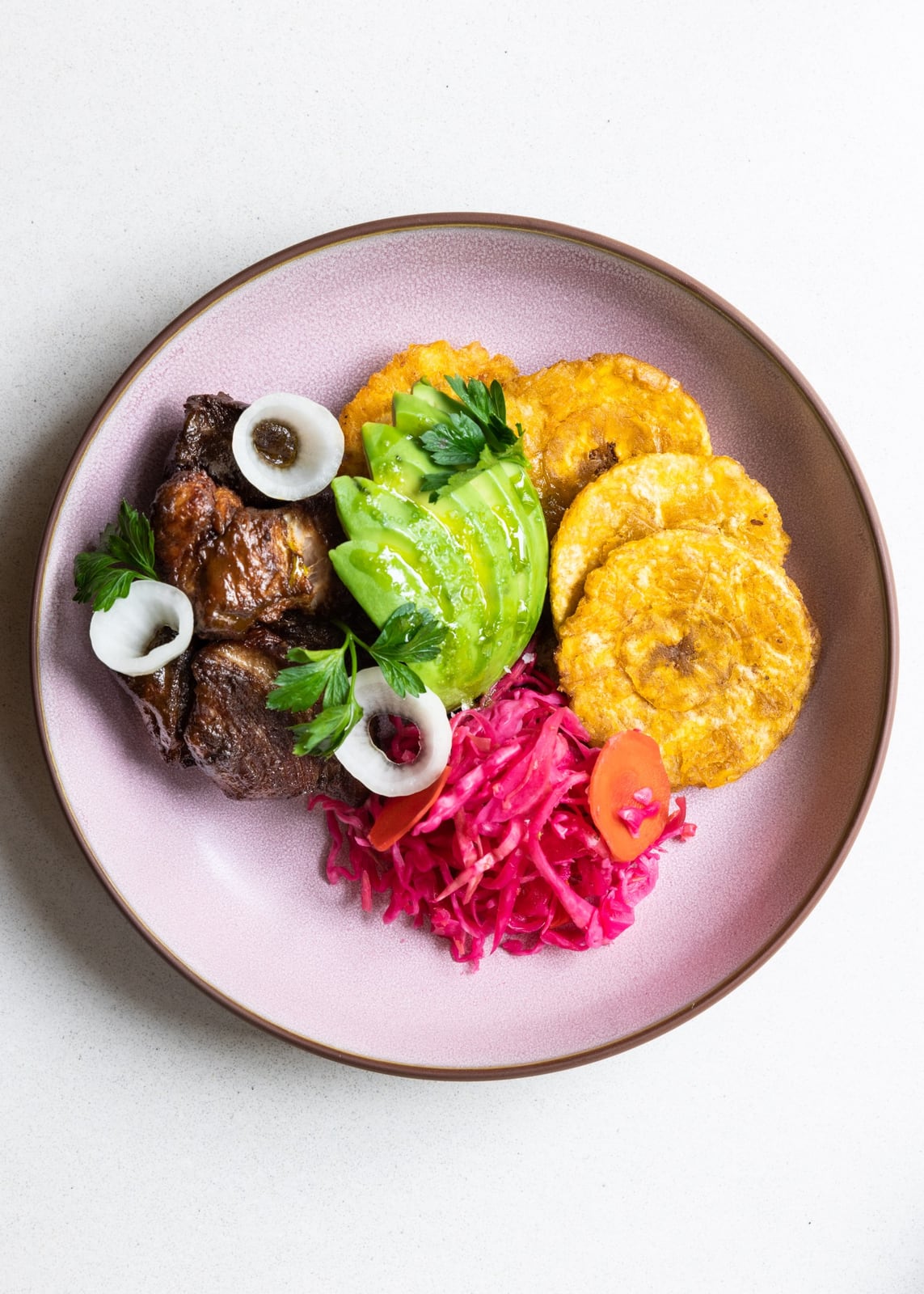
The plate has no quiet quadrant. Dark pork crowds one side; pressed plantain rounds flash gold on the other. Between them sit a fan of green avocado and a heap of pink pikliz bright enough to pull the eye across the table. White onion rings land on the meat like loose punctuation. In Eva Kosmas Flores’s overhead photograph, the arrangement is polished but immediately readable: this is griyo with its companions, not a chef’s riddle made from their memory.[2]
The decisive work is invisible. Before one piece of pork could hold that deep-brown edge, it had to leave its first cook at a point most cooks are trained to distrust—not fully soft, not ready to collapse under a fork. The meat still needed enough structure for a second encounter with heat.
Gregory Gourdet told writer Korsha Wilson that Kann’s griyo took five years to dial in. His restaurant roasts the pork with aromatics and then fries it. Take the roast too far and the pieces turn mushy, unable to withstand the fryer; stop too soon and the pork stays chewy and insufficiently rendered.[1] The target is a narrow and counterintuitive middle: tender enough to yield after frying, firm enough to reach it intact.
That middle is the whole dish.
The fryer grades the roast
Tenderness is usually described as an endpoint. A braise is done when the spoon wins; a roast is praised when the meat gives way. Griyo rearranges that logic because the first cook is only one shift in a two-shift process. The roast must build flavor and begin the tenderizing, then stop while the pieces can still be handled as pieces. The fryer completes the texture rather than decorating a finished one.
It cannot restore structure that the roast has already surrendered. Oil may brown a fragment, but it cannot turn a collapsing mass back into a crisp-edged cube. Nor can the last burst of heat erase chewiness left by an abbreviated first cook. The second stage exposes the judgment made in the first.
This is why “twice-cooked” is more than a menu flourish. The two applications of heat have different jobs. Roasting with aromatics works inward, setting the pork’s seasoning and degree of tenderness. Frying works at the boundary, darkening the exterior and making the edge answer back before the interior yields. A successful bite preserves both events: first resistance at the surface, then softness within.[1]
Published reporting does not reveal Kann’s cut dimensions, temperatures, cooling interval or fryer settings. Inventing those numbers would mistake false precision for access. What is documented is more useful to understanding the plate: the process has a failure state on either side, and Gourdet spent years finding the interval between them.[1]
The spelling also carries information. Griyo is the Haitian Creole form; griot is another common rendering. Eater writer Annie Harrigan, describing the dish through her own Haitian American family experience, identifies it as pork that is braised and fried and recalls preparing it from pork shoulder with epis, Haiti’s foundational aromatic seasoning.[2] Kann’s roast-to-fry method belongs inside that recognizable sequence without pretending that every Haitian cook follows an identical formula.
Tenderness needs a reserve
The pork in the photograph does not advertise delicacy. Its surfaces are rugged rather than uniformly lacquered; one piece catches the light while another retreats almost to black. Those irregular faces are exactly where the final cook becomes legible. Crispness needs corners, seams and enough remaining body for the outside to differ from the center.
Too-soft pork erases that difference. If every part gives way at once, frying becomes merely a darker flavor on a uniformly yielding bite. Too-firm pork fails in the opposite direction: the browned shell arrives, but the center remains a task. Kann’s version seeks what might be called a reserve of tenderness. The first cook leaves some transformation for the second, so that the meat reaches its intended texture only after the fryer.
That idea explains why five years of development can hide inside a plate that looks so direct. The work was not necessarily the addition of more components. It was learning when to stop. A restaurant also has to reproduce that decision across many portions, not just recognize one beautiful piece at home. The luxury here is repeatability without the texture becoming standardized into softness.
Griyo therefore makes a useful correction to a common fine-dining reflex. Refinement is not always an extra pass through the kitchen, a smoother purée or a more fragile garnish. Sometimes it is the refusal to complete a process too early. Restraint in the roast creates possibility in the fryer.
The sides keep the pork legible
Kann’s current summer menu gives the dish one spare line: “griyo twice cooked pork” with bannann peze, avocado and pikliz.[3] The photograph shows why the list needs no extra sauce or decorative scatter. Each companion occupies a different textural and sensory register, and each protects the pork from becoming the only loud thing on the plate.[2]
The plantain mirrors the meat without copying it. Wilson reports that Gourdet fries the plantains twice because that method produced the texture he wanted.[1] Pork and plantain thus both arrive through two stages of cooking, but their results diverge: the meat offers a crisp perimeter around a yielding center, while the pressed plantain gives a denser, starchier crunch. One carries aromatic richness; the other gives the teeth a cleaner kind of resistance.
Avocado moves in the other direction. Its cool-looking green and seamless softness create a pause between fried elements. It does not compete for crispness, acidity or heat. A slice can round the pork’s darker flavors without turning the whole plate into a creamy composition.
Then pikliz cuts the circuit. The Haitian pickled-cabbage condiment brings acid, chile and a raw vegetal snap; at Kann, its magenta color is as forceful as its job.[1] The pork’s richness can linger, but the pickle keeps it from smudging every subsequent bite. Pikliz is not a little salad placed for color. It is part of the dish’s pacing.
Seen this way, the plate contains a sequence the diner can edit: pork alone to measure the roast and fry; pork with pikliz for heat and acid; plantain after the pickle; avocado when the edges need softening. Fine dining often centralizes control at the pass. This arrangement returns some of it to the fork.
Recognition is a technical standard
Kann opened in Portland in August 2022 as a live-fire dinner house joining Haitian flavors to the Pacific Northwest’s produce and pantry.[4] The James Beard Foundation named it Best New Restaurant the following year.[5] Those facts explain the attention around the dining room, but they do not explain why the griyo works. The more revealing achievement is that a heavily scrutinized restaurant serves a composed plate without disguising the dish that brought it there.
Wilson described Kann’s version as visually playful while still recognizable to people who know the classic.[1] Harrigan later presented its twice-cooked pork as an introduction to Haitian cuisine and reported that Kann’s servers briefly explain each dish and its significance.[2] Recognition, in this setting, is not the opposite of creativity. It is one of the constraints against which the kitchen’s creativity must be tested.
That distinction matters because the language of “elevation” can imply that a familiar or communal dish acquires dignity only after a celebrated chef gives it more space on the plate. Griyo arrives with its dignity intact. Kann’s contribution is not to rescue it from informality, but to make Gourdet’s interpretation precise enough for restaurant service without sanding away the relationships that identify it: pork transformed by two cooks, plantain, pikliz, avocado, heat, acid and crunch.
The dish also resists deconstruction. The pickle has not become a gel. The plantain is not a crisp balanced vertically in the pork. The avocado is still recognizably avocado. A diner new to Haitian food can learn the plate by eating it, while a diner who knows griyo can still find the landmarks. Service may supply history, but the food does not require a lecture to reassemble itself.[2]
What five years bought
Five years of work do not appear here as visible complexity. They appear as the absence of two disappointments: pork that disintegrates before it can crisp, and pork that looks burnished but refuses to yield. Success sits between them, in pieces sturdy enough to enter hot oil and tender enough to leave it changed.
The sides make that achievement easier to notice, not easier to hide. Plantain doubles down on the pleasure of frying. Avocado supplies softness without taking it from the pork. Pikliz clears the palate and restores the appetite for another dark-edged piece. Their colors may make the photograph; their contrasts make the dish.[1][2]
Kann’s griyo offers a definition of refinement built on sequence. Roast until the pork is almost—but deliberately not yet—where it needs to be. Fry until the exterior speaks in a different voice from the center. Keep the accompaniments distinct. Stop before polish becomes disguise.
The most exact decision on the plate happened before the fryer was switched on. Tenderness had to be held back so the second cook could finish it.
Sources
- Korsha Wilson, “How Gregory Gourdet Is Creating a Home for Haitian Cuisine in Portland, Oregon.” Food & Wine, August 8, 2023 — reporting on Kann’s five-year griyo development, roast-to-fry process, plate and twice-fried plantains.
- Annie Harrigan, “Haitian Chefs Introduce Americans to Haitian Culture Through Their Food.” Eater, November 4, 2024 — griyo and epis context, Kann’s service approach and Eva Kosmas Flores’s photograph of the dish.
- Kann, “Summer Food Menu” — the restaurant’s current listing for griyo with bannann peze, avocado and pikliz.
- Gregory Gourdet, “Kann Restaurant” — the chef’s official description of Kann’s live-fire Haitian and Pacific Northwest concept and its August 2022 opening.
- James Beard Foundation, “The 2023 James Beard Award Winners,” June 4, 2023 — official record naming Kann Best New Restaurant.