
A chef's knife likes to present itself as a singular thing. One blade, one maker's mark, one handle shaped to one hand. Set it on a white cloth and it becomes an emblem of authorship: the chef's tool, as personal as handwriting. But a knife can hide a brigade before it ever joins one.
In Sakai, the old cutlery city south of Osaka, a traditionally made blade commonly moves among specialists. One craftsperson forges. Another corrects and sharpens. Another fits the handle. Sakai City's own account describes this division as hizukuri, hazuke or togi, and ezuke: fire, edge, haft.[3] The finished knife compresses those separate workshops until their joins seem as seamless as the steel.
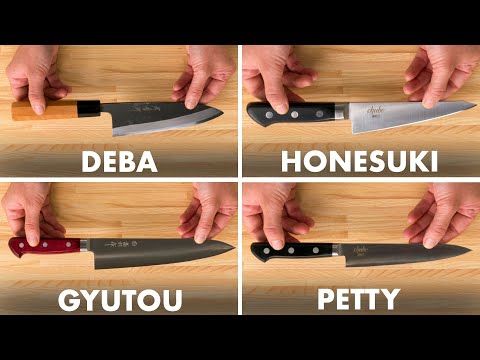
The two films here open that object from opposite directions. Japanese Food Craftsman's visit to Yamawaki Cutlery watches a knife pass through the Sakai production chain.[1] Epicurious then puts a broad family of Japanese knives into chef Christine Lau's hands and against actual food.[2] The first video asks who makes a blade. The second asks why a blade takes one shape instead of another. Together they turn knife luxury away from price and polish and toward a more demanding test: does each choice of material, geometry, task, and care continue the work of the person before it?
Before the edge, a chain of hands
Japanese Food Craftsman published its Yamawaki film in 2024. The channel documents food and craft, and its description also links to a retail shop, so this is a promotional workshop portrait rather than an independent audit.[1] That provenance is worth keeping in view. What makes the film useful is not its sales language but its patient view of work normally collapsed into the word “handmade.”
The crucial passage arrives early, around 0:51, before the sparks get their close-up. The film explains Sakai's divided labor and then physically follows the blade between workplaces.[1] This is not merely an efficient factory line broken into picturesque rooms. Each hand receives an incomplete object and has to read what the previous hand left behind.
Around 5:14, the blacksmith's hammering supplies the sequence's obvious drama: hot metal, scale, noise, the quick judgment of color. Yet the smith does not make the knife alone. Sakai City's technical outline distinguishes bonding, shaping, annealing, trimming, grinding, hardening, and tempering before final honing and hafting.[3] Heat must make a hard edge possible without making the whole object too brittle to work. The forge produces potential, not readiness.
At roughly 6:39, the film moves to the sharpener; by 7:43, grinding and polishing occupy the frame.[1] The change of workshop changes the visual tempo. Force gives way to alignment. Reflections across the metal become evidence of high and low spots. The official Sakai Kitchen account says that sharpening alone runs through more than ten steps, while learning the associated craft can require ten to fifteen years.[5] Those figures are institutional descriptions rather than guarantees for every maker, but they make the handoff legible: the sharpener is not tidying the blacksmith's finished product. The sharpener is authoring the surface and edge that the cook will actually meet.
That distinction changes how one reads the final stages, beginning around 10:56. A handle setter aligns wood and tang; engraving gives the collective object a public name; wrapping prepares it to travel.[1] Sakai City's description emphasizes the sensitivity of hafting: a wooden mallet fixes the blade into the handle, while the craftsperson listens for changes in sound rather than simply striking harder.[3] Even at the quiet end of the process, too much force can spoil what several specialists have already done.
The film's best correction to fine-dining mythology is therefore social. We are used to treating a beautiful knife as proof of a heroic smith, then treating a finished plate as proof of a heroic chef. Sakai's relay makes both ideas feel incomplete. Precision survives because one specialist can inherit another specialist's work, recognize its condition, and improve it without erasing it. The knife will soon enter another brigade, where prep cooks, fish cooks, sous-chefs, and chefs may repeat the same compact bargain.
On the board, shape becomes an instruction
Epicurious released its 24-minute survey in 2020 with Christine Lau, then executive chef at Kimika in New York.[2] “Every” in the title is best read as an invitation, not a complete taxonomy. Japan's Ministry of Agriculture, Forestry and Fisheries notes that there are more than twenty Japanese kitchen-knife types, including highly specific blades for eel, noodles, and the fine bones of pike conger.[4] Lau's selection is already large enough to reveal the important pattern: profiles are stored decisions about ingredients and motion.
At about 1:55, Lau begins with a gyuto and an onion.[2] The sequence is deliberately ordinary. A relatively light, general-purpose blade turns peeling, thin slicing, and dicing into one continuous demonstration. That is the useful baseline for everything that follows: specialization is meaningful only in relation to work a versatile knife can already do.
The vegetable section sharpens the contrast. Around 8:08, the flatter profile of a nakiri meets the board differently from a curved knife; around 9:17, an usuba performs the kind of controlled vegetable work associated with a single-bevel edge.[2] The visible lesson is not that a cook needs both. It is that edge line, blade height, thickness, and bevel affect how a hand can approach the ingredient. A broad, flat blade can make repeated board contact and move cut vegetables efficiently. A single-bevel knife can favor exact presentation, but it also introduces handedness and a sharpening geometry that demand practice.
Fish makes the relationship between form and service even clearer. Lau introduces the thick deba near 10:26 and the long yanagi near 12:13.[2] One is built for the resistant work of breaking down fish; the other gives a cook enough length to draw a clean sashimi slice rather than saw back and forth. The ministry's washoku guide makes the same division: deba for gutting and filleting, yanagiba for slicing sashimi, usuba for vegetables.[4] A polished slice is not cosmetic once raw fish reaches the plate. The cut surface is part of the texture the guest feels.
This is where a catalog can seduce a cook into learning the wrong lesson from the film. Fourteen named profiles do not make fourteen mandatory purchases. A knife earns space in a working roll when its geometry answers a recurring task often enough to repay the training and maintenance it requires. A fish restaurant may make a long pulling stroke essential. A vegetable-led tasting menu may value a tall, flat profile. A small station, a mixed menu, or a cook still building technique may get more precision from one familiar generalist than from a case of unfamiliar specialists.
Lau begins the film with care before cutting, showing stones, a wooden sheath, drying, and protection at about 0:39.[2] The sequence completes the first video's relay. The sharpener at the workshop establishes an edge; the cook decides whether that edge remains usable. The ministry describes sharpening as a daily responsibility for a dedicated washoku chef.[4] That does not mean every stone should be soaked for the same time or every blade held at one universal angle. Steel, bevel, and stone differ. The broader discipline is the point: a thin, exact edge is not a permanent feature delivered in a box. It is a condition the kitchen must repeatedly restore.
The knife roll should describe the menu
Seen together, the videos replace the fantasy of the “best knife” with a chain of fit. The blacksmith fits heat treatment to steel. The sharpener fits an edge to the forged blank. The handle setter fits blade to hand. The cook fits profile to ingredient and motion. The kitchen fits its maintenance habits to the demands of that edge. If one link is chosen for prestige rather than use, the object may remain beautiful while becoming less useful.
Fine dining raises the stakes because a cut is rarely performed once. A garnish may have to repeat across dozens of plates; fish portions must meet a service clock; an edge must still feel predictable late in the shift. Under those conditions, specialization can be a form of generosity. The right geometry removes unnecessary force and makes a delicate result easier to repeat. But specialization without fluency creates its own friction: another bevel to learn, another blade to protect, another failure mode when the station is busy.
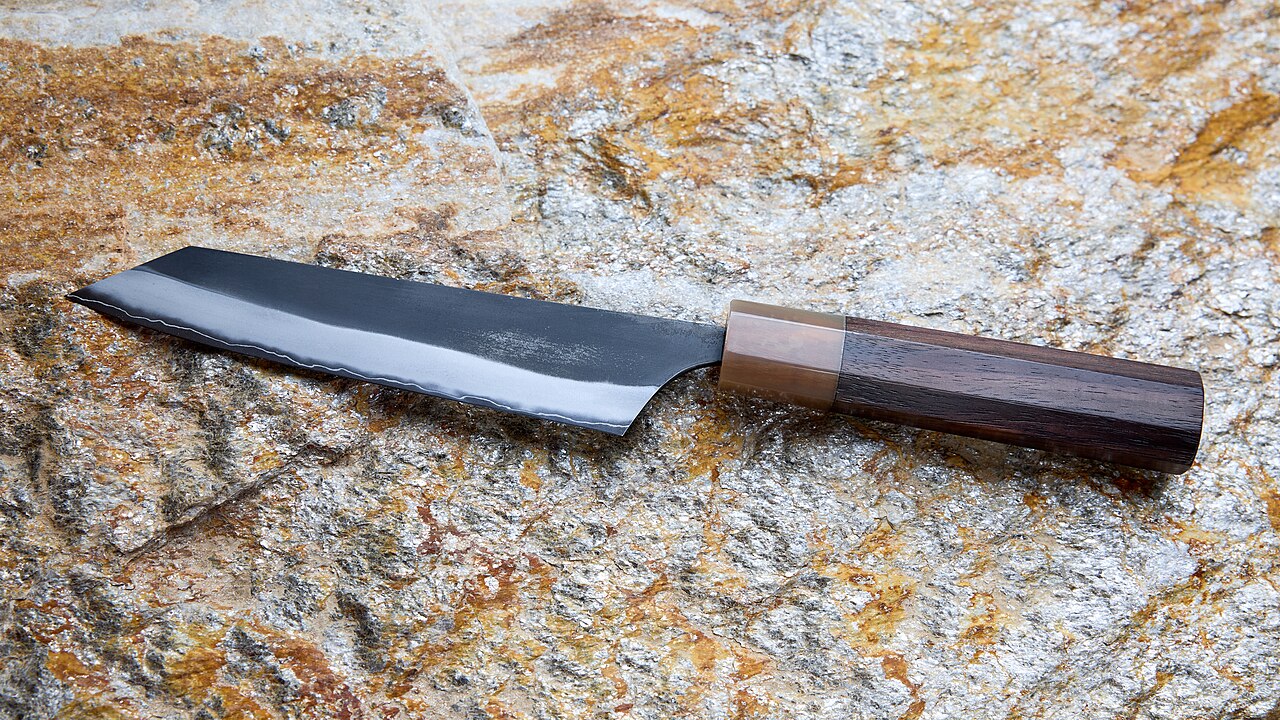
That is why the still photograph's compact kiritsuke-style petty feels like an apt final image.[6] It was made in Sanjō, not in the Sakai workshop on film, and its hybrid name joins a pointed profile to a small utility scale. It refuses the idea that Japanese knives form one pure, frozen family. Regional production, traditional food-specific blades, Western-influenced generalists, and contemporary hybrids all coexist.
The strongest knife roll is therefore not the one that contains the whole Epicurious lineup. It is the one whose contents can explain the menu: this blade because we break down fish; this profile because we cut vegetables all morning; this smaller knife because the work happens close to the hand. The films begin with fire and finish with food, but the same standard governs both. Craft becomes luxury only when the next person in the relay can use it well.
Sources
- Japanese Food Craftsman, “Forging Japanese Blades Since 1888! FULL PROCESS,” May 26, 2024 — the embedded YouTube film following forging, sharpening, polishing, handle fitting, engraving, and wrapping at Yamawaki Cutlery in Sakai.
- Epicurious, “How To Use Every Japanese Knife | Method Mastery,” October 22, 2020 — the embedded YouTube demonstration by chef Christine Lau, with chapter timestamps for care and fourteen knife profiles.
- Sakai City, “Cutlery” — official history and technical account of Sakai's divided forging, sharpening, hardening, honing, and hafting process.
- Japan's Ministry of Agriculture, Forestry and Fisheries, Washoku: Form and Style, pp. 22–23 — official guide to knife specialization, single-bevel form, fish and vegetable uses, cutting motion, and maintenance.
- Sakai Kitchen, “Steps in Sakai Forged Knife Production” — institutional overview of forging, multi-stage sharpening, handle attachment, and the apprenticeship horizon.
- Wikimedia Commons, “Masashi Kokuen Kiritsuke Petty 135mm (2026)-104A7479.jpg” — Frank Schulenburg's photograph and metadata for the Sanjō-made knife used as the article image.