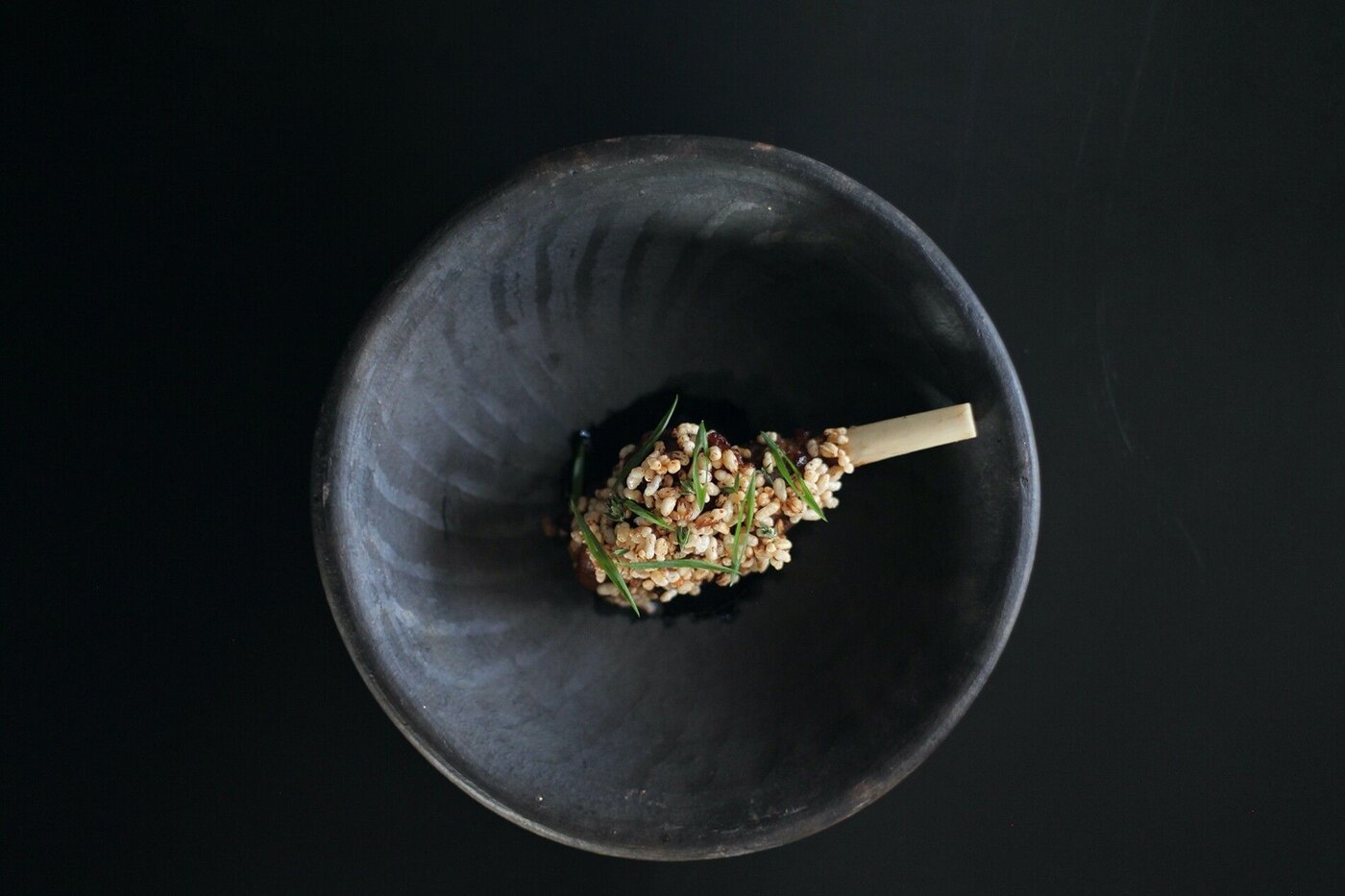
Goat and rice make a familiar enough promise. At ÌTÀN Test Kitchen in Lagos, the rice changed position: puffed ofada grains coated ayamase-braised goat, becoming part of the meat's outer texture. The dish, documented in National Geographic Traveller Food, offered a compact introduction to chef Michael Elégbèdé's work. Recognition could survive a change of shape.[1]
This is a portrait of a restaurant that has closed. In July 2024, local publication EatDrinkLagos reported that ÌTÀN's building was to be sold and demolished, ending the Ikoyi restaurant's run after an earlier pause.[2] Looking back at its cooking brings a question into focus: what can fine dining give a cuisine whose pleasures and sophistication already exist beyond the restaurant?
A homecoming that required homework
Elégbèdé came from a family of professional cooks. His mother and grandmother worked in food before him; his own training took him to the Culinary Institute of America at Greystone. His biography on Elevate's website describes that third-generation inheritance alongside the research that shaped his work in Nigeria and elsewhere in West Africa.[3]
That family history changes the familiar chef-profile arc. The restaurant was one expression of knowledge already being carried between people and kitchens. A formal culinary education could expand his methods, while leaving him with plenty to learn about the food he wanted to represent.
He returned to Nigeria in 2016. In his account to National Geographic, familiarity with Yoruba cooking had made him aware of how much he still needed to discover elsewhere in the country. Travel brought encounters with fishing communities, farmers and regional preparations. The landscape mattered because it helped explain what people cooked and how they lived.[1]
Familiar food, a different encounter
In an interview with ROADBOOK, Elégbèdé resisted describing his work as an elevation of Nigerian food. His aim was another perspective: home cooking and an artistically composed tasting menu could both belong to the same cuisine. He also hoped an unfamiliar dish at ÌTÀN might send a guest looking for its everyday version in a local buka, or eating house.[4]
That is a generous direction for a luxury restaurant to point. The expensive meal becomes an invitation to keep eating elsewhere. It can sharpen curiosity about a dish without claiming ownership of its best or final form.
La Liste's 2022 Young Talents recognition singled out Elégbèdé's shrimp with banga, a soup made from palm fruits, and his goat-and-rice interpretation of ayamase. Its description connected these freely interpreted dishes to his grandmother's cooking.[5]
Soup, stew and rice remained legible foundations for the courses. The craft lay partly in deciding what to alter and what to leave recognizable: a change of texture, a different proportion, a new way for one ingredient to meet another.[5]
The work before service
The restaurant's ambitions also depended on people who would never sit down for its tasting menu. Elégbèdé founded Abóri in spring 2019. His IMAGINE Leaders profile describes a Food Design Summit that gave vendors a farmers' market at Lagos's Mike Adenuga Centre, alongside his collaboration with local artisans.[6]
That puts the chef in another role: someone making introductions. A memorable ingredient has to reach a kitchen, and the person producing it needs opportunities to be seen. A market cannot by itself prove that livelihoods improved, but it provides a concrete example of the work surrounding the plate. The restaurant's regional curiosity had a practical counterpart in bringing producers together.[6]
Inside ÌTÀN, education preceded service. Elégbèdé told ROADBOOK that employees received three months of theoretical instruction before entering the kitchen, including the behavior of starches and proteins.[4] Such teaching gave a team more than a sequence of movements to copy; it offered reasons for what happened in the pan.
An address can disappear
EatDrinkLagos's closure report recalled both the tasting menus and staff training. It also recorded the chef's intention to continue working in Nigerian and African gastronomy, without announcing a definite next project.[2] A statement of intent cannot tell us what became of every cook, supplier or idea associated with ÌTÀN. It does, however, help explain why the loss of the dining room was more than the removal of somewhere to book dinner.
The old menus remain a useful record of the restaurant's proposition. In La Liste's account, the connection to family cooking survived the chef's freedom to reinterpret it.[5] That leaves a more interesting legacy than novelty alone: the possibility that a transformed dish can make its origins easier to notice. The rice moves. The relationship remains.
Sources
- Lauren Jade Hill, “The pioneer: chef Michael Elégbèdé's new Nigerian cuisine,” National Geographic Traveller Food, spring 2021; updated April 25, 2023 — reporting and Tola Odumosun's dish photograph.
- Food Prefect, “ÌTÀN Test Kitchen Closes Its Doors in Lagos,” EatDrinkLagos, July 22, 2024 — closure reporting.
- Elevate, “Michael Elégbèdé” — professional biography and family background.
- Ollie Horne, interview with Michael Adé Elégbèdé, ROADBOOK, updated July 22, 2024 — culinary philosophy and staff training.
- La Liste, “Michael Adé Elégbèdé,” Young Talents of the Year, 2022 — dishes and their relationship to family cooking.
- IMAGINE Leaders, “Michael Elegbede” — Abóri, its Food Design Summit and work with artisans.