A Malakoff arrives looking reassuringly self-contained: a rounded golden top, a flat bottom, nothing spilling onto the plate. The pleasure comes when that tidy shape gives way. In the bread-based version familiar around La Côte, in the Swiss canton of Vaud, a mound of cheese mixture and its little bread platform go into the oil together.[1] The bread is part of the fritter, already waiting beneath the filling when the knife comes down.
That small construction deserves attention. Cheese, bread and a hot pan suggest something almost automatic. A Malakoff asks the cook to turn them into a single object with contrasting textures: a crisp exterior around a yielding middle. Published recipes reveal several ways of getting there—and some useful disagreements about the route.
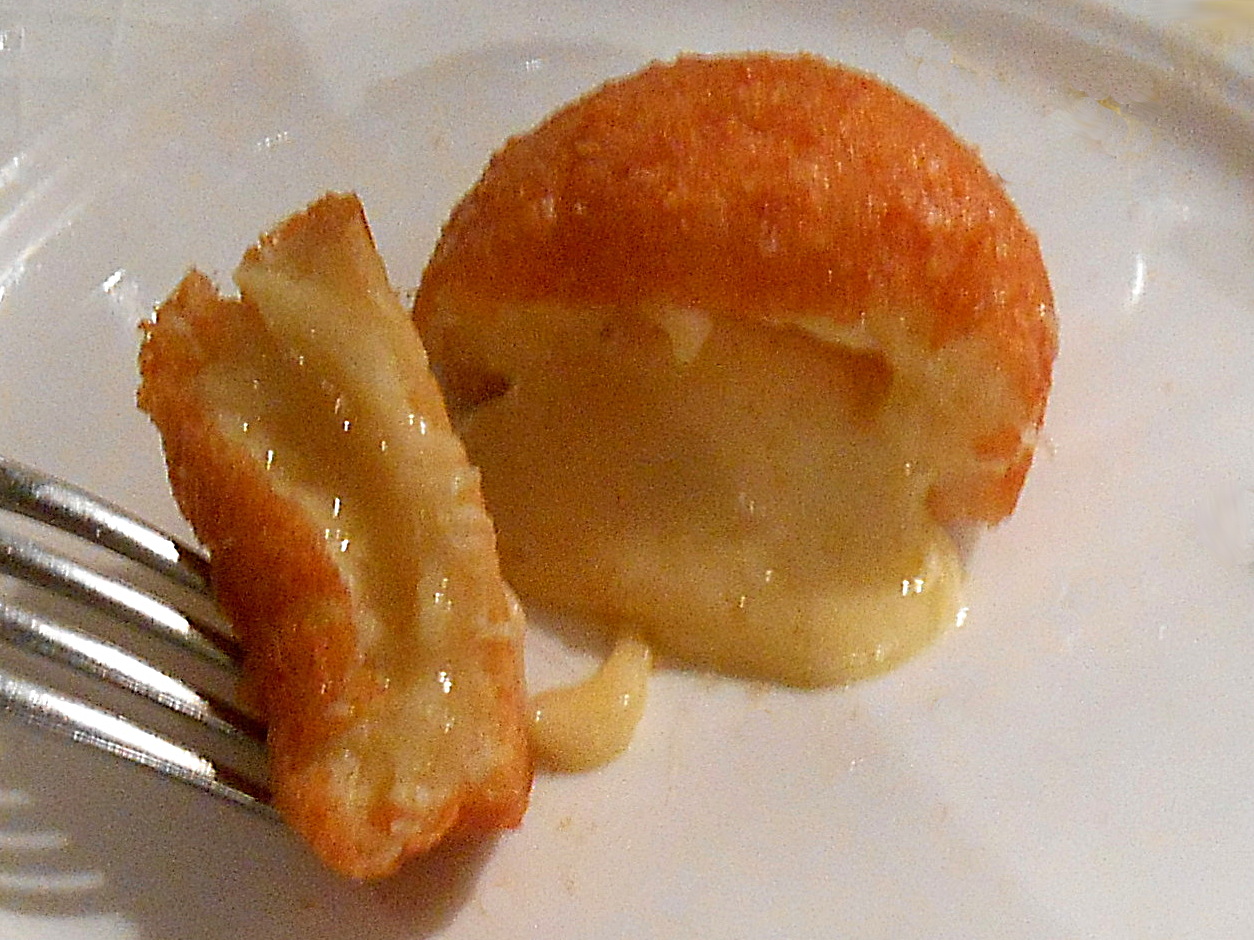
A dome assembled before it melts
Saveur's recipe, adapted from Malakoffs that writer Savita Iyer ate at Au Cœur de la Côte in Vinzel, starts with grated Gruyère. Flour, eggs, garlic, nutmeg, white wine and kirsch turn the cheese into a mouldable mixture. Portions are shaped with wet hands onto rounds cut from sandwich bread.[2]
Notice the order. The cook establishes the shape while the filling can still hold it. The cheese does not begin as a flowing sauce to be poured into a waiting shell; the exterior and interior take on their finished textures during frying. That makes the smooth mound more than a pretty silhouette. It is the form the cook has prepared to meet the oil.
Saveur specifies bread circles three inches across and mounds about an inch and a half high.[2] Those dimensions make this a substantial little dish, despite its modest footprint.
The join is part of the recipe
Pastry chef Nick Malgieri approaches the bread with particular care. His version, adapted from Marianne Kaltenbach's Aus Schweizer Kuechen, dries the cut rounds in the oven without toasting them. He then brushes each with egg white before shaping the cheese mixture on top.[3]
The important detail is the meeting point. Bread and topping have been prepared separately; now they need to survive being turned in hot oil as one piece. Malgieri explicitly starts frying with the bread underneath to seal the cheese to it. He turns the fritters after a minute and finishes the other side.[3]
The diner sees a comfortable, rounded shape; the cook has worked on its underside and its seam.
Two recipes, two first moves
Here the instructions diverge. Saveur puts the cheese side into the oil first and gives a total frying time of six to eight minutes. Malgieri starts with the bread and takes about three minutes in total. Both specify oil at 350°F, roughly 177°C.[2][3]
The difference is useful. An oil temperature alone does not describe the whole method. These recipes also differ in their mixtures and preparation. For someone cooking the dish, the sensible reading is to follow one complete version, including its shaping and sequence. Borrowing the starting orientation from one and the timing from another would create a method neither author actually gives.
For someone eating it, the disagreement is permission to look beyond a single supposed secret. Different preparations can pursue the same appealing contrast.
A Malakoff need not have a bread floor
Switzerland Cheese Marketing publishes another construction entirely. Its recipe marinates pieces of Gruyère in white wine, then coats them in flour and a batter into which beaten egg whites have been folded. The cheese remains in pieces rather than being grated into a mound.[4]
That changes where the cook does the enclosing. A separate batter surrounds the cheese; there is no bread disk to attach. The recipe fries these pieces at 180°C, then drains them. It is another answer to the same inviting prospect of hot cheese inside a browned exterior, but its preparation should not be confused with the dome's.[4]
Swissmilk offers a third approach: grated cheese mixed with wine, egg, mustard, garlic and flour, shaped into balls, chilled, then coated twice with egg and breadcrumbs before frying.[5] Here, the crust is deliberately built around the formed filling. The distinction is visible before any oil heats up: a bread pedestal, a batter coating, or a breadcrumb covering.
Leave room for the pickle
La Côte's tourism office describes the bread-based fritter arriving with mustard, pickles, onions and salad.[1] On the plate, these accompaniments offer a different register from the golden mound: sharpness, crunch and a mouthful of something green. They make the next piece of cheese seem inviting again.
The most rewarding way to look at a Malakoff is from the bottom up. Find the bread, if this version has it; notice how the crust meets the soft filling. A seemingly simple cheese fritter turns out to contain a series of deliberate decisions, right down to which side entered the oil first.
Sources
- La Côte Tourism, “Gourmet specialities of the region” — the bread-based dome and its customary accompaniments.
- Savita Iyer, “Malakoffs (Swiss Fondue Fritters),” Saveur, updated 20 October 2021 — recipe adapted from Au Cœur de la Côte in Vinzel; mixture, dimensions and frying sequence.
- Nick Malgieri, “Swiss Malakoffs” — his published adaptation of Marianne Kaltenbach's recipe; bread drying, egg-white join and bread-first frying.
- Switzerland Cheese Marketing, “Le Malakoff” — French-language recipe for wine-marinated Gruyère pieces in batter, used here for technique rather than its origin story.
- Swissmilk, “Malakoff” — German-language recipe for chilled, double-breaded cheese balls.
- Traumrune, “Malakoff-repas 02 detail.JPG,” Wikimedia Commons — restaurant photograph taken in Vaud on 26 October 2015; original image and attribution.