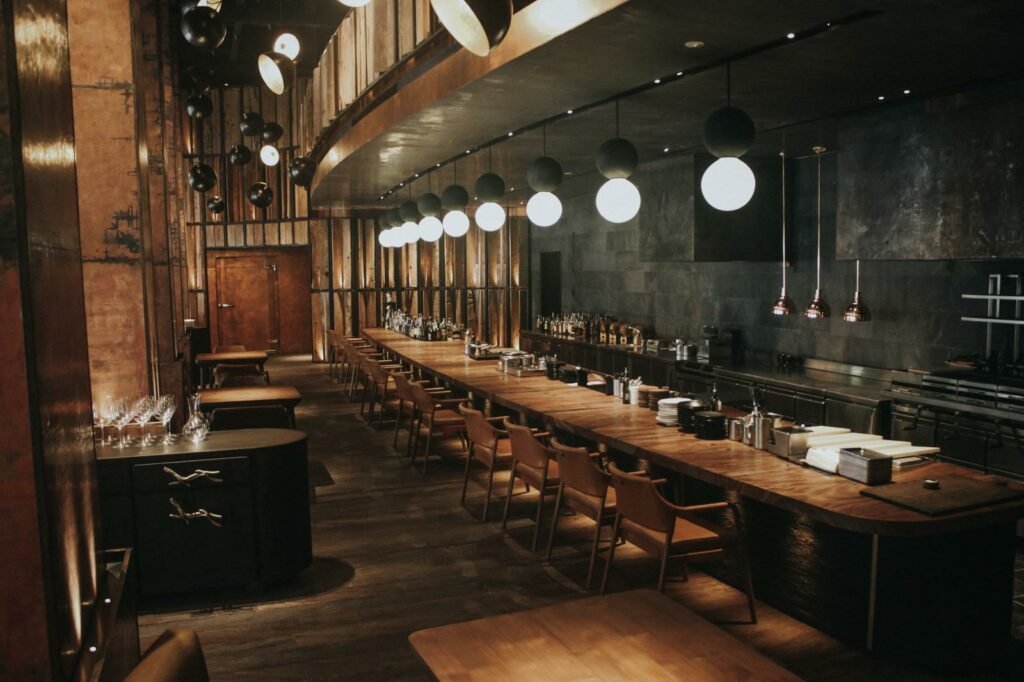
At many live-fire restaurants, smoke is the mood and the grill is the logo. Burnt Ends is more interesting because the fire is the floor plan.
That distinction matters. The official Burnt Ends description does not begin with a signature dish or a luxury ingredient. It begins with infrastructure: an open kitchen, a custom four-tonne dual-cavity oven, four elevation grills, and menus rewritten daily.[1] Michelin's current listing lands in the same place from the outside, describing refined barbecue cooked in a wood-fire brick kiln and noting that the restaurant's 2021 move to Dempsey gave the concept a room twice as big as before.[3] Put together, those details explain why Burnt Ends still matters in 2026. The craft is not just "good with fire." The craft is building an entire restaurant around the management of fire.
1. The oven is not equipment; it is the organizing principle
Chef-owner Dave Pynt's own language is unusually direct. Burnt Ends calls itself a modern Australian barbecue restaurant, but the more revealing sentence is the one about the kitchen core: the dual-cavity oven, the four grill elevations, and the belief that there is magic in cooking with wood.[1] That reads less like branding once you compare it with Michelin's older and newer reporting.
In Michelin's interview with Pynt, Burnt Ends is described as a room where everything centers on a wood-burning oven powered by apple and almond wood.[4] In Michelin's craft feature, Pynt sharpens the point further: 90% of what the restaurant does is cooked on grills, in the ovens, or smoked.[5] Once you look at the room through those numbers, the restaurant stops being a generic barbecue success story. It becomes a heat-management system.
That is why the counter matters so much. Burnt Ends was originally built around 18 counter seats facing the oven when it opened in 2013, and the current Dempsey version still treats proximity to fire as part of the product rather than hiding it behind kitchen walls.[4] The restaurant is selling cooked food, but it is also selling legibility. You are meant to understand that temperature, distance, and timing are the real ingredients.
2. "Cooking with fire" here means controlling a moving life cycle
The easiest mistake is to imagine live-fire cooking as a style of roughness: more char, more smoke, more instinct, less precision. Pynt describes the process in almost the opposite way. In Michelin's 2021 feature, he says that if you do not understand the process, you will not get a good result, because the fire has its own life cycle and the cook has to build with touch and feel.[5]
That phrase is the key to the restaurant's technique. Wood is not valuable because it makes everything taste smoky. Wood is valuable because it gives the kitchen a range of states to work with: rising heat, settled embers, fragrant smoke, different intensities at different grill heights, and oven chambers that can handle distinct tasks at once.[1][4][5]
This is where Burnt Ends separates itself from restaurants that use flame mostly as spectacle. The four grill elevations imply controlled distance from heat, not just theatrical proximity to it.[1][5] The dual-cavity oven implies parallel temperature logic, not a single rustic hearth.[1][4] Once that structure is in place, the kitchen can decide whether a dish should pick up smoke, deep roast, fast crust, gentle baking, or some combination of all four.
The result is not a menu that tastes like ash. It is a menu that can move between heavier and lighter notes without losing identity. Michelin's current write-up calls attention to meats and fish alike and recommends exploring the snack menu rather than treating the restaurant as a brute-force carnivore temple.[3] That is exactly what you would expect from a room where fire is disciplined instead of romanticized.
3. Daily rewriting is part of the technique
Burnt Ends also makes a more important claim than many famous open-fire restaurants are willing to make: it writes new menus daily.[1] That single sentence changes how the craft should be read.
If the heat source is alive and ingredients change, then repetition cannot be the restaurant's only measure of seriousness. The stronger measure is whether the kitchen can keep translating its fire grammar into new dishes without collapsing into randomness. Daily menu writing suggests a house that treats live fire as a language rather than one fixed performance.
That approach has consequences for how diners should read the food. Burnt Ends is not organized like a museum of canonical plates where the point is to reenact one historical greatest hit after another. It is organized more like a workshop with a stable machine and a shifting script. The machine stays constant: wood, oven, grill heights, direct sightlines, counter service.[1][4][5] The script moves with product and with the kitchen's judgment about what those tools should do today.[1]
This is also why Pynt's formative time at Asador Etxebarri matters, even if Burnt Ends is not trying to imitate that restaurant literally. Michelin traces his fire education through Victor Arguinzoniz's world of wood grills and ovens in the Basque region, then through the Burnt Enz pop-up in London, before Burnt Ends opened in Singapore in 2013.[4] The important inheritance is not one dish. It is the idea that world-class precision can be built out of fire if the cook treats heat as a craft medium instead of a mood board.
4. The room's scale-up only works because the logic stayed intact
Restaurants often lose edge when they move into bigger, more polished rooms. Burnt Ends is interesting because Michelin's current note makes the opposite claim in compressed form: the 2021 relocation produced a restaurant twice as big as the previous space, yet the inspectors still frame it around the brick kiln, the snack menu, the Australian wine program, and the need to book ahead.[3]
That matters because it suggests the scale increase did not dilute the core system. The new room appears to have expanded capacity without breaking the old logic that made Burnt Ends distinctive in the first place: a visible heat source, direct service energy, and a menu that still reads as barbecue translated through chef-level control rather than piled-on luxury garnish.[1][3]
The reservations page adds one more practical clue. Burnt Ends states that reservations are accepted only 45 days in advance.[2] That booking structure fits the rest of the restaurant's personality. It is a room built on controlled release: controlled heat, controlled menu cadence, controlled access.
Why Burnt Ends still feels sharp now
Burnt Ends has now held its one Michelin star since 2018, according to both the restaurant's own current about page and Michelin's continuing listing.[1][3][5] Burnt Ends also still uses its official materials to anchor the restaurant in rankings and in the Dempsey room's continued relevance.[1] Those status markers matter, but they are not the best explanation of the restaurant's staying power.
The better explanation is structural. Burnt Ends works because it does not treat fire as an attitude. It treats fire as kitchen architecture. The oven decides the room. The grill heights decide the cuisine. The daily menu keeps the technique alive. The counter turns heat into something diners can almost read with their bodies.[1][4][5]
That is why Burnt Ends still feels more precise than most copycat open-fire rooms. Precision here does not arrive by removing the primitive element. It arrives by building a whole restaurant around it and refusing to let any part of the operation pretend otherwise.
Sources
- Burnt Ends, "About". Official restaurant description covering Dempsey Hill, the four-tonne dual-cavity oven, four elevation grills, daily menu writing, Michelin-star continuity, and current rankings.
- Burnt Ends, "Reservations". Official reservations page noting that bookings are accepted 45 days in advance.
- MICHELIN Guide, "Burnt Ends - Singapore - a MICHELIN Guide Restaurant". Current listing with one-star status, 2021 Dempsey move, wood-fire brick kiln framing, snack-menu note, wine context, and book-ahead guidance.
- Rachel Tan, "The First Day We Got Our Stars: Dave Pynt", MICHELIN Guide. Interview covering apple-and-almond-wood firing, the four-tonne dual-cavity oven, the 2013 opening, the original 18-seat counter, and Etxebarri's influence.
- June Lee, "Handcrafting Techniques: Dave Pynt Masters Wood-Fired Cooking", MICHELIN Guide. Feature detailing the four-tonne dual-cavity ovens, four grill elevations, the claim that 90% of the menu is grilled, oven-cooked, or smoked, and Pynt's view of fire as a process.