ION Harbour has the kind of view that can ruin a restaurant. Put white linen above Valletta's Grand Harbour, aim the tables toward the Three Cities, and the room could coast on light, limestone, boats, and occasion. The meal would not have to say very much. The harbor would do the emotional labor.
The reason ION Harbour is worth looking at more closely is that it does not quite let that happen. The restaurant sits on the fourth floor of Iniala Valletta, on St Barbara Bastion, and its own site foregrounds the panorama over Cospicua, Vittoriosa, and Senglea.[1] Iniala's page gives the same hard address, 11 St Barbara Bastion, and frames the restaurant as a two-Michelin-star room shaped by seasonality, hyper-local produce, provenance, and place.[2] Those details make the view more than scenery. They turn it into a test: can a restaurant this obviously blessed by location still build a meal that feels earned?
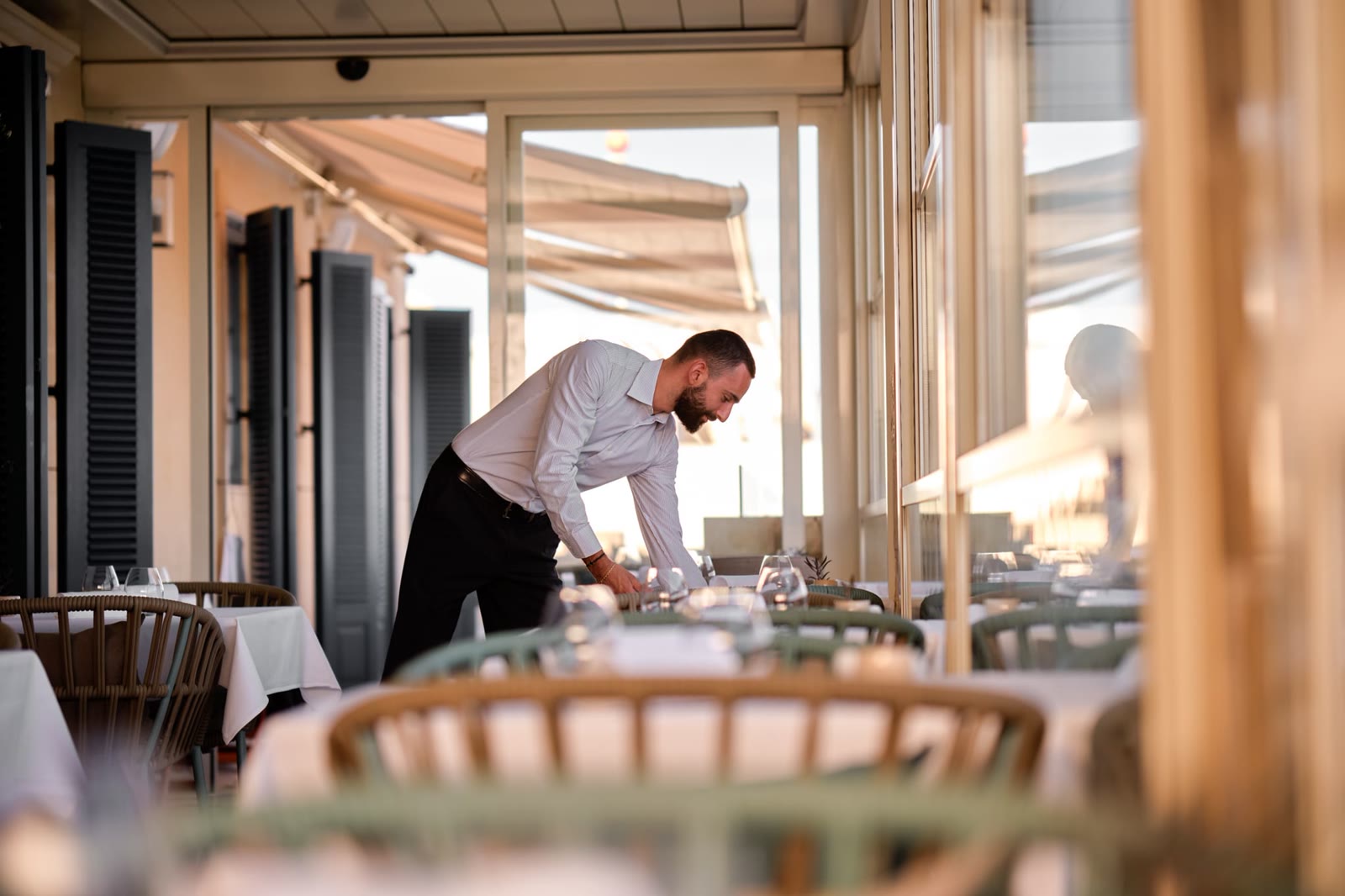
Image context: the cover uses ION Harbour's own photograph of a server setting the room before service. It is a better image for this piece than a glamour plate because the restaurant's central problem is spatial. The table, the glass, the light, and the harbor edge have to become part of service rather than a background postcard.[1]
The first course is altitude
ION Harbour's first move is vertical. Before a guest tastes anything, the restaurant has already separated itself from the street and placed dinner over one of Malta's most theatrical pieces of urban geography. That could easily become a luxury shortcut, but the location is more interesting when read as a pressure system. The Grand Harbour is not a generic blue view. It is working water, fortification, hotel theatre, cruise-port memory, and civic stage. A restaurant on its edge has to decide whether to behave like a scenic balcony or like a serious room with a view.
The public record suggests ION Harbour is trying to be the second. Michelin's 2026 Malta selection says ION Harbour by Simon Rogan confirmed its two stars with modern cuisine marked by balance, detail, and a strong farm-to-table philosophy.[3] That matters because the star language does not reward the view by itself. It points back to the plate and the sourcing chain. The better way to read the room is therefore not "eat while looking at Valletta." It is "watch how a Maltese harbor room tries to make its location edible."
That distinction changes the diner's attention. The best table is not simply the one with the cleanest photo angle. It is the one that lets the meal breathe with the harbor without being swallowed by it: lunch when the limestone is bright, dinner when the city goes dark around the glass, and service steady enough that the room does not become a sightseeing deck with courses attached.
Rogan's method had to become Maltese
Simon Rogan's strongest restaurants are often described through the Lake District, especially L'Enclume, where hyperlocal growing, foraging, preservation, and development kitchens have become a complete operating culture. The danger in exporting that method is obvious. A chef can bring a prestigious philosophy to a new country and accidentally make the new place sound like a branch office of the old one.
ION Harbour is more persuasive when it treats Rogan's method as a grammar to be translated, not as a landscape to be copied. The official site says Rogan's first Mediterranean restaurant is guided by seasonality and local produce, then names the people who make the translation practical: head of sustainability Keith Abela, executive chef Oli Marlow, and head chef Christian Cali.[1] Simon Rogan's own 2024 announcement makes the adaptation clearer, saying Rogan took stewardship in March 2023 and worked with Marlow to bring a farm-to-table ethos to Valletta through local ingredients that are harvested, fished, and foraged by ethical, sustainable producers.[4]
Abela's role is especially important because it keeps the project from becoming abstract. ION's official biography describes him as coming from a family of farmers and fishermen in northern Malta, working with local suppliers, developing items such as Xemxun cheese from local goat milk, and repurposing unused produce into kombuchas, syrups, and other preparations.[1] That is the article's hinge. The restaurant's claim to place does not rest only on naming Malta. It rests on someone doing the unglamorous work of finding, preserving, fermenting, and redirecting local material until it can support a two-star room.
The harbor view, then, is not the local ingredient. It is the local amplifier. If the meal underneath it were built from generic luxury products, the setting would feel like theatre. When the kitchen works through Maltese suppliers, foraged ingredients, goat milk, wild herbs, fish, and preservation, the view starts to make more sense. The city outside and the pantry inside begin to answer each other.
The drinks programme is part of the neighborhood
The most revealing detail at ION Harbour may be liquid. The restaurant's official site describes a drinks list that uses surplus kitchen material such as peels, stalks, and stems.[1] Supper Magazine's 2025 retention piece echoes that point, connecting the drinks programme to a zero-waste philosophy and noting foraging trips for wild local ingredients.[5] That sounds small beside two Michelin stars, but it is exactly the kind of small practice that prevents the restaurant from floating above its setting.
In many destination restaurants, the wine list is the prestige engine and the non-alcoholic or cocktail work is decorative. At ION Harbour, the surplus-based drinks idea does something sharper. It turns what would normally be trimming, peel, stem, or excess into another way of reading the kitchen. A guest who chooses the pairing is not only matching alcohol to courses. They are seeing whether the restaurant can keep flavor moving after the main ingredient has already been cut, juiced, trimmed, cooked, or served.
That is a very Maltese problem in a quiet way. Island cooking is rarely about infinite abundance. It is about making weather, water, garden, trade, and preservation work together. A fine-dining drinks programme built from surplus does not automatically make the meal sustainable, but it does make waste visible as a design question rather than a press-release adjective.
Service turns the view into time
ION Harbour's service structure is also more specific than the postcard version of the restaurant. The official site lists a multi-course tasting menu for lunch and dinner, a shorter tasting menu at lunch, Friday lunch service from 12:30 to 14:00, and dinner service daily from 18:30 to 20:30.[1] Those windows reveal a useful practical truth: this is a room where time of day changes the meal.
Lunch should make the harbor legible. It is the meal for reading masonry, water, glare, the opposite shore, the movement of boats, and the practical edge of Valletta as a port city. Dinner should make the room more theatrical, with the glass turning reflective and service carrying more of the atmosphere. The shorter lunch option is therefore not just a budget step down. It is a different way to use the site. The fullest dinner menu may be the better way to read the kitchen's long argument; lunch may be the cleaner way to understand why the restaurant belongs exactly where it is.
The cancellation terms also say something about the room's operating seriousness. ION asks for credit-card details, requires a deposit for groups of six or more, and lists charges for late cancellations of EUR 95 per person at lunch and EUR 195 per person at dinner.[1] That is not romantic, but it is part of how a small, high-cost destination room protects the rhythm of service. Empty seats are not abstract in a restaurant built around a fixed team, fixed prep, terrace weather, and a view that changes by the hour.
Why the two stars matter here
In 2024, ION Harbour became the first restaurant in Maltese history to receive two Michelin stars, one year after Rogan took the helm.[4] Michelin's 2026 selection then confirmed the restaurant at that level.[3] The important point is not trophy collecting. It is that Malta's top-end dining story is being pulled away from pure resort luxury and toward a more specific question: what does contemporary Maltese fine dining look like when it is built from place rather than merely placed somewhere beautiful?
ION Harbour's answer is still a controlled luxury answer. It lives in a high-end hotel. It uses a celebrated British chef's system. It benefits from a view that most restaurants would envy. But the room is interesting because those advantages do not fully explain it. The better explanation sits in the translation work: Abela's local sourcing and preservation, Marlow and Cali's adaptation of Rogan's kitchen language, surplus-based drinks, the fourth-floor harbor edge, and a service structure that lets lunch and dinner behave differently.[1][4][5]
The restaurant's real accomplishment is making the view less passive. Valletta is not simply outside the window. It presses on the meal through light, water, limestone, suppliers, foraging, fish, goat milk, and pacing. ION Harbour is strongest when it makes diners feel that pressure without turning dinner into a lecture. The harbor gets to be beautiful, but it does not get to be lazy. It has to work.
Sources
- ION Harbour by Simon Rogan official site - current restaurant description, rooftop St Barbara Bastion setting, team roles, menus, opening hours, cancellation terms, surplus-based drinks note, and official photograph used as the cover image.
- Iniala Valletta, "ION Harbour by Simon Rogan" - address, hotel context, Grand Harbour positioning, provenance and local-produce framing, and two-Michelin-star status.
- Michelin, "The MICHELIN Guide Malta - 7th Edition" - 2026 selection note confirming ION Harbour's two stars and Michelin's description of its modern cuisine, balance, detail, and farm-to-table philosophy.
- Simon Rogan, "ION Harbour becomes First Two Michelin-Starred Restaurant in Malta" - 2024 announcement covering Simon Rogan's March 2023 takeover, Malta's historic second star, the L'Enclume connection, and ethical local sourcing.
- Hannah Currie, "ION Harbour by Simon Rogan retains two Michelin stars," Supper Magazine, February 28, 2025 - retention coverage, local ingredient examples, foraging, the surplus-based drinks programme, and St Barbara Bastion view.