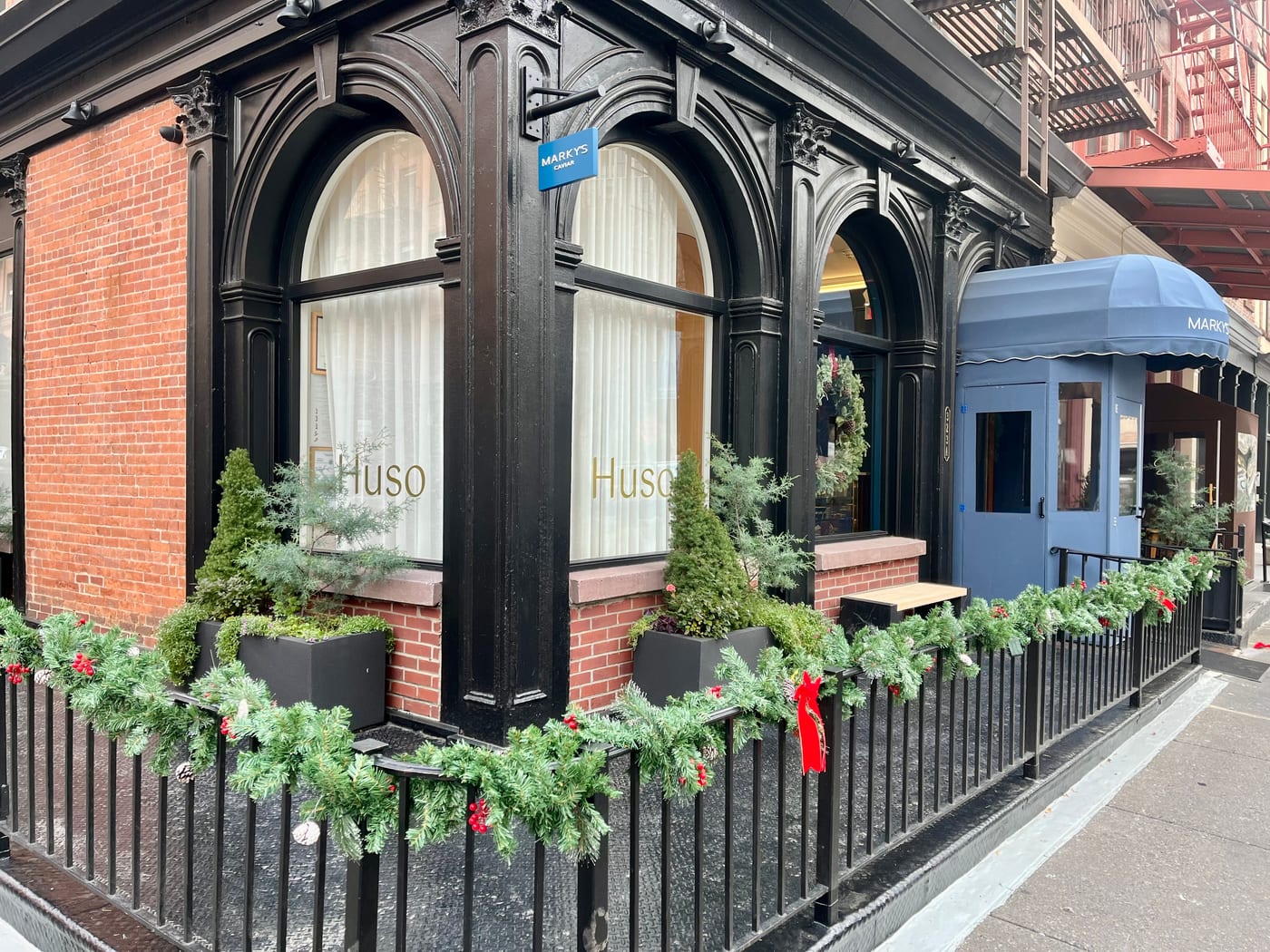


Some fine-dining rooms announce themselves with staircase drama, flower budgets, and a lobby that tells you the money has already been spent. The more interesting rooms in the two videos below do almost the opposite. Huso sits inside the Marky's Caviar orbit in Tribeca, while Noksu is built within the 32nd Street entrance of Herald Square. Both ask a useful question: what happens when high-end cooking is placed behind a threshold that feels narrower than the ambition?
That constraint can become a gimmick if the restaurant treats hiddenness as the product. A code-locked door, a caviar counter, or a subway-adjacent address is only a first impression. The meal still has to solve the ordinary hard problems of fine dining: timing fish and shellfish, keeping service calm in a small room, explaining luxury without draining it of pleasure, and making a tasting menu feel authored rather than merely expensive. The videos are worth watching because they show the labor that has to sit underneath the hidden-room romance.[1][2]
The cover photograph of Huso is helpful for the same reason. From the street, the restaurant reads as a polished but compact Tribeca storefront, not as a trophy room. The real promise has to be made inside, course by course.[7] That is also why this collection pairs Huso with Noksu rather than with a more obvious palace restaurant. The point is not that small or hidden rooms are automatically more soulful. The point is that limited rooms expose whether a restaurant has an operating idea strong enough to carry scarcity.
Huso: caviar as pressure, not garnish
Bon Appetit's Huso video is framed around a restaurant that earned a Michelin star quickly, but the useful part is not the award headline. The useful part is the pressure that caviar creates for a kitchen. Caviar is easy to misuse because it already carries a luxury signal before a chef has done anything. If a room merely places it on top of dishes, the ingredient becomes a shortcut. If the kitchen uses it well, caviar behaves more like seasoning, temperature contrast, salinity, and pacing at once.[1]
Huso's own site describes the restaurant as a one-Michelin-star fine-dining experience inside Marky's Caviar, now led by executive chef Buddha Lo and his team.[3] Michelin's inspector note sharpens that by calling the room a refined downtown evolution of Lo's original concept, discreetly set behind a caviar shop in Tribeca, with a tasting menu that incorporates caviar with restraint and relies on calibrated sauces.[4] Those two descriptions matter because they keep the restaurant from being read only as a luxury retail extension. It is a dining room trying to make a luxury product submit to a menu's rhythm.
The video makes that rhythm more legible than a static menu can. Watch how much of the drama is quiet: small adjustments, cold service windows, sauce finishing, and the recurring need to make a rich ingredient feel precise instead of heavy. The real risk is repetition. Caviar can flatten a meal if every appearance says the same thing. Huso's challenge is to make each use answer a different culinary job: sometimes salinity, sometimes texture, sometimes aroma support, sometimes a final flash of marine concentration.
That is why the hidden threshold matters. A guest walks in with a built-in expectation that caviar will define the room. The kitchen has to reverse the hierarchy. The product may be the door, but technique has to be the house. If the fish cookery, sauce work, pacing, and temperature control do not hold, the room collapses into expensive branding. If they do hold, the caviar shop becomes useful context rather than a trap.
Noksu: the counter under the city
Noksu's constraint is different. The official site describes it as a 2024 and 2025 Michelin-star recipient, a 15-seat tasting counter within Herald Square's 32nd Street entrance, serving a 10-course menu focused mainly on seafood.[5] Michelin's listing gives the scene more vividly: an ambitious team, a code-locked door, a black marble counter, chefs working with tweezer-level precision, and a seafood-forward menu in the heart of Koreatown at Herald Square.[6]
The Bon Appetit video works because it refuses to let the subway setting stay as a cute premise.[2] A 15-seat counter is not just intimate; it is unforgiving. Every course is assembled close to the guest's field of attention. Every pause is visible. Every temperature problem has fewer places to hide. Seafood makes that sharper because many of the pleasures are short-lived: cold, clean, bright, just-set, just-dressed, or just warm enough. A room like Noksu succeeds only if the staff can keep concentration high without making the evening feel anxious.
There is also a specifically New York problem here. A hidden restaurant inside a transit threshold could easily become novelty dining: look where we are, look how unlikely this feels, look how expensive dinner can be underground. The written sources suggest a stronger reading. Noksu uses the Herald Square location as pressure on focus. The address gives the meal urban charge, but the counter format turns that charge inward. The guest is close enough to watch the construction of each plate and small enough in number that the room cannot outsource atmosphere to scale.[5][6]
That makes Noksu a useful counterpoint to Huso. Huso has to discipline a prestige ingredient. Noksu has to discipline an unusual location. Both rooms could fail in the same way: by confusing premise with structure. In Huso's case, the premise is caviar behind a caviar shop. In Noksu's case, it is a tasting counter behind a subway door. The videos show the more important layer, which is not the reveal but the repetition after the reveal: the next plate, the next handoff, the next decision about salt, heat, sauce, and silence.[1][2]
Viewed together, the two clips make a compact argument about contemporary fine dining. Scarcity is not enough. A hidden address is not enough. A counter seat is not enough. Even a Michelin star is not enough as an explanation, because stars describe recognition after the fact. What matters inside the meal is whether the restaurant's constraints keep producing better decisions.
Huso's best lesson is that luxury ingredients need resistance. Noksu's best lesson is that dramatic location needs calm. One asks caviar to stop being a symbol and become part of the grammar. The other asks a subway-adjacent room to stop being a stunt and become a disciplined seafood counter. In both cases, the hidden kitchen tells the truth because it removes some of the usual protective fog around fine dining. The guest can see whether the premise keeps working after the first surprise fades.
Sources
- Bon Appetit, "This Restaurant Earned a Michelin Star in Just 9 Months | On The Line" - YouTube video source for the embedded Huso service segment.
- Bon Appetit, "The Michelin Star Restaurant in an NYC Subway Station | On The Line" - YouTube video source for the embedded Noksu service segment.
- Huso, official restaurant site - current restaurant positioning inside Marky's Caviar, Michelin-star framing, tasting menu, and chef leadership.
- Michelin Guide, "Huso - New York" - inspector listing covering the Tribeca caviar-shop setting, one-star status, tasting-menu restraint, and sauce work.
- Noksu, official restaurant site - current description of the 15-seat Herald Square tasting counter, 2024 and 2025 Michelin-star recognition, and seafood-led 10-course format.
- Michelin Guide, "Noksu - New York" - inspector listing covering the subway-adjacent entrance, code-locked door, counter format, and seafood focus.
- Wikimedia Commons, "File:Huso NYC.jpg" - photographic source for the article image.