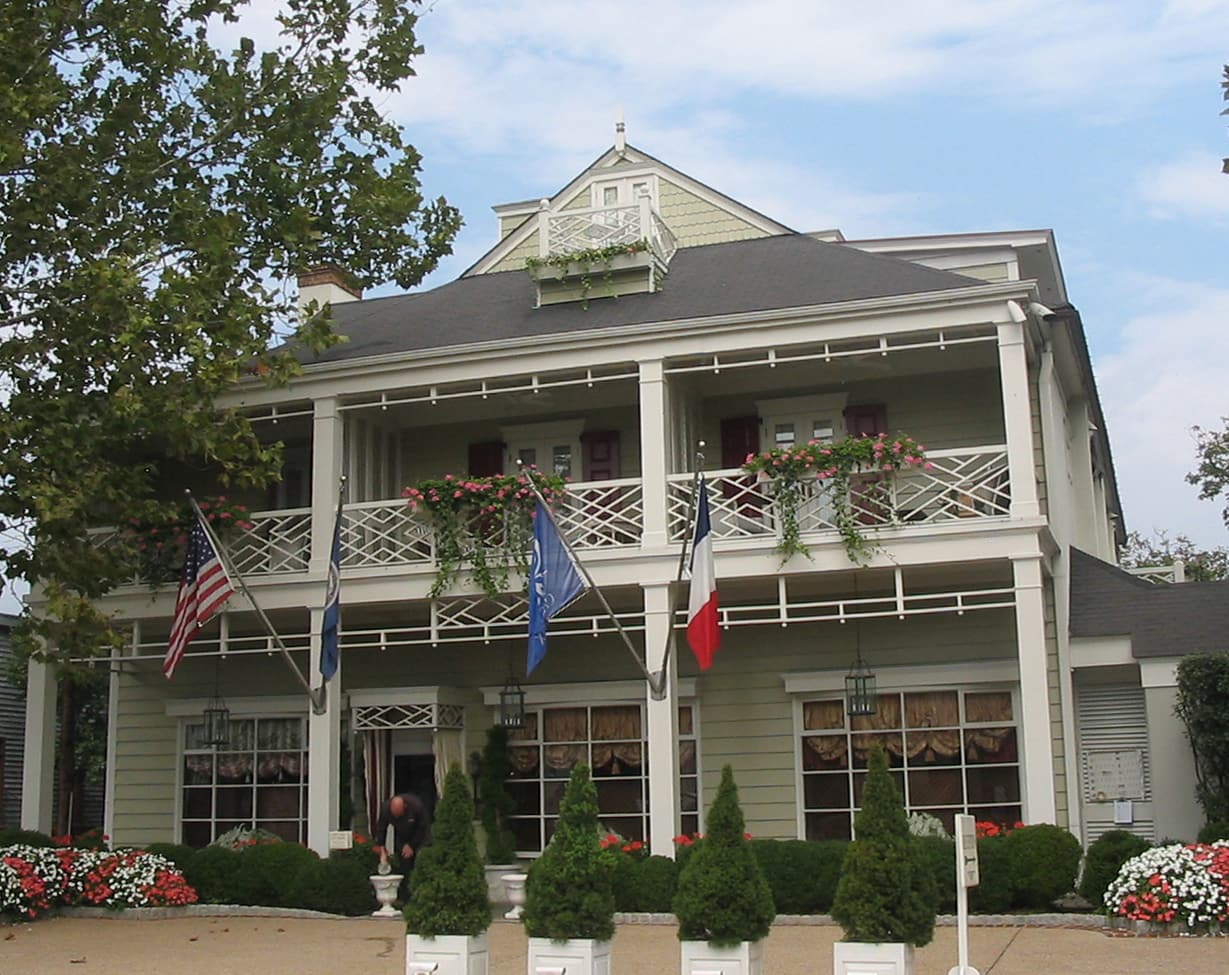
The Inn at Little Washington is easiest to caricature as a velvet fantasy: a tiny Virginia village, a maximalist dining room, a chef-proprietor with theatrical instincts, carts moving through the room, and guests who arrive ready to be charmed. That reading is not false. It is just incomplete. The more useful way to read the restaurant in 2026 is as a service operation that has learned how to make fantasy repeatable.
That distinction matters more after Michelin's current guide moved the restaurant to two stars. The live listing now describes The Inn as "Two Stars: Excellent cooking," while still calling Patrick O'Connell an iconic steward of an idyllic restaurant outside Washington, D.C., and still emphasizing the room's grandeur, signature preparations, roaming bread and cheese carts, and garden-backed sourcing.[2] In other words, the status line changed, but the operating question did not. What does a restaurant built on enchantment have to do every night so enchantment does not become costume?
The answer begins with a useful contradiction. O'Connell's official biography says he opened The Inn in 1978 in a former garage at Main and Middle Streets in a Virginia village 67 miles west of Washington, D.C.; it also frames his regional American cooking as a necessity-driven alliance with farmers and artisanal producers in a town where almost nothing was delivered except milk.[3] A place like that cannot behave like an urban luxury room that simply orders prestige ingredients into being. It has to turn distance, scarcity, local suppliers, and guest expectation into choreography.
Image context: the cover image shows the exterior rather than a plated dish because this article is about the house as a working system. The Inn's service begins with arrival, village scale, the old building, and the expectation that a meal in Washington, Virginia should feel like a complete excursion rather than a restaurant slot copied from a city calendar.[3][6]
The Room Sells Abundance, But The Rules Keep It Legible
The current dining-room page is revealing because it lets romance and constraint sit next to each other. The restaurant describes the main room as an enchanting setting, but the posted menus are structured, priced, and bounded: the main tasting paths are listed at $388 per person, paired wines at $250, with beverage, tax, and service charge additional.[1] The page also says the restaurant limits alterations so guests can experience the chef's intended menu, accommodates several common dietary restrictions, and offers a full vegetarian alternative, while sending guests who want an a la carte experience across the street to Patty O's.[1]
That is service design, not mere policy language. A kitchen that promises maximal theater needs a narrow enough lane to protect timing. If every table rewrites the menu course by course, the room loses the very calm it is selling. The Inn's solution is to make choice feel generous while keeping the production map readable: curated tasting menus, an alternative vegetarian track, named restrictions the kitchen can absorb, and a separate casual restaurant for guests who want a looser format.[1]
The format is old-fashioned in one sense and highly modern in another. It acknowledges that luxury guests increasingly expect customization, but it refuses to let customization become the organizing principle. The restaurant is effectively saying: we can care for you, but we cannot let each table become a private restaurant. That line is what keeps a heavily staged dining room from turning into a traffic jam.
Carts Make Hospitality Visible
Michelin's current note singles out the roaming bread and cheese carts as reminders of a kind of luxury that has become less common.[2] That observation is sharper than it first looks. Carts slow the room down. They put abundance on wheels. They make a server's judgment public: what to offer, when to linger, when to explain, when to move, when to let the guest simply enjoy the procession.
At The Inn, carts also solve a tonal problem. A grand room can become stiff if every gesture arrives pre-plated and sealed. A cart interrupts that distance. Bread and cheese have a social looseness that caviar and composed courses do not. They let the restaurant perform generosity in a way that feels legible even to diners who are not tracking technique.
But carts are operationally expensive. They require staffing, inventory control, training, timing, and floor awareness. They can clog sightlines or make service feel fussy if the room does not know its own rhythm. Their survival at The Inn suggests that the restaurant still values a labor-intensive style of hospitality in which part of the meal's pleasure comes from watching service happen. The cart is not decoration. It is a moving stage, and the staff has to act without letting the act show strain.[2]
The Kitchen Tables Turn Backstage Into Product
The official dining page lists two kitchen tables set on either side of a baronial fireplace, each seating up to six guests, with a $750 surcharge per table and phone availability rather than casual online impulse booking.[1] This is a small detail with a large meaning. The kitchen table is not just a better seat. It is a controlled breach in the wall between production and performance.
That kind of seat changes the service contract. In the main room, the kitchen's work is translated into sequence. At the kitchen table, the guest buys proximity to the machine: heat, movement, correction, and the fascination of seeing a serious restaurant keep itself synchronized. The "dinner and a movie" idea works only if the kitchen can remain watchable while still being a workplace.[1]
There is a risk here. Too much backstage access can trivialize labor, turning cooks into scenery. The Inn's surcharge and limited capacity help define the boundary. The kitchen tables are special because they are scarce and because they sit inside a room still built to function. This is not a chef's counter trying to make every seat a pass-side spectacle. It is a traditional dining room allowing a few guests to observe the older truth: the fantasy upstairs depends on the discipline downstairs.
Wine Turns The Excursion Into A Full House
The wine program shows the same operating logic at a different scale. The Inn says its cellar holds more than 14,000 bottles, has received Wine Spectator's Grand Award for 29 years, and was one of 96 restaurants worldwide to receive that award for 2024.[4] It also presents a cellar strategy that moves across Europe, California, Oregon, and Virginia, with sommeliers creating pairings for the various menus.[4]
Those numbers matter because a destination restaurant has a different burden from a neighborhood tasting room. Guests have often driven, stayed over, or built an anniversary around the meal. The wine program has to support ceremony without forcing every table into the same prestige ladder. A deep cellar gives the room options: local Virginia context for guests who want place, classic European gravity for guests who want the old luxury register, West Coast familiarity for American collectors, and pairings for diners who prefer not to turn the night into a bottle-selection exam.[4]
The corkage policy is also telling. The page lists a $200 corkage fee per 750 ml bottle if the wine is not already on the list, and adds that more than three bottles bring dedicated sommelier butler service for an additional $200.[4] That is not only pricing. It is workload recognition. Outside bottles still have to be received, opened, sequenced, served, and integrated into the meal. The policy converts a guest's private cellar into a service plan.
The Star Loss Clarifies The Real Product
It would be dishonest to ignore the Michelin change. Eater DC reported in November 2025 that the D.C. area no longer had a three-star restaurant after The Inn was moved down to two, and quoted the restaurant's response that it still saw its mission as creating a restorative and magical experience for guests.[5] The current Michelin page confirms the new two-star status while continuing to describe an unmistakably lavish, destination-minded restaurant.[2]
For diners, that should make the decision cleaner rather than murkier. If the only reason to go was to collect a three-star receipt, the premise has already weakened. If the reason is to experience a very specific American hospitality machine, the live question remains strong. The Inn is not trying to be the newest counter, the sharpest minimalist room, or the cleanest expression of contemporary tasting-menu austerity. It is trying to make a village-scale dream behave with nightly precision.
That is why the former garage matters. The village matters. The carts matter. The kitchen tables matter. The limited menu alterations matter. The wine cellar matters. Even Patty O's across the street matters, because it gives the property a second, looser valve for guests who want O'Connell's nostalgia without the full formal apparatus.[1][3][4]
The Inn at Little Washington's most interesting service lesson is that whimsy is not the opposite of discipline. Whimsy is what discipline can make possible when a room has a stable enough operating grammar. Without rules, the fantasy frays. Without generosity, the rules become cold. The Inn's enduring appeal sits in the exchange between the two: country-house theater held together by a staff, a kitchen, a cellar, a farm-and-garden network, and a room that knows how to make old-fashioned abundance feel intentional.
That does not make it an automatic booking for every serious diner. A guest who wants radical novelty, urban pace, or stripped-down modernism may find the room too ornate. A guest who wants to test whether American fine dining can still make ceremony feel personal will understand the point faster. The meal is not only what lands on the plate. It is the whole apparatus by which a small Virginia address convinces people, night after night, that dinner can still become an event.
Sources
- The Inn at Little Washington, "The Main Dining Room" - current dining-room page with tasting-menu examples, pricing, dietary-alteration policy, kitchen table details, caviar, wine, and Patty O's references.
- The MICHELIN Guide, "The Inn at Little Washington" - current live guide listing, two-star status, inspector description, carts, signature dishes, and sustainability note.
- The Inn at Little Washington, "Patrick O'Connell" - official chef biography covering the 1978 former-garage opening, village setting, regional American cuisine, farmer and producer network, awards, and Green Star history.
- The Inn at Little Washington, "Our Wine Cellar" - official wine-program page covering cellar scale, Grand Award history, regional focus, pairings, and corkage policy.
- Tierney Plumb, "Inn at Little Washington Loses Its Ultimate Michelin Three-Starred Status," Eater DC, November 2025 - report on the demotion to two stars and the restaurant's response.
- Wikimedia Commons, "File:The Inn at Little Washington.jpg" - 2008 exterior photograph used as the article image.