Dakar NOLA would be easy to reduce to a clean awards sentence: a Senegalese tasting-menu restaurant in New Orleans that won the James Beard Foundation's 2024 Best New Restaurant award.[4] That sentence is true, and it still misses the meal's more interesting pressure. The restaurant matters because Serigne Mbaye has found a way to make fine dining behave less like a sealed ceremony and more like a memory table, where Senegalese childhood, Gulf seafood, New Orleans history, and communal service all have to sit together.
That is a harder proposition than it sounds. New Orleans already has one of America's strongest dining identities, and its restaurant culture can absorb new rooms by turning them into local color. Dakar NOLA resists that flattening. Its own story frames the tasting menu through the two coastal cities in its name: Dakar and New Orleans, joined by seafood, produce, West African dining traditions, and the echoes of Senegalese and other West African foodways in Louisiana's Creole pots.[1] The point is not to prove that Senegalese cooking influenced New Orleans in a vague ancestral way. The point is to build a modern restaurant where that relationship has sequence, timing, sauce, rice, and service.
The current format makes the thesis concrete. Dakar NOLA's menu page describes a seasonal seven-course pescatarian tasting menu with Senegalese flavors and a stated link between Senegambia and New Orleans.[2] The reservations page adds the operating terms: $175 for the seven-course menu, $100 wine pairing, $60 non-alcoholic pairing, two-week reservation releases at 10:00 a.m. Central Time while the new location settles in, Tuesday through Saturday service, two seating styles, and an experience of roughly two hours.[3] Those numbers matter because they show that the restaurant is no longer just a moving pop-up with a powerful story. It is a high-demand room turning narrative into a repeatable service system.
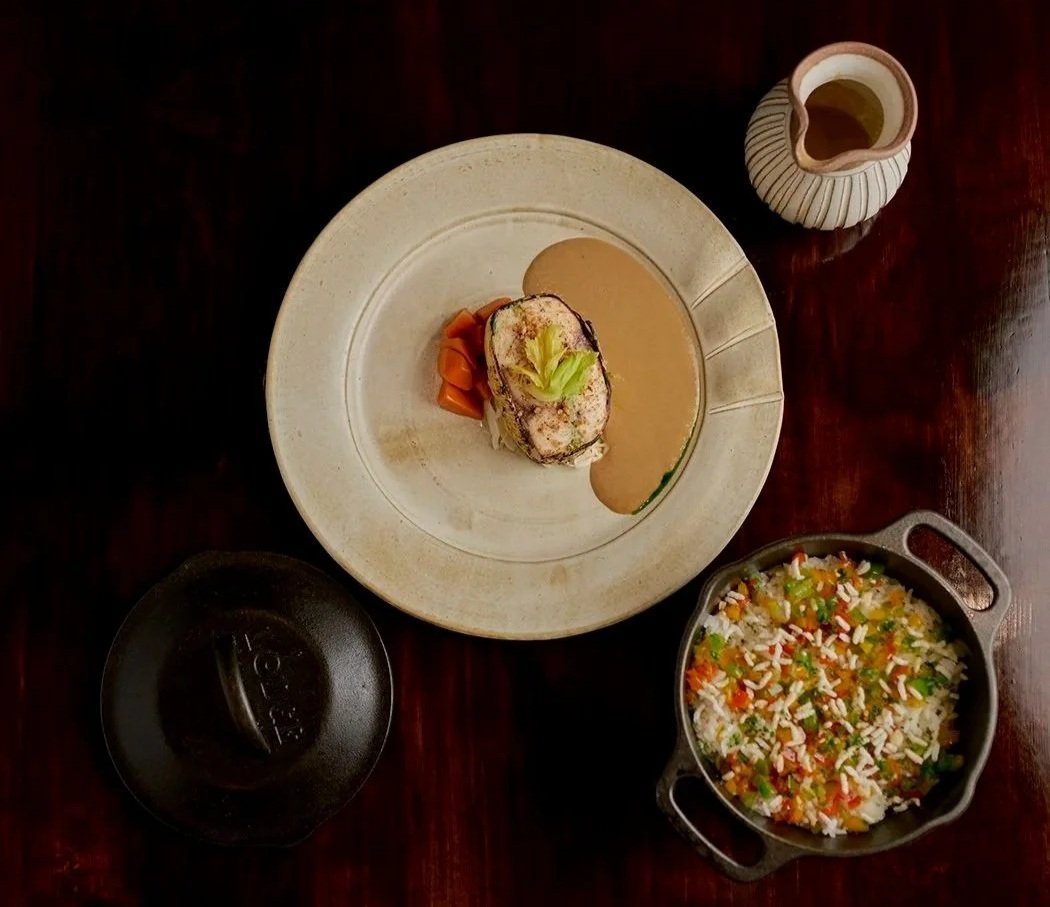
Image context: the cover uses Dakar NOLA's official red snapper yassa photograph rather than a generic dining-room image. Yassa is exactly the kind of dish that explains the restaurant's method: acid, heat, onion, fish, rice, and sauce carry memory, but the plating and service frame turn that memory into a contemporary tasting-menu course.[2][7]
The Biography Is A Structure, Not A Backstory
Mbaye's biography could fill a conventional chef profile, but at Dakar NOLA it works more like a menu architecture. The official team page places him between Harlem, Dakar, and New Orleans, with kitchen experience at Commander's Palace, Atelier Crenn, and L'Atelier Joel Robuchon.[5] The story page gives the more important culinary translation: he learned to cook in Senegal at his mother's knee, then brought traditional Senegalese spices and techniques into contact with fine-dining training and New Orleans product.[1]
That movement is why Dakar NOLA feels different from a restaurant that simply imports a national cuisine into a luxury format. The menu is not "Senegal, polished." It is Senegalese memory being tested against the professional habits Mbaye gathered in French, Creole, Japanese, and other kitchens, then narrowed again by a pescatarian commitment and a New Orleans supply chain.[1][5] This is where the restaurant earns its seriousness. It is not asking diners to admire identity as decoration. It is making identity perform under the constraints of a timed, priced, reservation-only tasting room.
Eater's 2022 opening report helps preserve the pop-up roots behind that structure. Before the permanent restaurant, Mbaye had held Dakar NOLA dinners around the city since 2020, including at Margaret Place, the Southern Food and Beverage Museum, and Mosquito Supper Club.[6] Those dinners already served everyone simultaneously, with Mbaye introducing dishes and their historical significance.[6] The permanent restaurant did not invent the memory-table idea; it stabilized it.
That stabilization matters. Pop-ups can survive on charisma, scarcity, and a special-night glow. A standing restaurant needs systems: seats, courses, staff, dietary boundaries, payment rules, beverage service, and a room that can repeat emotional intensity without exhausting itself. Dakar NOLA's current public materials show that shift clearly. The restaurant now states its allergy limits, its non-vegan and non-vegetarian boundary, its cashless policy, its service charge, its party-size limits, and its late-arrival rules.[2][3][10] The romance is protected by the rules.
Communal Dining Is Not A Cute Extra
One of the most revealing current details is the choice between communal dining and private tables. Communal diners are seated with other guests at a table for six, a format the restaurant explicitly describes as a way to bring strangers, acquaintances, and loved ones closer together through food.[3] In another tasting room, that might read as an efficiency move or a social novelty. At Dakar NOLA, it is part of the argument.
West African food traditions do not enter the room only through ingredients. They enter through the act of eating in proximity, through family-style courses, through a server's explanation, through the slight vulnerability of listening to a history you may not own while sitting next to someone you did not arrive with.[1][3] Fine dining often uses distance as a luxury signal: individual plates, hushed tables, private pace, limited eye contact. Dakar NOLA keeps some tasting-menu control but lets the table push back against isolation.
That does not mean the room is casual in the loose sense. The rules are strict because the format depends on synchrony. The FAQ says all guests are served at the same time, and late arrivals receive the current course being served.[10] This is not punitive so much as structural. A course that carries context cannot be endlessly paused and restarted without losing its social force. The restaurant is asking diners to join a shared clock.
Condé Nast Traveler's review noticed the same communal atmosphere in the earlier Magazine Street room, connecting the Senegalese sculptures and masks to a dining room that felt immediately social.[8] The address has since moved to Leonidas Street, but the operating idea remains visible in the current reservation language: intimacy, small tables, limited party size, and a meal designed to make people face one another as much as the plate.[3]
Seafood Keeps The Bridge Honest
Dakar NOLA's pescatarian menu is not a soft accommodation. It is the restaurant's cleanest bridge between place and memory. The official press kit says Dakar NOLA highlights seafood from local waters and produce from South Louisiana, while the current menu names courses such as Bounty of the Gulf shrimp, Louisiana rice, and Bounty of the Gulf fish.[2][9] That is not just local sourcing copy. It keeps the restaurant from turning Senegal into nostalgia detached from New Orleans.
Seafood is one of the few ingredients that can make both cities feel present without forcing an artificial equivalence. Dakar faces the Atlantic. New Orleans is shaped by the Gulf, river, bayous, and a long seafood economy. When the restaurant builds a course around Gulf fish or shrimp, the plate can carry Senegalese technique and Louisiana material at the same time.[2][6][9] The result is more precise than fusion because neither side becomes a garnish.
Rice does similar work. The menu's Louisiana rice course is not a small technical detail.[2] Rice is one of the great connectors across West Africa, the Atlantic world, and Louisiana. In Dakar NOLA's hands, it can become a memory engine without needing a lecture to do all the work. A diner may first experience it as comfort, starch, and sauce absorption. The context arrives around the pleasure rather than replacing it.
That order is crucial. The restaurant's strongest political intelligence is that it does not make history compete with appetite. The press kit describes one constant, "Last Meal," built around black-eyed peas, crab meat, and palm oil, as a dish of remembrance for enslaved Africans before forced journeys across the Atlantic.[9] A weaker restaurant might turn such a course into moral instruction. Dakar NOLA appears to treat remembrance as something food can carry when the plate is generous enough and the room is attentive enough.[6][9]
Why The Award Was A Beginning, Not The Point
The James Beard award gave Dakar NOLA national validation, but the validation is less interesting than the question it raises: can a small, story-heavy tasting room stay alive after attention stops being a novelty? The current reservation page suggests the team is answering that question by tightening the system, especially during the move to 937 Leonidas Street: reservations released two weeks at a time, two seating styles, clear party limits, and detailed policies for payment, beverage, service charges, and dietary restrictions.[3][10]
Those constraints may disappoint diners who want maximum flexibility. They are also why the restaurant can keep its promise. A seven-course seafood-only tasting menu with family-style moments cannot behave like an a la carte bistro. A room built around context cannot absorb every allergy, late arrival, or party-size request without diluting the shared experience.[2][3][10] Fine dining sometimes hides its constraints behind velvet language. Dakar NOLA states many of them plainly.
That plainness is part of its appeal. The restaurant is tender in subject, but not vague in operation. It wants to nurture the soul, as the team page puts it, yet it also publishes the mechanics that let nurturing happen at scale: price, release cadence, seating pattern, service charge, and menu boundaries.[3][5] The emotional register and the business model are not separate. The second protects the first.
The result is one of the more compelling profiles in American fine dining right now: a restaurant that uses tasting-menu discipline to make African food harder to marginalize, not easier to assimilate. It does not filter Senegalese cuisine through Creole food for permission, and it does not ignore the Creole pot either. It lets the relationship remain charged, intimate, and edible.
That is why Dakar NOLA's best descriptor is not simply "award-winning." It is a memory table with service rules. The table holds Senegal and New Orleans, childhood and professional polish, Gulf seafood and rice, strangers and loved ones, pain and celebration. The rules make sure the table can be set again tomorrow.
Sources
- Dakar NOLA, "Our Story" - official account of the restaurant's Dakar-New Orleans frame, Mbaye's Senegalese childhood memory, family-style West African dining references, training path, and Creole-foodways context.
- Dakar NOLA, "Our Menu" - current menu page describing the seasonal seven-course pescatarian tasting menu, Senegambia-New Orleans connection, example courses, seafood-only boundary, and allergy limits.
- Dakar NOLA, "Reservations" - current price, pairings, two-week release cadence, Leonidas Street location, seating styles, service timing, party-size limits, and service charge.
- James Beard Foundation, "The 2024 James Beard Award Winners," June 10, 2024 - official winner list naming Dakar NOLA as Best New Restaurant.
- Dakar NOLA, "Our Team" - official team page covering Serigne Mbaye's Harlem-Dakar-New Orleans biography, prior kitchens, Effie Richardson's front-of-house role, team values, and the "We cook to nurture the soul" statement.
- Clair Lorell, "New Orleans's Most Exciting Tasting Menu Arrives At Its Forever Home," Eater New Orleans, November 15, 2022 - pop-up history, permanent-opening context, simultaneous service model, ataya, Last Meal, jollof, yassa, and Mbaye's training path.
- Dakar NOLA official gallery image, "Dakar Nola Red Snapper Yassa, Photography Jeremy Tauriac" - real food photograph used as the article image.
- Paul Oswell, "Dakar NOLA," Conde Nast Traveler - review noting the Senegal-meets-Creole frame, 30-seat Magazine Street room, communal atmosphere, beverage program, and response after the 2024 James Beard win.
- Dakar NOLA, "2024 Press Kit" - official press kit covering local seafood and South Louisiana produce, childhood-memory framing, family-style courses, James Beard recognition, and the Last Meal dish.
- Dakar NOLA, "FAQs" - current FAQ covering the new-location reservation opening, payment, service fee, cancellation policy, allergy restrictions, vegetarian boundary, late-arrival rule, and accessibility note.