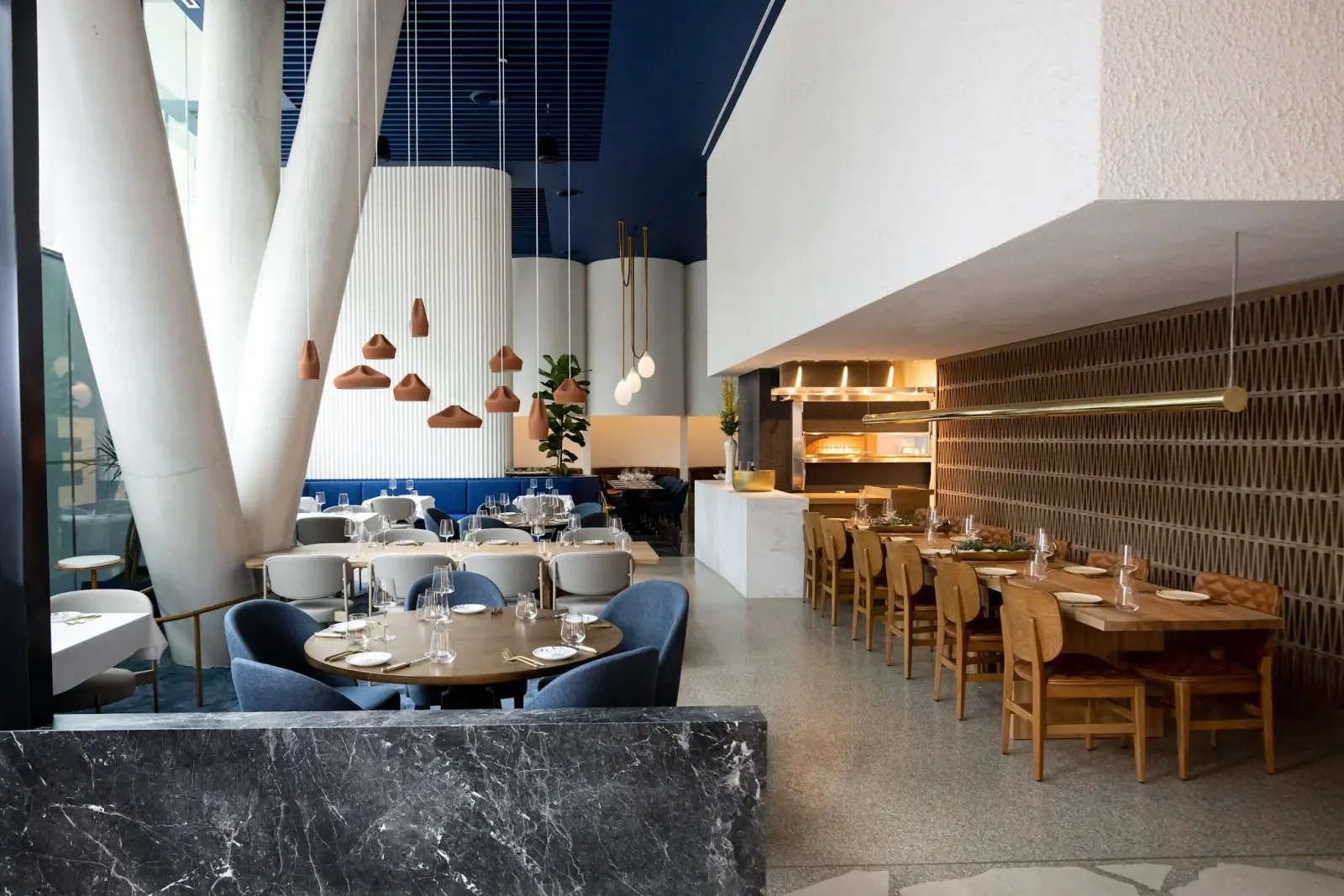

The useful way to watch Eater's Imperfecto film is to ignore the word "exclusive" for a moment. The surface attraction is obvious: a Michelin-starred Washington, DC room, chef Enrique Limardo, a chef's table, and dishes that move between Latin American and Mediterranean references. But the deeper story is operational. Imperfecto is not presented as one tasting menu hidden from ordinary restaurant life. It is a restaurant trying to run three different promises from the same kitchen: a la carte flexibility, a set menu, and a chef's-table tasting sequence.[1][2]
That is a harder problem than it sounds. A la carte dining rewards responsiveness: a table orders unevenly, the kitchen reacts, and the room keeps its social noise. A set menu rewards sequence: the guest accepts a route, and the kitchen protects pacing. A chef's table rewards concentration: guests expect the work itself to become legible, not just the finished plates. Put those formats too close together and one can damage the others. The a la carte side can make the tasting menu feel chaotic. The tasting menu can drain labor and attention from the dining room. The set menu can become an awkward compromise if it lacks its own rhythm.
Imperfecto's own public description helps explain why the tension is central rather than accidental. The restaurant frames itself as Mediterranean-Latin, gives its address in the West End, and separates dinner, brunch, and a Michelin Chef's Table degustation as distinct ways to dine.[3] Michelin's guide entry sharpens the outside view, describing the Chef's Table as an elaborate tasting menu built around Latin flavors, strong ingredients, and exacting technique.[4] Eater's companion writeup supplies the moving parts: Limardo's team serves three separate menus, while sous chef Kelvin Gomez's agnolotti shows how an Italian format can carry the restaurant's Latin and Mediterranean vocabulary.[2]
The first annotation is about format discipline. Around the opening stretch, the video establishes that the restaurant is not simply scaling one plate up and down for different price points. The menus are different service contracts. That matters because fine dining often talks about creativity as if dishes alone carry the whole claim. In practice, a dish only works if the service structure around it is honest. A delicate filled pasta can be compelling on a set menu because it has a controlled handoff. The same idea can become fussy or sluggish if it enters a high-volume lane without enough mise en place, station clarity, and pickup timing.
That is why Gomez's agnolotti is such a useful anchor. Eater's article describes fennel confit with Morita chiles, olives, garlic, rosemary, and olive oil being piped into pasta, a preparation that lets a familiar Italian shape hold a less expected flavor field.[2] The point is not fusion as a decorative label. The point is compression. The filling has to carry smoke, salt, aroma, sweetness, and Mediterranean fat inside a bite that still reads as pasta. If the kitchen overstates the concept, the dish turns into a slogan. If it understates it, the dish becomes merely competent. The useful middle is technical: flavor is concentrated before service so the plate can move quickly when the room needs it.
The second annotation is about the room as a pressure regulator. Imperfecto's official photography and event language show a large, designed dining room with a visible kitchen counter and separate private-room possibilities.[3] A blog review from I Am Lost and Found notices the same spatial risk from the guest side: the room is big, high-ceilinged, and visually bold, yet it still has to feel convivial rather than hollow.[5] That detail belongs in the analysis because the video keeps returning to a live-room problem. A chef's-table dish may tolerate a pause because the guest is watching the work. A la carte tables experience that same pause as delay. The architecture has to absorb both tempos.
The third annotation is about "imperfect" as a better operating idea than a branding flourish. Limardo's restaurant name can sound like a clever humility gesture, but in this video it becomes more practical. A three-menu kitchen cannot behave like a sealed lab. It has to let different forms coexist without pretending they are identical. The chef's table can be more intricate; the set menu can be more guided; the a la carte dining room can stay looser and louder. The achievement is not to erase those differences. The achievement is to keep them from contradicting one another.
This is also where Michelin language can mislead if read too narrowly. "Exacting technique" sounds like tweezers, reductions, and composed plates.[4] Those matter, but exactness here is also calendar and traffic control. Which prep can be done early without dulling texture? Which sauces can hold? Which dishes need immediate finishing? Which station can take a chef's-table pickup without slowing the main dining room? The video is most interesting when it makes those questions visible behind the glamour.
Seen that way, Imperfecto belongs to a current fine-dining lane that is neither old white-tablecloth formality nor casual looseness dressed up with expensive ingredients. It is a hybrid room that wants breadth, noise, and accessibility while still protecting a star-level tasting experience. The hard part is not making one impressive course. The hard part is making three kinds of dinner feel intentional on the same night.
The video is worth watching because it gives the claim a physical body. You see prep that exists before the guest arrives, service choices that only make sense under pressure, and dishes that have to travel from idea to plate without losing their internal logic. The written takeaway is simple: at Imperfecto, fine dining is less a hierarchy of luxury and more a synchronization problem. The restaurant is strongest when the three clocks remain distinct, audible, and in time.
Sources
- Eater, "How a Master Chef Runs D.C.'s Most Exclusive Michelin-Starred Restaurant - Mise En Place" - YouTube video source for the embedded Imperfecto segment.
- Avery Dalal and Eater Video, "How D.C.'s Michelin-Starred Imperfecto Makes Agnolotti," Eater, 2023 - companion article on the three menus, agnolotti preparation, and Latin-Mediterranean framing.
- Seven Reasons Group, "Imperfecto" - official restaurant page with address, dining formats, Michelin Chef's Table schedule, and photographic source for the article image.
- MICHELIN Guide, "Imperfecto: The Chef's Table - Washington" - guide listing describing the tasting menu, flavor frame, ingredients, and technical standard.
- I Am Lost and Found, "On Being Imperfecto, The DC Restaurant Review" - independent room and restaurant review with context on Limardo, West End, and the dining-room design.