Ichiban dashi does not look like a luxury object. It is almost too clear, too brief, too quiet. No bones cloud the pot for a day. No roasted carcasses give the kitchen that deep brown perfume of stockmaking. The cook places kombu in water, warms it carefully, removes it before the water turns rough, then lets katsuobushi fall like pale shavings into heat. A few minutes later, the broth is strained. If it is right, the result tastes less like an ingredient than like a room suddenly coming into focus.
That is why ichiban dashi belongs in fine dining. It is not showy technique; it is control disguised as simplicity. Japan House London describes dashi as a foundation of Japanese cooking and distinguishes awase dashi, the mixed form commonly made with kombu and katsuobushi.[1] The Umami Information Center makes the contrast sharper: unlike Western bouillon, dashi uses matured ingredients that are soaked or briefly heated rather than boiled for a long time.[2] The point is not extraction at maximum force. The point is extraction at the edge before bitterness, slime, smoke, and fishiness crowd the broth.
In a tasting menu, that edge can be more impressive than a louder sauce. A spoonful of clear soup can expose everything: the chef's water, the cut of the dried fish, the age and thickness of the kombu, the timing of the strain, the restraint of the seasoning. There is nowhere for the broth to hide.
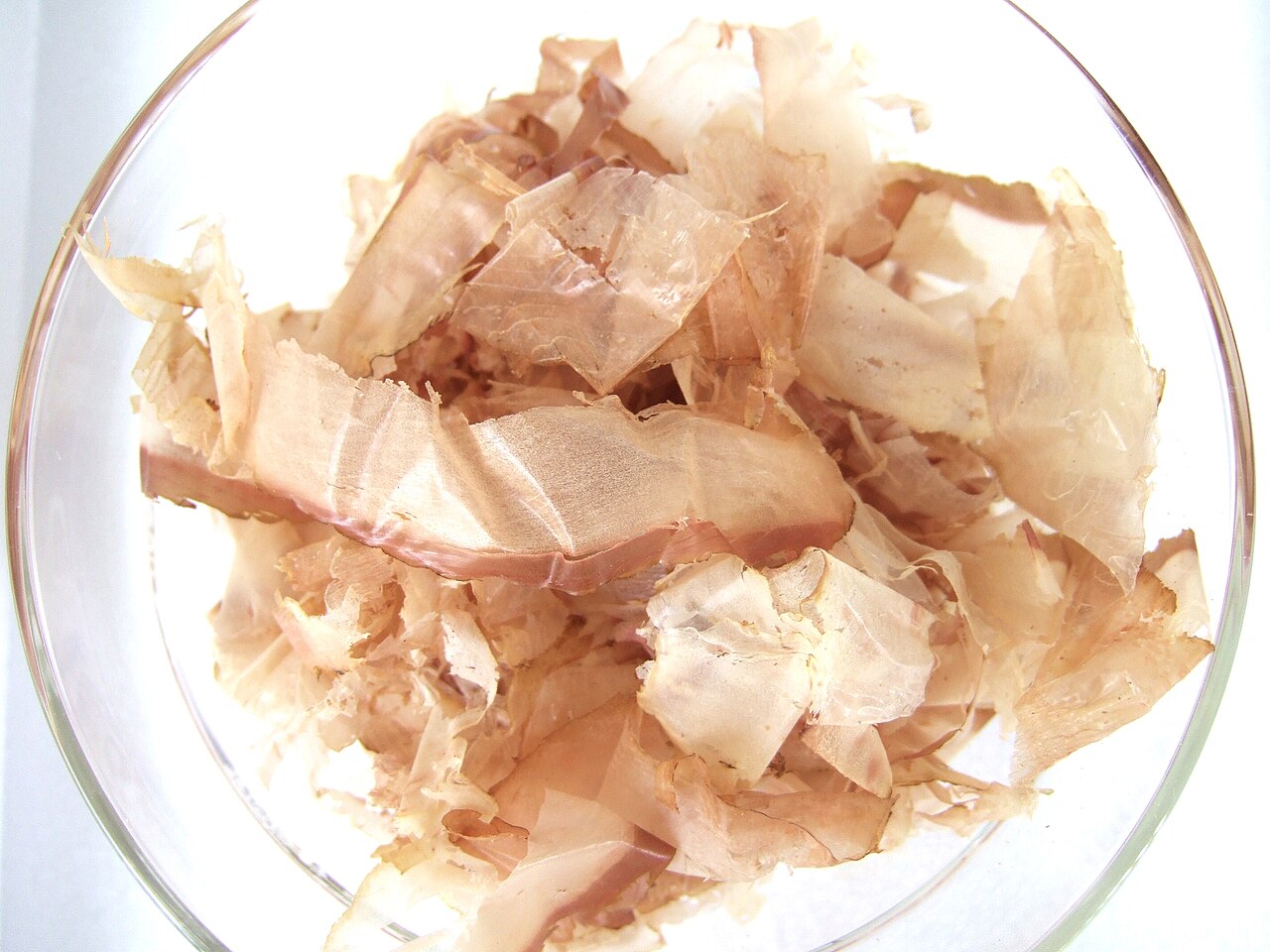
Image context: the cover uses a real Wikimedia Commons photograph of shaved katsuobushi, not a diagram or generated image. It shows the physical ingredient whose lightness can be misleading: these flakes are the final visible form of a long curing and drying process, and they surrender their aroma almost immediately when they meet hot water.[6]
The First Extraction Has A Narrow Window
Ichiban means "first," and the name matters. This is the clean, primary extraction, the one meant for dishes where the broth itself is audible: clear soup, chawanmushi, delicate simmered vegetables, early courses in a kaiseki sequence. Niban dashi, the second extraction from spent kombu and bonito, has its own usefulness, especially where stronger seasonings will join the pot. But ichiban dashi is the exposed version. It asks for less time and better judgment.
Kikkoman's basic method is almost severe: 10 grams of kombu and 20 grams of katsuobushi for 1,000 milliliters of water, with the kombu soaked for 30 minutes, removed just before boiling, and the bonito flakes steeped for about 2 minutes before straining.[3] The Ministry of Agriculture, Forestry and Fisheries gives the same spirit in a broader washoku guide: start kombu in cold water, heat slowly to about 80 degrees Celsius, add bonito shavings, let them sit briefly, then strain.[4]
Those instructions are simple, but they are not casual. Kombu gives clean marine depth when it is coaxed. Push it too far and the liquid can become harsh or slippery. Katsuobushi gives smoke, savor, and aroma, but it is easy to over-extract into something blunt. The fine-dining version is not necessarily more complicated than the home version. It is more exact about when to stop.
That stopping point is the luxury. Many restaurant techniques are impressive because they extend labor: long fermentation, aging, reduction, drying, pressing. Ichiban dashi is impressive because the last act is short. The labor has already been hidden inside the ingredients. The cook's job is to release it without damaging it.
Kombu Brings The Floor, Katsuobushi Lifts The Ceiling
The broth's intelligence is chemical, but it does not taste like a science demonstration. Kombu contributes glutamate; katsuobushi contributes inosinate along with smoke and dried-fish aroma. The Umami Information Center traces the discovery of umami to Kikunae Ikeda's work on kombu dashi and explains that combining umami sources creates a synergistic effect stronger than the ingredients alone.[2] It also notes that ichiban dashi from a Kyoto ryotei can contain both glutamate and inosinate in nearly equal amounts, a combination associated with a much greater perception of umami than either component alone.[2]
That is the hidden architecture of the bowl. Kombu gives the broth its floor: round, clean, mineral, almost silent until salt or soy wakes it up. Katsuobushi lifts the ceiling: smoke, cured fish, warmth, a faint movement in the nose. If kombu alone can feel meditative and bonito alone can become too pointed, together they make a broth that feels complete without heaviness.
This is one reason dashi changes the economics of pleasure in a dining room. A Western luxury sauce often signals expense through fat, reduction, gelatin, wine, butter, or truffle. Ichiban dashi signals expense through clarity. It lets a chef make a turnip taste more like itself, a mushroom feel deeper, a piece of white fish seem cleaner, a clear soup feel full without becoming rich.
That restraint is not austerity. It is a different route to abundance. The pleasure comes from resonance rather than weight.
The Bonito Flake Is Already A Finished Craft
Katsuobushi looks weightless once shaved, but the flake is the end of a hard process. MAFF's washoku guide describes cured bonito as a central dashi ingredient and lays out the labor behind it: fish is filleted, simmered, deboned, dry-smoked, cured with mold spores, and sun-dried until it becomes rock-hard.[4] The guide also notes that a tool resembling a carpenter's plane is used to shave the hardened block, and that the best flavor comes from shaving just before use.[4]
That matters because it reframes the "quick" broth. The pot may take minutes, but the flavor was built over weeks. Smoking, drying, curing, and shaving convert fish into an ingredient that can give itself up fast. Fine dining often celebrates the chef at the final moment; ichiban dashi asks the diner to taste the upstream craft as well.
The best bowls preserve that sense of material. The aroma should not be generic. It should have direction: seaweed without mud, smoke without campfire heaviness, fish without stale flakes, depth without murk. A chef who treats katsuobushi as a commodity loses the thing the broth is designed to reveal.
This is why counter restaurants and kaiseki rooms can make the act of shaving or steeping feel quietly theatrical. The guest may not see flames, tweezers, or a dramatic sauce pour. Instead, the performance is restraint: the flakes bloom, sink, and disappear into a cloth or fine strainer. The broth remains.
Kaiseki Uses Dashi As Pacing, Not Background
Dashi is often described as a base, but in fine dining that word can undersell it. In kaiseki, the broth is not merely support; it is pacing. The Michelin Guide's kaiseki explainer frames kaiseki as one of Japan's most elaborate fine-dining forms, built from beauty, intricacy, and sustained thought across courses.[5] Within that grammar, dashi appears not as a loud signature but as a recurring measure of proportion.
A clear soup early in the meal tells the guest how the kitchen thinks. Is the salt restrained? Is the aroma immediate or delayed? Does the garnish float because the broth is calm, or does it feel like an object trapped in liquid? In a simmered course, dashi becomes a negotiation between broth and vegetable. In a chawanmushi, it turns egg from custard into a savory vessel. In a dipping sauce, it carries soy, mirin, and seasonal garnish without letting any one of them dominate.
The most expensive part of the course may not be visible. It may be the decision to leave the broth pale. To stop before concentration becomes force. To let the guest notice the difference between clear and thin.
That is why the finest dashi can feel almost moral in a restaurant setting. It refuses the easy proof of richness. It asks the cook to make flavor arrive without shouting, and it asks the diner to slow down enough to hear it.
Why It Still Feels Modern
Ichiban dashi fits contemporary fine dining because it solves a problem many tasting menus create for themselves. After a run of fermented sauces, aged proteins, charred edges, reductions, oils, and powders, the palate wants relief that is not emptiness. Dashi gives relief with structure. It clears the table without resetting it to zero.
It also travels well as an idea. Chefs outside Japan do not have to copy kaiseki to learn from ichiban dashi. The deeper lesson is that intensity can be assembled from precise extraction rather than accumulation. A broth can be fast because the ingredients are matured. A dish can feel complete because two sources of savor amplify each other. A course can be memorable because it removes distractions.
But there is a boundary. Dashi should not become a vague restaurant word for any clear savory liquid. Its craft depends on particular materials and timing: kombu, katsuobushi or another chosen bushi, water, temperature, short steeping, careful straining, and seasoning that knows when to stay out of the way. Once those choices become blurry, the broth loses the discipline that made it compelling.
The quiet flex of ichiban dashi is that it makes confidence taste transparent. It does not need a garnish pile, a luxury name-drop, or a speech about minimalism. It needs a cook who can stop at the right second. The flakes fall, the kombu leaves, the cloth catches what should not remain, and the bowl arrives looking almost empty. Then the first spoonful explains why it is not.
Sources
- Japan House London, "Making dashi" - overview of dashi types, awase dashi, kombu, katsuobushi, and the role of dashi in Japanese cooking.
- Umami Information Center, "What is Dashi?" - explanation of dashi, umami, kombu, katsuobushi, ichiban and niban dashi, and glutamate-inosinate synergy.
- Kikkoman Corporation, "Dashi/bonito and kombu broth" - basic method, quantities, soaking time, kombu removal, bonito steeping, and straining guidance.
- Ministry of Agriculture, Forestry and Fisheries of Japan, The Washoku Way: Japan's Nuanced Approach to Food - official washoku guide covering dashi ingredients, katsuobushi production, temperature control, and the role of dashi in soups and simmered dishes.
- MICHELIN Guide, "Kaiseki 懐石 or kaiseki 会席?" - fine-dining context for kaiseki structure, seasonal thought, service setting, and dashi's place in Japanese haute cuisine.
- Wikimedia Commons, "File:Katsuobushi 02.jpg" - real 2006 photograph by Sakurai Midori used as the article image.