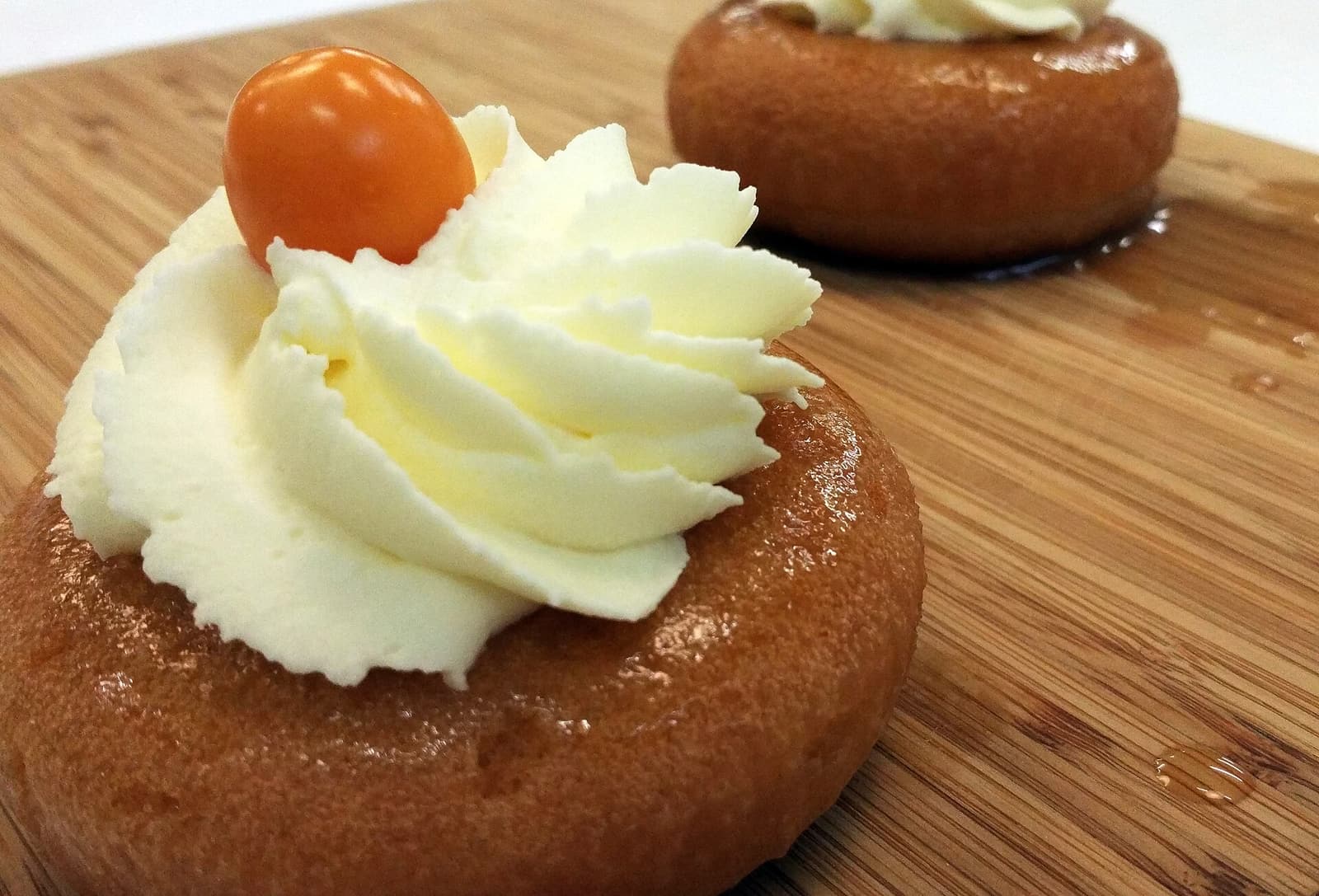
Baba au rhum is one of fine dining's best arguments against visual overproduction. It is not a sculptural dessert. It is not built from brittle sugar architecture, spray-gunned velvet, or a dozen tiny garnishes. At first glance, it can look almost stubbornly old-fashioned: a small yeasted cake, syrup, rum, cream. Then the spoon goes in and the dessert explains itself. The luxury is not what sits on top. The luxury is what the cake has learned to hold.
That is why the baba still belongs in serious dining rooms. Its basic promise is simple enough for a pastry shop and theatrical enough for a three-star restaurant. Stohrer, which calls itself the oldest patisserie in Paris, traces the dessert to Nicolas Stohrer, pastry chef to Louis XV, and describes the original story as a dry kouglof rescued with wine before rum entered later versions.[1] Smithsonian's 2024 history gives the modern service clue: in high-end Ducasse rooms, the baba can become a tableside event with vintage Caribbean rums, while still remaining a plain pastry at heart.[2]
The dessert survives because those two identities do not cancel each other. The baba is humble enough to be sold in a bakery window, but it becomes fine dining when the last act is delayed until the guest is watching. The syrup arrives as flavor, but also as timing.
Image context: the cover uses a Wikimedia Commons photograph of actual babas au rhum, not a generated or diagrammatic image. It is useful because the article is about the dessert's physical state: a yeasted cake made to absorb syrup, shine at the surface, and stay soft enough for cream to matter.[5]
A cake designed to be rescued
The origin story is almost too perfect: a dry cake, an exiled Polish king, and a pastry chef clever enough to turn a flaw into a method. Stohrer's official version says Nicolas Stohrer created the baba from a kouglof judged too dry by Stanislas Leszczynski, moistening it with Tokay wine or Malaga, depending on the version; rum came later.[1] Smithsonian's account expands the migration: Stohrer followed Maria Leszczynska to Versailles after her marriage to Louis XV, then opened his Paris shop on rue Montorgueil in 1730.[2]
What matters for the dish is not whether every royal detail can be pinned down like a notarized contract. What matters is the technical idea hidden inside the legend. The baba begins as a problem of dryness. Instead of hiding that dryness with custard or glaze, the pastry makes dryness useful. The cake has to be absorbent enough to drink, structured enough not to collapse, and plain enough that rum, vanilla, citrus, or cream can become the expressive layer.
Smithsonian describes the method in the bluntest useful terms: the sweet yeasted bread is dried, then plumped back up with rum-and-sugar syrup.[2] That reversibility is the whole dessert. A sponge cake wants tenderness from the start. A baba wants a second life. It is baked, dried, and revived. The drama is not decoration but resurrection.
That is why mediocre babas fail so obviously. If the crumb is too tight, syrup sits outside and the center stays dull. If it is too weak, the cake becomes wet bread. If the rum is harsh, the dessert feels like a dare. If the cream is too sweet, the contrast disappears. The dish looks forgiving, but it is a test of balance: dryness must be intentional, soaking must be calibrated, and cream must soften the alcohol without muting it.
Stohrer keeps the pastry-shop version honest
The pastry-shop baba matters because it protects the dessert from becoming pure dining-room theater. Stohrer still lists baba au rhum as a historic house cake invented by Nicolas Stohrer in the eighteenth century, sold in individual and shareable forms.[4] Its jarred babas are described as small bouchons generously soaked in amber rum syrup from the Antilles, with a light, soft texture and balanced flavor.[3] Even the ingredients list is clarifying: flour, eggs, butter, yeast, water, sugar, salt, and a syrup built from sugar, water, rum, and vanilla.[3]
That plainness is important. The baba's dignity does not come from secrecy. It comes from proportion. A great version understands that the cake is mostly a delivery system, but not an expendable one. The crumb has to taste faintly of butter and fermentation. The syrup has to travel all the way through. The surface should glisten, not leak. The cream should feel like relief rather than frosting.
Stohrer's current range also shows why the dessert travels so well. A baba can be sold as a single pastry, a shared cake, or small jarred bouchons.[3][4] It does not depend on one architectural form. Its grammar is portable: yeasted crumb, drying, soaking, rum, cream or fruit, and a final temperature that keeps the alcohol fragrant rather than brutal.
Fine dining often damages classic desserts by mistaking complexity for seriousness. The baba resists that because its seriousness is already internal. Add too much and the cake loses its identity. Remove the syrup and it is not a baba. Remove the cream and it can still work, but the bite becomes more severe. The dessert teaches restraint by threatening to become silly the moment restraint is lost.
The pour is the luxury
The fine-dining version of baba au rhum is not only about better rum. It is about giving the guest control over excess. Smithsonian notes that at Le Meurice the dessert is served tableside with vintage Caribbean rums, a detail that turns the baba from plated sweet into negotiated intensity.[2] The Michelin Guide makes the same point from another angle: Paris remains full of rum-baba destinations, and its inspector frames the dessert as a restaurant favorite rather than a relic.[6]
This is where the dish becomes more than pastry. A plated baba soaked entirely in the kitchen can be excellent, but a tableside baba lets appetite set the limit. The server brings the bottle, the syrup, or the rum. The guest sees the cake darken or shine. A second pour can make the dessert more aromatic, more adult, more reckless. Cream waits nearby as the safety net.
That interaction matters because baba au rhum is built around appetite's edge. Too little rum and the dessert becomes polite sponge. Too much and it becomes a bar trick. The best service keeps the edge visible without pushing the guest over it. The room does not need a speech. It needs a practiced hand and enough trust to let the cake absorb the moment in public.
This is why Alain Ducasse's orbit is so attached to the dessert. Michelin's London listing for Alain Ducasse at The Dorchester describes the restaurant's cooking as a blend of modernity and classicism and singles out the rum baba as one of the signature recipes.[6] A 2025 Dorchester menu PDF lists "Baba like in Monte-Carlo" among the desserts.[7] That phrase is doing quiet work. It does not present baba as a museum piece. It treats it as part of Ducasse's personal language: Riviera memory, French classicism, hotel luxury, and a dessert whose final pleasure can still be poured.
Cream is not decoration
Chantilly cream is often treated as the baba's obvious partner, but it is more structural than decorative. Smithsonian quotes Steve Dolfi of Stohrer describing Chantilly as the classic counterbalance to rum's aromas and the cake's softness.[2] That is exactly right. Cream gives the spoon a place to land between heat and sweetness. It stretches the bite so the rum does not simply announce itself and leave.
The cream also restores innocence to a dessert that is fundamentally boozy. Baba au rhum is a grown-up sweet, but it should not feel cynical. Cream gives it back some bakery softness. A cherry, citrus peel, vanilla, or fruit garnish can do similar work if used lightly, but cream is the most direct answer because it changes texture as much as flavor.
This is the hidden reason the baba belongs at the end of a long meal. After savory intensity, cheese, wine, and possibly a pre-dessert, the guest does not necessarily need more complication. The baba offers a clearer sequence: spoon, syrup, crumb, rum, cream. It is rich, but legible. It can close a meal without trying to summarize the whole kitchen's intelligence.
That restraint is hard to maintain in modern restaurants. Dessert courses often feel pressured to deliver spectacle because they are the last visual memory. Baba au rhum delivers a different kind of memory. It asks the guest to remember saturation, warmth, and the small suspense of whether the next spoonful will be more cake, more cream, or more rum.
Why the old dessert still feels current
Baba au rhum has become fashionable again not because nostalgia is enough, but because the dish solves a contemporary dining problem. Many tasting menus now search for gestures that make luxury feel personal rather than remote: a broth poured at the table, a sauce finished in front of the guest, a trolley, a bottle, a last-minute shave or spoon. Baba already contains that logic. It is a dessert whose final form can happen close to the diner.
It also cuts against the fatigue of over-designed sweets. A good baba does not need to look clever. Its intelligence is in the crumb's porosity, the syrup's concentration, the rum's aroma, and the cream's discipline. The guest understands it by eating, not by decoding.
That is the dish's real fine-dining lesson. Luxury is sometimes a rare ingredient, sometimes a room, sometimes a view. Here it is absorption under control. The cake begins plain. The syrup changes it. The rum gives it risk. The cream brings it back. The server or pastry chef decides how much of that transformation happens before the plate arrives and how much happens in front of the guest.
The baba has lasted because it turns a weakness into a ritual. Dry cake becomes an invitation. Soaking becomes service. Excess becomes adjustable. The final spoonful tastes like old Paris, Caribbean rum, hotel dining, pastry-shop memory, and home-comfort cream at once. It works because the syrup arrives last, and because the cake was waiting for it all along.
Sources
- Stohrer, "Notre Maison" - official history of the Paris patisserie, Nicolas Stohrer, the 1730 founding, and the baba origin story involving kouglof, wine, and later rum.
- Michelle Tchea, "The Boozy History of Baba au Rhum," Smithsonian Magazine, July 18, 2024 - history, Stohrer context, Ducasse service references, technique notes on drying and soaking, and cream pairing commentary.
- Stohrer, "Babas au Rhum - en bocal" - current product page describing jarred babas, amber rum syrup from the Antilles, texture, balance, ingredients, and alcohol warning.
- Stohrer, "Baba au rhum 6 pers." - current product page identifying baba au rhum as a historic house cake invented by Nicolas Stohrer in the eighteenth century and sold in individual and sharing formats.
- Wikimedia Commons, "File:BabaRum.jpg" - real 2016 photograph by Popo le Chien used as the article image.
- MICHELIN Guide, "A MICHELIN Guide Inspector Puts Paris's Rum Babas to the Test" - inspector feature on baba au rhum as a Paris restaurant favorite and its early-eighteenth-century Stohrer/Luneville history.
- Alain Ducasse at The Dorchester, "A La Carte Menu" PDF, May 2025 - current menu evidence listing "Baba like in Monte-Carlo" among the desserts.